+8615674993216
 sales@forever-steels.com

 English
 العربية


ASTM A312 covers seamless, straight-seam welded and heavily cold-worked welded austenitic stainless steel pipe, so a TP304L or TP316L quotation can be either product. Seamless pipe has no longitudinal seam. A312 welded pipe has one. Either route can be acceptable unless the piping class or purchase order calls for seamless. Compare quotes on the same size, wall, lengths, tests, finish and certificate. [1]
· Ask the supplier to declare the manufacturing route on each line item.
· Separate the mill's longitudinal seam, where present, from the circumferential weld made during installation.
· Mark each commercial or technical difference as compliant, open for clarification or a formal deviation.
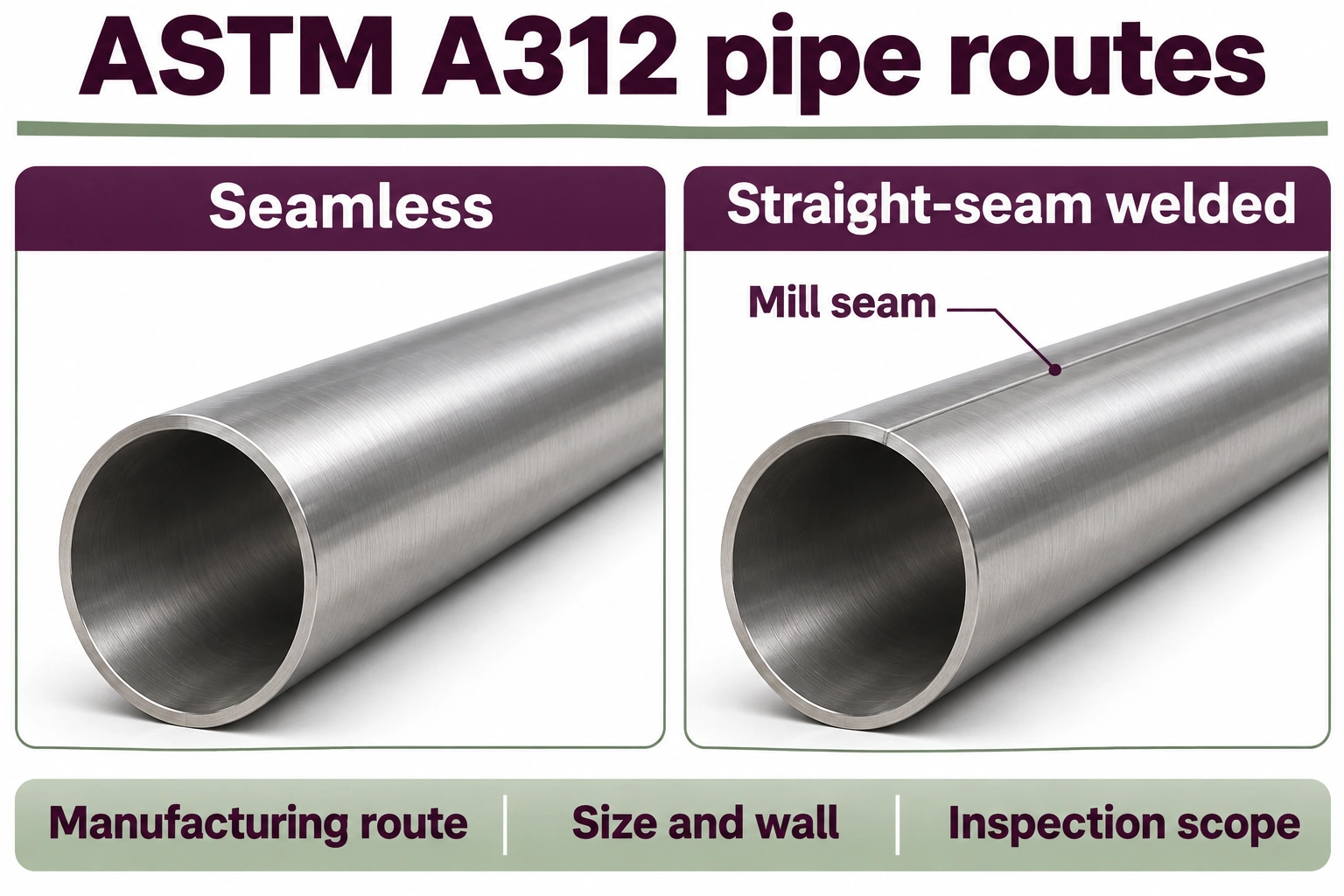
Figure 1. Seamless pipe on the left and straight-seam welded pipe on the right. The graphic marks the longitudinal mill seam. Confirm the route, dimensions and inspection scope from the order and the supporting documents.
ASTM A312/A312M-25 covers seamless, straight-seam welded and heavily cold-worked welded austenitic stainless steel pipe. Its public abstract lists hydrostatic or nondestructive electric testing for each pipe. The purchase order can specify additional or more restrictive requirements, subject to the ordered edition and applicable code. Confirm the method in the offer rather than inferring it from the grade. [1]
A312 is not the only welded stainless pipe specification. ASTM A358 covers electric-fusion-welded pipe ordered by class (Class 1 to 5), with the class setting the weld type and radiographic examination. Published comparisons place A312 as the more economical choice at NPS 24 and below and A358 as the practical choice for larger sizes. [6] For that comparison, see our guide to ASTM A312 vs A358 EFW weld class and RT requirements.
|
Item |
Seamless route |
Straight-seam welded route |
|
Manufacture |
A hollow is formed and worked from solid starting stock. |
Flat stock is formed into a cylinder and joined longitudinally. |
|
Longitudinal seam |
None. |
One straight seam. Confirm in the ordered A312 edition how the seam is made and whether the pipe is cold-worked or heat treated after welding. |
|
Pressure design basis (ASME B31.3) |
The longitudinal joint quality factor listed for A312 seamless pipe is 1.00.[7] |
Listed separately by specification and class in the same code table. Look up the exact entry for the ordered edition and any added examination.[2] |
|
Size range |
Check the mill's offered range for the size and wall. |
Practical for larger diameters. Very large sizes often move to A358 EFW pipe.[6] |
|
Cost and lead time |
Often priced higher than welded pipe of the same size and grade. |
Often lower for standard sizes. Compare lead time against your cut plan. |
|
What to inspect |
Wall around the circumference, surface condition, ends, and the specified pipe tests. |
The same dimensional and delivery checks, plus any ordered examination or finish requirements for the mill seam. |
|
Fit and dimensions |
Schedule and OD come from the ordered dimensional basis. Confirm actual fit at the ends when fit-up is critical. |
Use the same dimensional basis. If an internal seam profile matters to fit, cleaning or flow, state the requirement and how to verify it. |
|
Typical purchasing reason |
The piping class calls for seamless, or documented stock meets the line item. |
The piping class permits welded, and the offered size, finish and inspection package satisfy the order. |
The route belongs in the order line even when both offers quote the same grade. Use A312/A312M for the product requirements, the specified dimensional standard for size and wall, and the applicable piping code and material class for service eligibility. A pipe-body seam and the circumferential weld created at installation are different examination scopes. [1] ·[2]
Not because of the grade name. A welded and a seamless TP316L pipe are both TP316L. What changes is how the design code treats a longitudinal seam and how much of the seam record you can see. For pressure design, ASME B31.3 applies a longitudinal joint quality factor, and the welded entry may differ from the 1.00 shown for seamless pipe. [2] ·[7]
For corrosion, the risk sits in the weld zone and the surface condition, not in the route label. Ask for the delivery heat-treatment condition and the finish (pickled, annealed or polished). Where sensitization matters, ask whether an intergranular corrosion test applies. See our guides to the A262 Practice E IGC test for welded stainless pipe and to pickling and passivation after welding.
ASME's B36.19M description specifically identifiesNPS 12 Schedule 40Sas having a different wall thickness from the corresponding B36.10M schedule. If a quotation shortens "12 in Schedule 40S" to "12 in Schedule 40," ask the bidder for the standard and edition, nominal wall and end dimensions before approving the pipe or mating components. Confirm what the buyer's drawing calls out for any minimum-wall requirement. [3] For wall choice between common stainless schedules, see SCH 10 vs SCH 40 stainless steel pipe.
|
Situation |
Route to expect |
What to confirm |
|
The piping class or PO says seamless |
Seamless. A welded offer is a formal deviation. |
Who may approve the deviation, and what changes in cost or delivery. |
|
The class permits both and the size is standard |
Compare both offers on one basis. |
Lengths, ends, pipe test, finish and certificate mapping. |
|
Large diameter |
Welded, often A358 above NPS 24. |
Size limit, weld class and radiography scope.[6] |
|
The seam must not affect bore, cleaning or fit-up |
Either route, with a stated seam requirement. |
The profile requirement, inspection location and acceptance basis. |
Owners often fix the route line by line. Bharat Heavy Electricals Limited's tender schedule lists A312 TP316Lseamlesspipe at168.3 mm OD × 3.4 mm walland at219.1 mm OD × 12.7 mm wallon separate items, so a bidder must match each line separately. [4]
Illustrative bid comparison. An RFQ calls for ASTM A312/A312M TP316L, NPS 6 Schedule 40S, 20 pieces at 6 m each, beveled ends, a pickled finish and hydrostatic testing of each pipe. Both routes are permitted in this example. The buyer requires a mill test certificate (MTC) linked to the pipe markings.
|
RFQ requirement |
Offer A seamless |
Offer B welded |
Buyer decision |
|
Grade, route and wall |
TP316L, seamless, 6 in Schedule 40S |
TP316L, straight-seam welded, 6 in Schedule 40S |
Both routes pass the initial scope check for this RFQ. Confirm the ordered dimensional standard and wall basis. |
|
Required lengths and ends |
Twenty 6 m pieces with beveled ends |
120 m in random lengths with plain ends |
Ask B to reprice the piece schedule and bevels. Equal total length can leave a different cut plan. |
|
Pipe test |
Hydrotest per pipe included |
Electric test stated, hydrotest unpriced |
Ask B to meet the RFQ or submit the proposed change for approval. |
|
Surface and records |
Pickled finish declared, MTC and heat marking included |
Finish unconfirmed, MTC listed |
Ask B to confirm the ordered finish and show how the MTC maps to the shipped pipe or bundle markings. |
Offer A can proceed to technical review. Offer B needs a corrected quotation for lengths, ends and hydrotest, plus clarification of finish and traceability. The decision would change if the RFQ explicitly required seamless construction. In that case, a welded offer would require approval as a deviation even if its other fields matched.
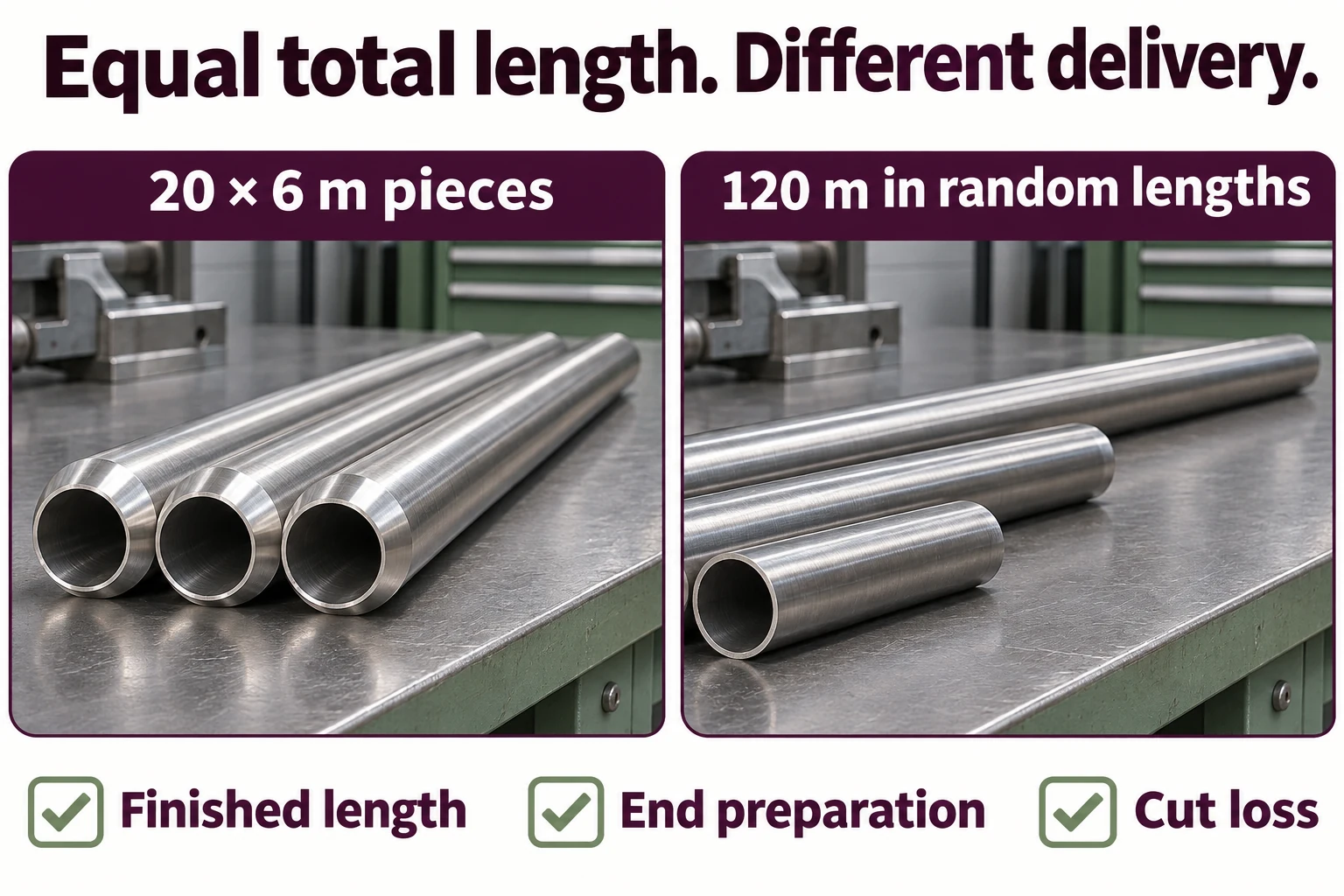
Figure 2. In the illustrative quotations, 20 finished pieces at 6 m each and 120 m in random lengths have the same total length. Compare accepted piece count, end preparation and cut loss before ranking the offers.
A line reading "100% NDT" leaves several decisions open. Ask for the method, coverage, acceptance reference and the report that will accompany shipment. For a welded option, identify any purchase-order examination of the longitudinal mill seam. For either option, separate pipe mill tests from fabrication or field-weld examination. If the buyer needs radiography of a specified weld, put the scope and acceptance basis in the RFQ. [2]
For a fabrication order, ask for price per piece or per accepted meter on the same cut list. For example, a stock length measuring exactly12.000 mcannot yield two pieces of6.000 mafter a cut with positive saw kerf. Ask for the actual stock lengths, the cut plan and the allowed finished-length tolerance. If the quotes use price per tonne, reconcile the weight basis and accepted lengths before comparing totals.
Ask for one specimen dossier at the quotation stage. For the purchased lot, match the final purchase line to the manufacturer's certificate, the physical markings or agreed bundle identification, and the packing list. For cut stock, agree in advance on how markings are transferred and recorded. If the PO asks for a heat-treated condition, require the certificate to state the delivery condition. Request any underlying heat-treatment record as a separate deliverable where the PO requires it. For positive material identification of delivered pipe, see stainless steel PMI testing and XRF limits for 304L and 316L.
|
If the offer or report says |
Ask the bidder to provide |
Hold the decision until |
|
TP316/TP316L dual grade |
The material certificate and exact declared specification and grade |
The certificate supports the required grade under the ordered edition. |
|
100% inspected |
A report identifying the method, coverage, applicable criteria and pipe or lot represented |
The inspection can be matched to the purchase requirement and shipped material. |
|
Stock cut to length |
Actual stock lengths, cut list, prepared ends and an identifier transfer record |
The pieces can be received, counted and traced as individual purchase items. |
|
Seam finished smooth |
The surface or seam profile requirement, inspection location and acceptance basis |
Any bore, cleanability or fit-up constraint in the order has been addressed. |
A technical comparison should carry theexact deviation,who may approve it, andwhat changes in cost or delivery. If a bidder's stock is acceptable only after extra testing or machining, ask for that scope and lead time before ranking the bids. A sample certificate helps agree the format. The supplied lot still needs its own supporting records.
Quote the permitted manufacturing route on a separate line. Confirm the ordered size and wall, piece count and lengths, end preparation, surface finish, pipe test and certificate traceability. Identify deviations and separately price work needed to meet the order.
Send the approved route and purchase basis when requesting ASTM A312 seamless stainless steel pipe or A312 welded stainless steel pipe. If the project specifically calls for A358 electric-fusion-welded pipe, review the A358 class and examination separately.
Both. A312 covers seamless, straight-seam welded and heavily cold-worked welded pipe, so the route must be stated on the purchase line. [1]
Check the piping material class and purchase specification first. If the order calls for seamless, document the welded offer as a deviation and obtain the designated technical approval before award.
Not automatically. Strength follows the grade and the delivered heat-treated condition. For pressure design, the code applies a joint quality factor to a longitudinal weld, so check the welded entry in the code table for the ordered edition rather than assuming the two routes are equal. [2] ·[7]
Welded pipe is often lower in price for standard sizes, but quotes are only comparable when they carry the same lengths, ends, pipe test, finish and certificate traceability. The worked example above shows how a lower headline price can hide unpriced hydrotest and bevels.
A312 covers seamless and straight-seam welded pipe. A358 covers electric-fusion-welded pipe ordered by class, where the class sets weld type and radiographic examination, and it is commonly used at larger diameters. [6]
Schedule 40S identifies a wall-thickness series. Design pressure comes from the applicable piping code, material properties, temperature, dimensions and relevant design allowances or factors. Use the stated design basis for approval of either route. [5] ·[2]
Ask how the certificate connects to the actual pipe, pieces or bundles offered. Agree how identifiers will be transferred if the supplier cuts stock, and which inspection records will accompany the shipment.
· ASTM A312 vs A358 EFW weld class and RT requirements
· ASME B36.10 vs B36.19 pipe dimensions
· SCH 10 vs SCH 40 stainless steel pipe
· Stainless steel welded pipe IGC test: ASTM A262 Practice E
· Stainless steel PMI testing and XRF limits for 304L and 316L
[1]ASTM International. ASTM A312/A312M-25. Public abstract and §1.1 scope. Manufacturing routes and per-pipe testing. Open source
[2]ASME. B31.3 Process Piping. Public description of code scope, including design, fabrication, examination and testing. Open source
[3]ASME. B36.19M Stainless Steel Pipe, 2018. Public description identifying schedule differences from B36.10M, including NPS 12 Schedule 40S. Open source
[4]Bharat Heavy Electricals Limited. ST Prep Shop tender schedule, items CPCA20097001 and CPCA20097015 (rows 350 and 362). TP316L seamless route, OD and wall. Open source
[5]ASME. B36.19 Welded and Seamless Wrought Stainless Steel Pipe. Public description of the dimensional standard. Open source
[6]Projectmaterials. What Is ASTM A358? Class system, size range and A358 vs A312 comparison. Open source
[7]Projectmaterials. What Is Weld Joint Efficiency? Quality factor table attributed to ASME B31.3 Table A-1B, including A312 seamless at 1.00. Open source