+8615674993216
 sales@forever-steels.com
 English
 العربية

ASTM A312 and ASTM A358 can both be used for austenitic welded stainless steel pipe, but they do not ask the buyer to control the same risk. ASTM A312 is a broad pipe specification for seamless, straight-seam welded and heavily cold-worked welded pipe in high-temperature and general corrosive service. ASTM A358 is specifically for electric-fusion-welded (EFW) austenitic pipe and makes the weld construction and radiographic examination visible through Classes 1 to 5. The purchase decision should therefore start with service, diameter, wall thickness, design code and the evidence the owner needs from the longitudinal seam, not with a vague request for 'stainless welded pipe with X-ray'.
|
Buyer rule:If the PO needs a defined EFW weld construction and a defined full-RT or spot-RT outcome, write ASTM A358/A358M, the class, the grade, dimensions, heat treatment and any project NDE acceptance criteria. 'ASTM A358' alone leaves a material part of the requirement undecided. |
The wrong comparison is 'A312 is low quality and A358 is high quality.' Both specifications can support serious industrial work when the pipe is correctly made, tested and matched to the piping design. The useful comparison is whether the order needs A358's explicit class-based weld and radiography route. A312 already includes heat-treatment, mechanical-test and hydrostatic-or-nondestructive-electric-test requirements, while A358 describes the EFW weld arrangement and radiographic level through its class designation.
|
Decision point |
ASTM A312 welded pipe |
ASTM A358 EFW pipe |
What the buyer should decide |
|
Core scope |
Seamless, straight-seam welded and heavily cold-worked welded austenitic pipe for high-temperature and general corrosive service. |
Electric-fusion-welded austenitic chromium-nickel stainless pipe for corrosive, high-temperature or general service. |
Does the line list need a named EFW route and class? |
|
Weld definition |
Welded construction is covered, but the specification is not purchased through A358 Class 1-5 language. |
Class explicitly establishes single/double welding, filler-metal use and RT level. |
Put the class in the PO if it affects acceptance. |
|
NDE / pressure test |
Each pipe receives nondestructive electric test or hydrostatic test; supplementary requirements can add testing. |
Includes transverse tension, guided-bend weld test and hydrostatic test, plus class-specific radiography. |
Do not treat hydrostatic, RT and UT/ET as interchangeable evidence. |
|
Typical buying trigger |
Standard process piping, utilities and corrosion-resistant service where the project specification calls A312. |
Large-diameter or project-controlled EFW pipe where seam inspection route is part of approval. |
Follow the piping specification and owner code, not a generic 'better' claim. |
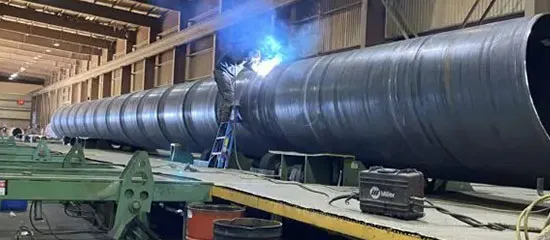
EFW means electric-fusion-welded. It describes a fusion-welding route used to join the formed pipe edges and should not be used as a synonym for every welded stainless product. It also does not, by itself, disclose the grade, weld class, extent of radiography, acceptance criterion, solution anneal, surface condition or final dimensional tolerance. Those controls come from the actual standard edition, class, project specification and inspection plan.
For a process-piping buyer, the practical importance of EFW is that the longitudinal seam is a defined production and inspection focus. That matters more as OD, wall thickness, design pressure, fatigue exposure, corrosion severity or owner documentation expectations increase. It does not mean that a smaller A312 welded pipe automatically needs an A358 class. Conversely, a large fabricated line should not be released on a simple 'EFW 316L' description when the owner requires a specific radiographic record.
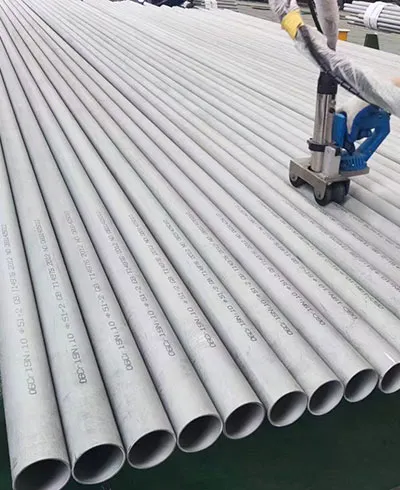
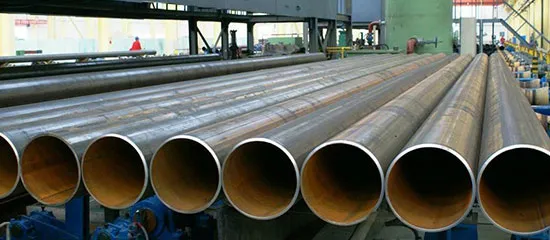
For sizes, grades, finishes and project-specified EFW production, see Forever Steel's Welded Stainless Steel Pipe page. The inquiry should state the service and inspection basis before the supplier proposes an EFW route.
A358's class is not a sales label. It tells the mill and inspector how the longitudinal weld is to be made and whether radiography is complete, absent or spot. The following table is a purchasing summary of the class language. It is not a substitute for the purchased edition of ASTM A358/A358M or for an owner specification.
|
A358 class |
Weld construction |
Radiography |
Procurement implication |
|
Class 1 |
Double welded; filler metal used in all passes. |
Complete radiography. |
Use where the project requires a double-weld route and documented full radiographic coverage. |
|
Class 2 |
Double welded; filler metal used in all passes. |
No radiography required by the class. |
Do not describe as 'X-ray tested' unless the PO adds a separate RT requirement. |
|
Class 3 |
Single welded; filler metal used in all passes. |
Complete radiography. |
Use only when the project accepts single-weld construction but requires full RT. |
|
Class 4 |
Same as Class 3, except the pass exposed to the inside surface may be made without filler metal. |
Complete radiography. |
The inside-pass condition matters where product-contact surface and weld procedure are controlled. |
|
Class 5 |
Double welded; filler metal used in all passes. |
Spot radiography. |
State the class clearly; spot RT is not full RT and should not be presented as equivalent. |
The distinction between Class 1 and Class 5 is a frequent quotation failure. Both use double welding with filler metal in all passes, but Class 1 is completely radiographed while Class 5 is spot radiographed. A supplier cannot price those requirements as though they were the same operation, and a buyer should not accept an inspection report without confirming its stated coverage and traceability to the pipe length or joint.
In project correspondence, '100% X-ray' can mean full radiography of the longitudinal seam, radiography at selected locations, radiography of field joints, or a general claim that is not tied to an acceptance standard. That ambiguity becomes expensive when the pipe reaches a third-party inspector. A technical PO needs the governing standard and edition, A358 class when applicable, whether examination is RT, digital radiography or another approved method, the extent of examination, acceptance criteria, report format, traceability and any purchaser witness or hold point.
|
Evidence |
What it can demonstrate |
What it does not replace |
|
Hydrostatic test |
Pressure containment at the specified factory test condition. |
A documented evaluation of internal weld discontinuities or all fabrication risks. |
|
Complete RT under A358 class |
Radiographic coverage required by the class, subject to the specified acceptance requirements. |
Material chemistry, solution anneal, corrosion suitability, dimensions or coating/finish control. |
|
Spot RT |
Examination of the specified sample extent. |
Complete RT; it must not be marketed or recorded as full coverage. |
|
UT or ET |
The particular discontinuities and coverage that the written procedure and calibration support. |
Automatic equivalence to RT unless the governing code and purchaser approve it. |
|
MTC and weld records |
Heat, grade and recorded production/inspection traceability when properly linked. |
A substitute for the tests actually required by the PO. |
A358 class is one control in a wider quality plan. ASTM A358 calls for transverse tension, transverse guided-bend weld testing and hydrostatic testing of finished pipe. ASTM A312 requires mechanical testing and requires each pipe to receive a nondestructive electric test or hydrostatic test. Neither sentence should be copied into an RFQ without considering the service. The line may also need PMI, ferrite control, intergranular-corrosion testing, solution annealing evidence, dimensional records, liquid penetrant examination of repairs, or an EN 10204 certificate level. These are project decisions, not automatic upgrades.
Grade selection still comes first. TP304/304L may suit many clean, low-chloride utilities; TP316/316L can be justified where chloride exposure or process chemistry requires its molybdenum-bearing composition. Low-carbon L grades are often selected for welded fabrications to reduce sensitization risk, but they do not make an unsuitable environment safe. Temperature, chloride concentration, oxidizing or reducing chemistry, crevices, deposits, cleaning regime and weld restoration all affect the result.
Where the service or size makes the absence of a longitudinal weld the controlling design issue, compare the project requirement with Seamless Stainless Steel Pipe. Seamless is not a default upgrade: it must be justified by the applicable design code, dimensions, service and owner specification.
|
Scenario |
Likely starting point |
Questions before approval |
|
General corrosive-service process line, standard NPS/schedule |
ASTM A312 welded pipe if the piping specification calls for it. |
Grade, schedule, heat treatment, hydrostatic or electric test, finish, MTC and any supplementary requirement. |
|
Large-diameter chemical or water-treatment line with owner seam scrutiny |
ASTM A358 EFW, with class selected by the project. |
Class 1/2/3/4/5, full or spot RT, weld procedure, solution anneal, dimensional tolerance and document package. |
|
High-temperature service |
A312 or A358 only after grade and design code review. |
Creep/stress-rupture grade, design temperature, expansion, pressure design, heat treatment and code requirements. |
|
Sanitary or high-cleanability pipework |
Product and finish specification may control more than A312/A358 alone. |
Grade, inside finish, Ra measurement method, weld-bead treatment, cleaning/passivation, fittings and hygienic standard. |
|
Bid comparison with one A312 and one A358 offer |
Normalize both quotations before choosing. |
Are grade, dimensions, class, RT extent, test plan, finish, packing, certificate and delivery basis actually the same? |
A practical RFQ removes the need for a supplier to guess. It also stops an apparent price gap from being caused by hidden differences in RT extent or finishing work. Include the following items in the purchase request and use the same list in the pre-shipment inspection plan.
|
RFQ item |
What to state |
|
Standard and edition |
ASTM A312/A312M or ASTM A358/A358M, plus the edition required by the project. |
|
Product form |
Welded or EFW; OD, wall thickness/schedule, length, straightness, end preparation and quantity. |
|
A358 class |
Class 1, 2, 3, 4 or 5 where A358 is specified. Never leave this blank when class matters. |
|
Grade and condition |
TP304, TP304L, TP316, TP316L or other approved grade; solution-annealed or other condition as required. |
|
NDE and pressure test |
RT extent, method and acceptance basis; hydrostatic/electric test; any UT/PT/PMI or third-party witnessing. |
|
Surface and packing |
Pickled, BA or polished finish; internal/external requirements; protective film, end caps, separators and seaworthy packing. |
|
Documents |
MTC, dimensional report, RT/inspection reports, heat-treatment record, packing list, marking and traceability format. |
ASTM A312 answers the need for standard stainless pipe in high-temperature and general corrosive service. ASTM A358 answers a more specific EFW purchasing question by tying weld construction and radiography to a class. The correct choice is therefore not driven by a slogan about EFW, but by the service, design code, diameter, seam-control expectation and inspection evidence the owner will accept. A buyer who specifies the class, RT extent, grade, finish and documentation before quotation receives comparable offers and avoids a late technical revision.
Confirm the ordered edition and applicable test or acceptance requirements against the project specification.
For the surface and material checks accompanying weld examination, see pickling and passivation after welding and stainless steel PMI testing and XRF limits.