+8615674993216
 sales@forever-steels.com

 English
 العربية


Order a butt-weld fitting by seven fields: type, NPS, wall or schedule at every end, material grade, component standard (ASME B16.9), construction route and test scope. Numbers that decide fit and quote comparison: a 90° long-radius elbow has a centre-to-end dimension of 1.5 × NPS (NPS 4 = 152.4 mm, NPS 8 = 305 mm) and a short-radius elbow 1.0 × NPS (101.6 mm and 203 mm), so swapping one for the other moves the spool dimension by 50.8 mm at NPS 4 and 101.6 mm at NPS 8 per elbow. Wall thickness at any point must be at least 87.5% of nominal. A234 WPB and A420 WPL6 have the same strength (415 MPa tensile, 240 MPa yield); WPL6 adds a mandatory impact test at −46 °C.
The table gives centre-to-end or overall-length values for two common sizes, in millimetres. They apply to standard-weight fittings; confirm in your edition of B16.9 before drawing release.
|
Fitting (B16.9 dimension) |
NPS 4 |
NPS 8 |
|
90° long-radiuselbow, centre to end (A) = 1.5 × NPS |
152.4 mm |
305 mm |
|
90° short-radius elbow, centre to end (A) = 1.0 × NPS |
101.6 mm |
203 mm |
|
Straighttee, run and outlet centre to end (C = M) |
105 mm |
178 mm |
|
Concentricreducer8 × 4, overall length (H) |
— |
152.4 mm (8 × 4) |
|
Cap, overall length (E) |
63.5 mm |
101.6 mm |
Long radius is the default when the isometric does not state a radius. Short-radius elbows are used where space is tight and the piping class permits them; they raise pressure drop, and the spool must be re-dimensioned if the substitution is made after detailing.
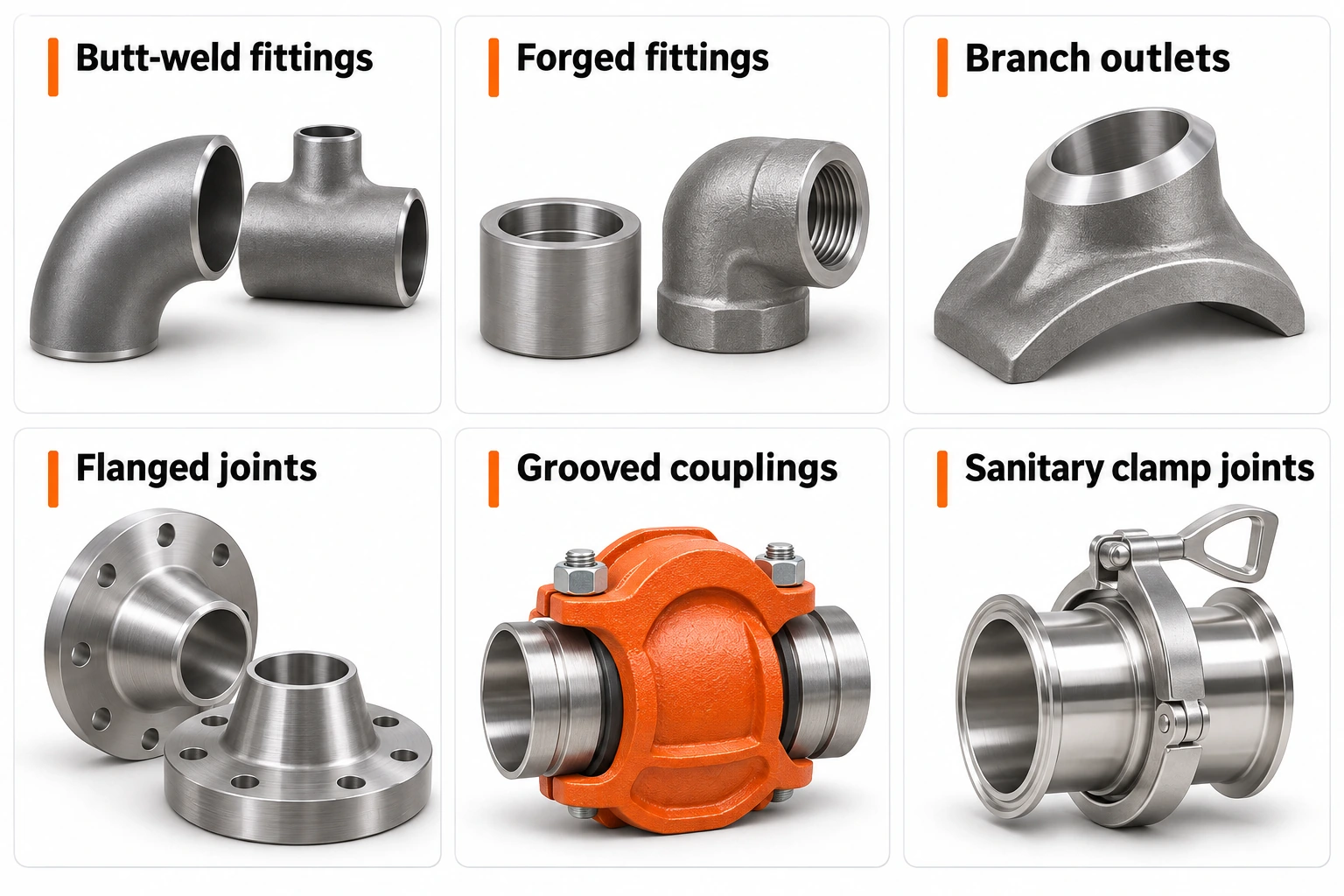
Figure 1. Representative butt-weld fitting families. Confirm end geometry and governing standard for each order item.
Pick the grade from the piping class and design temperature, then buy the evidence that grade needs. Strength alone separates very little in this table; toughness testing and construction class do.
|
Grade |
Min. yield |
Min. tensile |
Impact and other requirements |
|
A234 WPB |
240 MPa (35 ksi) |
415 MPa (60 ksi) |
No mandatory Charpy; a typical service limit of −29 °C (−20 °F) is cited, so the design code governs |
|
A420 WPL6 |
240 MPa (35 ksi) |
415 MPa (60 ksi) |
Charpy at −46 °C (−50 °F): 27 J average, 20 J individual minimum |
|
A860 WPHY 65 |
450 MPa (65 ksi) |
530 MPa (77 ksi) |
Carbon equivalent ≤0.42%; C ≤0.20%; Mn 1.00–1.45%; for high-strength pipeline fittings |
|
A403 WP304L / WP316L |
170 MPa (25 ksi) |
485 MPa (70 ksi) |
Class S, W, WX or WU sets seamless or welded construction and weld examination (below) |
A403 fittings carry a class suffix. WP-S is seamless with no examination required; WP-W is welded with radiographic or ultrasonic examination; WP-WX is welded with radiography; WP-WU is welded with ultrasonic testing. If the specification says only “A403 WP316L”, ask the bidder which class it is quoting, because the classes differ in cost and in the inspection record you receive.
A pipe grade and a fitting grade are different product forms. Keep the fitting designation on each line item, and record any proposed substitution as a deviation with the changed specification, grade, route and test evidence.
The wall at any point must be at least 87.5% of the nominal scheduled wall. Apply that to the mating pipe, not to the catalogue schedule, when you check fit-up.
|
Pipe wall (ASME B36.10 nominal) |
Nominal wall |
87.5% minimum |
|
NPS 8 SCH 40 |
8.18 mm |
7.16 mm |
|
NPS 4 SCH 80 |
8.56 mm |
7.49 mm |
|
NPS 4 SCH 40 |
6.02 mm |
5.27 mm |
A fitting can therefore pass its own standard and still have a bore that differs from the pipe by more than your fabrication detail allows. Ask for measured end wall and bore at each opening on the dimensional report for critical items.
Take a butt-weld NPS 8 × 8 × 4 reducing tee. The isometric calls for NPS 8 SCH 40 on the run and NPS 4 SCH 80 on the branch. Using nominal ASME B36.10 dimensions, the bores are calculated as OD minus twice the wall.
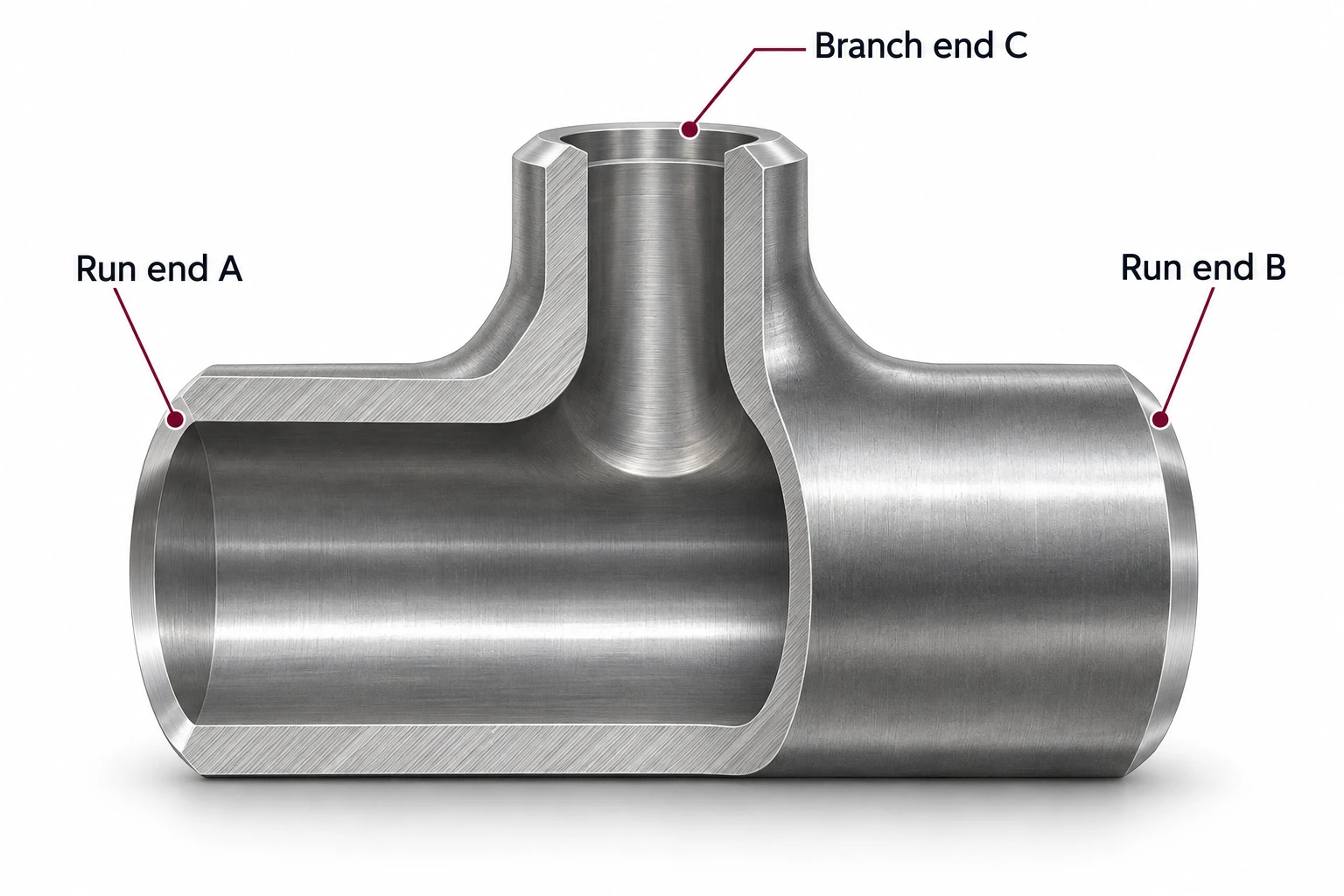
Figure 2. A reducing tee has three weld interfaces; call out the branch wall independently (schematic, not to scale).
|
Interface |
Nominal OD |
Nominal wall |
Calculated bore |
|
Run, NPS 8 SCH 40 |
219.1 mm |
8.18 mm |
202.7 mm |
|
Specified branch, NPS 4 SCH 80 |
114.3 mm |
8.56 mm |
97.2 mm |
|
Alternative branch, NPS 4 SCH 40 |
114.3 mm |
6.02 mm |
102.3 mm |
Receiving the SCH 40 branch instead of SCH 80 changes the bore by 5.1 mm, about 2.5 mm radial offset on concentric ends, and the branch wall differs from the SCH 80 pipe it will be welded to by 2.54 mm. Where mating walls differ, the weld end needs a transition. Sources citing ASME B31.3 and B31.8 give a maximum 30° external slope and an internal taper no steeper than 1:4; confirm the rule and any thickness-ratio trigger in the code edition that governs your project.
The quote line then reads: reducing tee, ASME B16.9, ASTM A234 WPB, NPS 8 × 8 × 4, SCH 40 run × SCH 80 branch, weld-end detail per project drawing, quantity. Ask the supplier to state branch wall and bore in the offer.
The construction route changes the evidence you receive and sometimes the price. A butt-weld end describes how the fitting joins the line; the fitting body may be seamless or fabricated from welded material, subject to the specification.
|
Route |
Where it applies |
Ask for |
|
Seamless formed |
Fittings with no manufacturing weld in the body; may be required by the purchase specification |
Starting material, finished grade, end wall, forming and heat-treatment records |
|
Welded or fabricated |
Formed from welded material or with fabrication welds |
Weld locations, which welds are examined, acceptance criteria and traceability; for stainless, the A403 class |
|
Forged and machined |
Socket-weld and threaded fittings, forged outlets, many flanges |
Forging specification, component standard, class, machined connection geometry |
If the project requires one route, ask each bidder to confirm it item by item and list deviations.
A standard elbow is ordered by size, angle and radius pattern under B16.9. An induction bend is controlled by an approved drawing: centreline radius, tangent lengths, post-bend minimum wall, ovality and heat treatment. ASME B16.49 covers factory-made induction bends for transportation and distribution systems where specified. Quote against the drawing number and revision, because a nonstandard angle or tangent length can decide spool fit even when size and material are familiar. For an eccentric reducer, put the flat-side orientation on the isometric.
Select the joint from the piping class and the mating ends before choosing a fitting by catalogue name. This guide covers butt weld in depth; the other families are listed so the right article is the next click.
|
Connection |
Use when |
Check before ordering |
Read next |
|
Butt weld |
Permanent welded joints in process spools and pipelines |
OD, wall and weld preparation at each opening |
|
|
Socket weld |
Small-bore branches where the class permits |
Socket dimensions, fitting class, weld detail |
— |
|
Threaded |
Instrument and utility branches |
NPT, BSPT or BSPP stated explicitly at each end |
|
|
Flanged |
Removable joints at equipment and valves |
Standard, size, class, face, gasket, bolting |
|
|
Grooved, hygienic clamp |
Water, fire protection, bioprocess |
Actual OD and wall, groove or ferrule series, gasket |
Supplier system data |
·Service and documents:piping class, code and component standard editions, isometric or drawing revision, line and item numbers.
·Configuration:type, angle, radius or pattern, reducer orientation, branch arrangement, tangent lengths.
·Interfaces:size and wall at every weld end, end preparation, critical bore or fit-up limits.
·Material and route:specification and grade (with A403 class where stainless), permitted construction, toughness, corrosion or heat-treatment needs.
·Release documents:MTC, dimensional report, traceability, specified inspection records; marking, preservation and packing.
Items that are easy to miss on a material take-off:
|
Item |
Write this on the MTO |
|
Cross, lateral or wye |
Run and branch sizes, wall at every end, angle, clocking, drawing reference |
|
Forged branch outlet (MSS SP-97) |
Run size range, branch size and end style, material, approved reinforcement and attachment detail |
|
Stub end with backing flange |
Stub-end pattern, lap dimensions, backing flange bore and class, gasket interface |
|
Nipple |
Overall length, pipe specification, wall and preparation at each end |
|
Cap, plug or blind flange |
Closure type, mating interface, material, governing standard or drawing |
State what the supplier must document and what needs review, witness or hold points. A dimensional report records critical ends and centre-to-end dimensions; an MTC supports grade and heat traceability. Specify weld examination, heat treatment and impact records separately, with acceptance basis and reporting frequency. When comparing two offers, compare forming route, presence and location of manufacturing welds, test scope and excluded requirements, not price alone.
Selected fields transcribed from a fitting inspection certificate. The certificate associates the mechanical test row with a group of listed fittings, including the elbow below.
|
Certificate field |
Selected information |
|
Product identification |
90° butt-weld elbow, NPS 8, Schedule 20 |
|
Material and fitting standard |
ASTM A234 WPB. The certificate lists ANSI B16.9. |
|
Reported mechanical results |
Yield strength 280 MPa, tensile strength 495 MPa, elongation 28%. |
|
Traceability |
The product line and mechanical test row are linked by item reference. Identifiers have been withheld. |
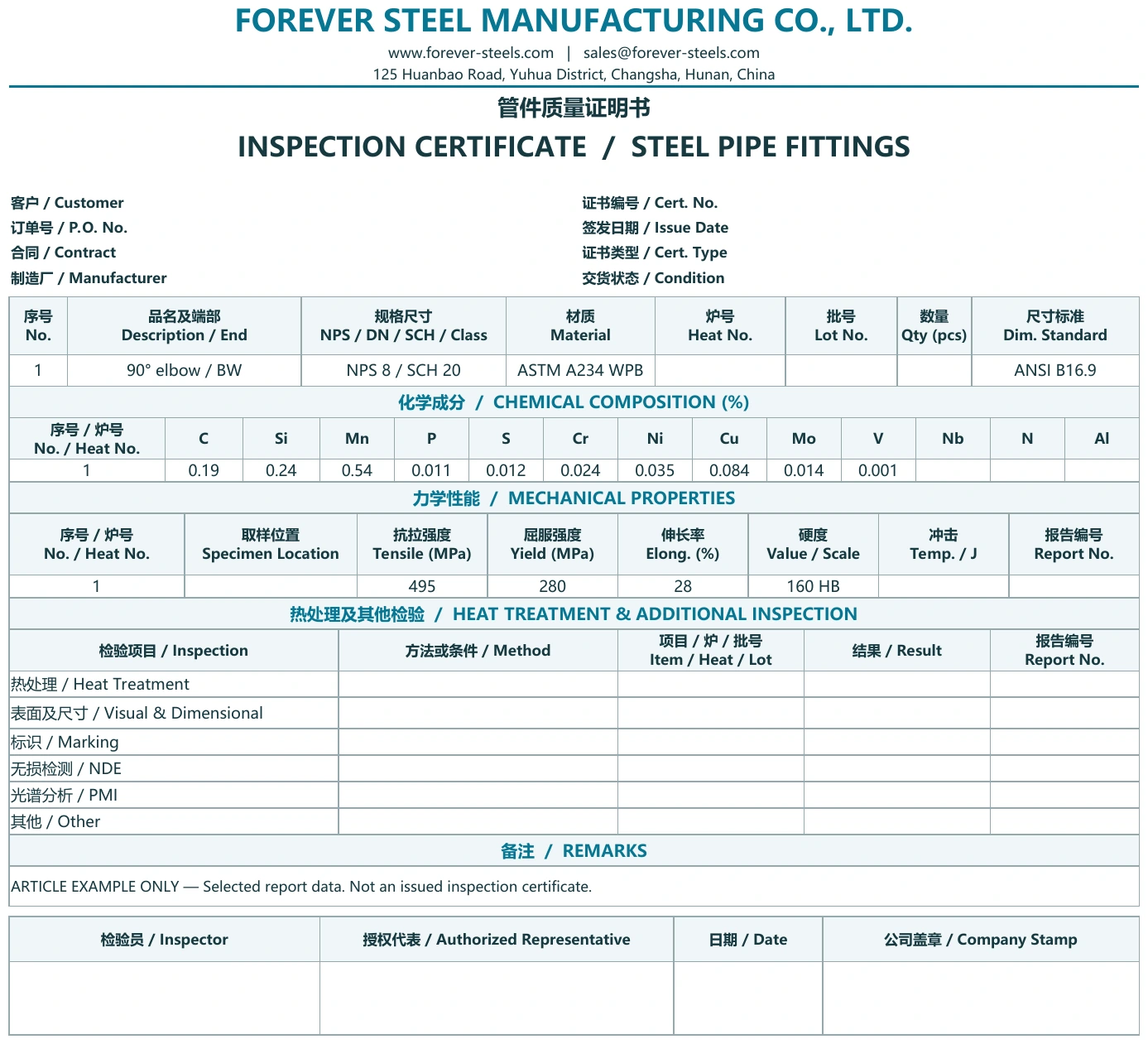
Article example using the Forever Steel fittings template, populated with selected data from the A234 WPB elbow inspection record.
Use the item reference to match the fitting to its test row. For spool fit-up, also request the measured weld-end wall and bore on the dimensional inspection report.
What is the difference between a long-radius and a short-radius elbow?
Long radius has a centreline radius of 1.5 × NPS and short radius 1.0 × NPS. For NPS 8 the 90° centre-to-end dimension is 305 mm against 203 mm, so the two are not interchangeable without re-dimensioning the spool.
What is the difference between A234 WPB and A420 WPL6?
Both have 240 MPa minimum yield and 415 MPa minimum tensile. WPL6 requires Charpy impact testing at −46 °C (27 J average, 20 J individual); WPB has no mandatory impact test.
Can I order butt-weld fittings by schedule alone?
No. Include size, grade, component standard and geometry. For reducing components, write the wall or schedule for each opening, and for stainless fittings the A403 class.
What is the minimum wall thickness of a B16.9 fitting?
At least 87.5% of the nominal wall at any point, for example 7.16 mm on an NPS 8 SCH 40 fitting.
What do WP-S, WP-W, WP-WX and WP-WU mean on A403 fittings?
Seamless (S), welded (W), welded with radiography (WX) and welded with ultrasonic testing (WU). Ask the bidder which class it is quoting.
Can a same-size fitting of a different material specification be substituted?
Only as an item-level deviation. Engineering review should cover the governing code, service, grade, route, weld compatibility, tests and dimensional interface before release.
Start from the piping function, then make material, wall and connection explicit at every opening. If a quote leaves a branch wall, reducer orientation, A403 class or drawing-controlled dimension unstated, clarify it before the order is placed. Send your item list, line class and drawings to Forever Steel for a quotation review, or browse the elbows, tees, reducers and caps range.
· Product pages: Elbows ·Tees ·Reducers ·Caps ·Pipe Bends ·Flanges
· Weld Bevel Types for Steel Pipe Ends
· BSP vs NPT Thread for Steel Pipe Orders
· Pipe Schedule Chart: Steel Pipe Dimensions and Wall Thickness
1. Projectmaterials, ASME B16.9 butt-weld fitting dimensions
2. Projectmaterials, A420 WPL6 vs A234 WPB
3. Ferrobend, ASTM A860 WPHY 65
4. GS Alloy, ASTM A403 austenitic stainless fittings (WP304L/WP316L strength)
5. ANSI Webstore, ASTM A403/A403M (class S, W, WX, WU summary)
6. Wermac, unequal wall thickness weld preparation (citing ASME B31.3 and B31.8)
7. ASME B36.10, welded and seamless wrought steel pipe (nominal dimensions used in the examples).
8. ASME B16.49, factory-made induction bends; MSS SP-97, forged branch outlets.