+8615674993216
 sales@forever-steels.com

 English
 العربية


3LPE (also written 3PE, or three-layer polyethylene) is a plant-applied system of FBE primer, adhesive and a polyethylene jacket. Single-layer FBE (fusion-bonded epoxy) is one cured epoxy film. 3LPE gives more mechanical and moisture protection and usually costs more at the plant. FBE is thinner and often lower in factory cost, and it is common where damage risk is controlled or the operator's cathodic protection design is built around it. Neither is better in general. Price the factory coating, field joints and repairs as one package. [8]
· Have the operator confirm which external systems are eligible for each route segment.
· Ask each bidder to name a compatible field joint and repair system, with responsibilities stated in the quote.
· Compare prices after the same pipe quantity, joints, repair allowance and inspection scope have been included.
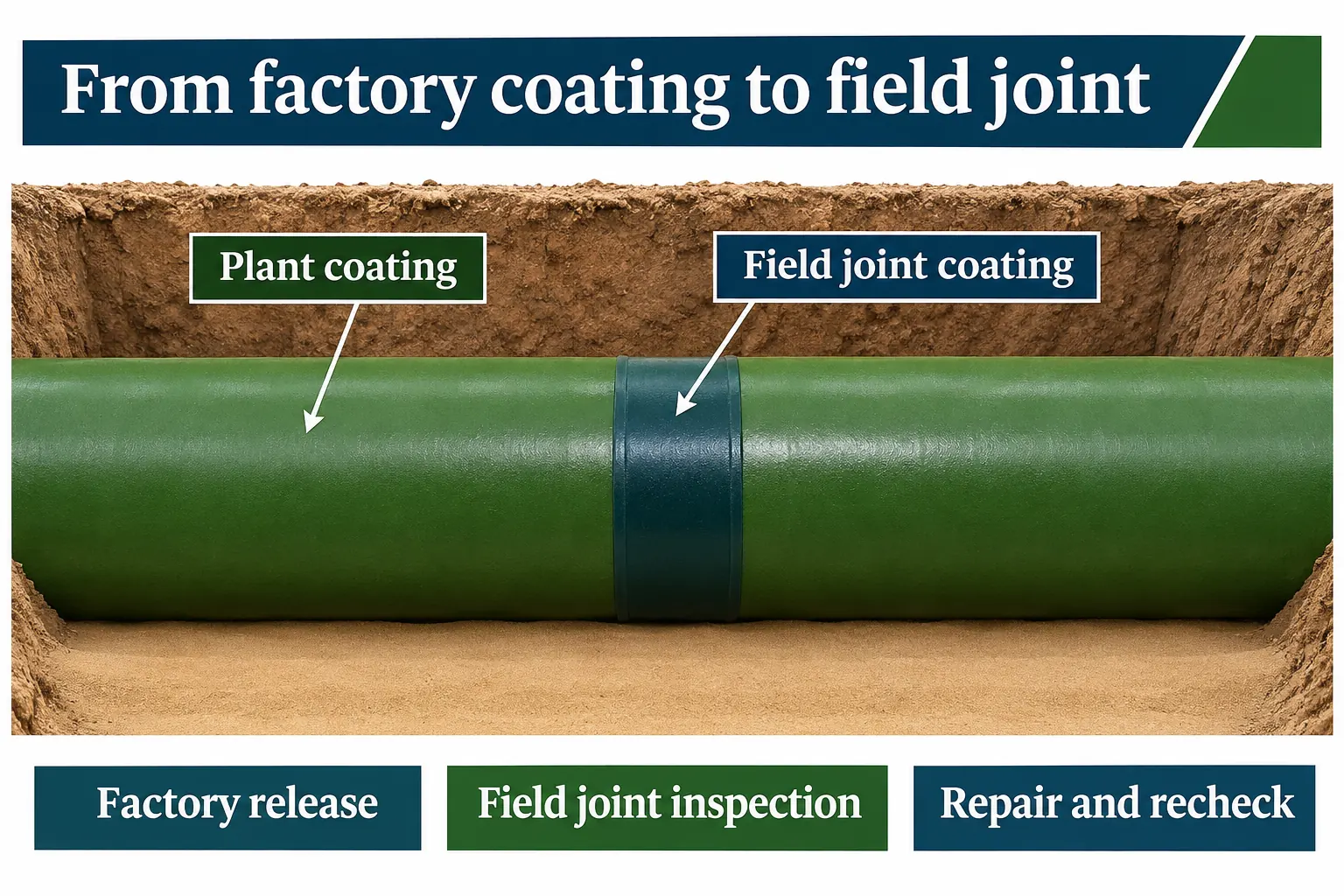
Figure 1. The plant coating and the overlapping field joint coating are shown on the same pipe. The graphic separates factory release, field joint inspection, and repair and recheck. The trench and coating details are schematic.
|
Factor |
3LPE (three-layer polyethylene) |
Single-layer external FBE |
|
Construction |
FBE primer against steel, adhesive, and polyethylene outer layer. |
Cured fusion-bonded epoxy film directly on prepared steel. |
|
Typical coating thickness |
About 1.8 to 3.2 mm in total.[8] |
About 300 to 600 µm single-layer. Dual-layer FBE is about 800 to 1,000 µm.[8] |
|
Published operating temperature |
About -40 to 80 °C. Above that, 3LPP is usually considered.[8] |
About -40 to 85 °C.[8] |
|
Impact resistance (published comparison) |
About 5 to 15 J/mm.[8] |
About 1.5 to 3 J/mm.[8] |
|
Moisture barrier |
Lower moisture absorption, because the PE layer acts as a barrier.[8] |
Higher moisture absorption.[8] |
|
Factory coating cost |
Commonly 30 to 50% above FBE.[8] |
Lower factory cost.[8] |
|
Typical use |
Rocky or aggressive soils, difficult terrain, long above-ground storage.[8] |
Non-aggressive soils and HDD with limited rock contact.[8] |
|
Product standard scope |
ISO 21809-1 covers plant-applied three-layer PE and PP for pipelines within its scope.[1] |
ISO 21809-2 covers single-layer external FBE for pipelines within its scope.[2] |
|
What to look for on the quote |
Material system, coating class or layer thickness requirements, accepted end detail, and applicable testing of layers and finished system. |
Powder system, dry film thickness, application and cure requirements, holiday and adhesion inspection, and the stated cutback. |
The temperature, thickness and impact figures are published comparison values from one supplier guide. They are not acceptance criteria. Use the ordered edition and owner specification to determine the required tests, and select the system against the operator's temperature, handling and corrosion-control criteria. The product descriptions alone cannot establish whether a specific coating system is qualified for a route. [1] ·[2]
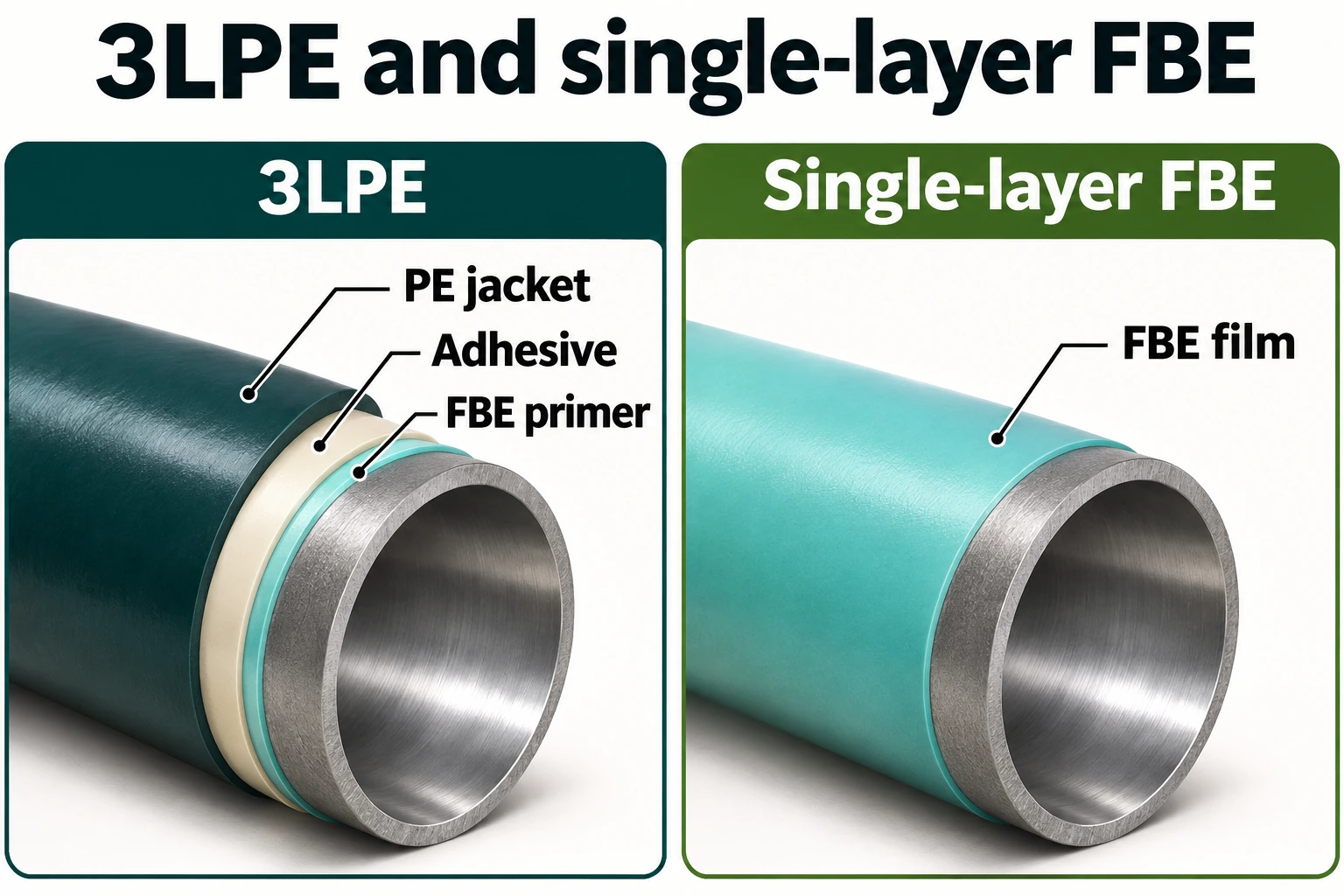
Figure 2. Left, the 3LPE build from steel outward is FBE primer, adhesive and polyethylene jacket. Right, single-layer FBE sits directly on the prepared steel. The illustration exaggerates layer thicknesses for clarity.
·Lean toward 3LPEwhen the route crosses rocky or aggressive soil, handling and backfill damage are the main risk, or pipe will sit above ground for a long period. [8]
·Lean toward FBEwhen soils are non-aggressive, the operator's cathodic protection design is built around FBE, or the crossing is installed by HDD. For HDD where gouge resistance matters, read FBE and ARO coating for HDD crossings.
·Look at 3LPP insteadwhen operating temperature is above the 3LPE range. See 3LPE vs 3LPP pipe coating selection.
·Do not decide on factory price alone.Field joints, repairs and inspection can reverse the installed ranking, as the worked example below shows.
ISO 21809-1 covers plant-applied three-layer PE and PP external coatings. In a 3LPE system, the epoxy primer, adhesive and polyethylene outer layer work together. ISO 21809-2 covers single-layer external FBE. The FBE primer under 3LPE is one component of that system. Dual-layer FBE with an abrasion-resistant overcoat, internal linings and field joint products need their own specification when included in the package. [1] ·[2]
|
Buyer question |
Evidence to request |
What changes in the comparison |
|
Which systems may be used on this segment? |
Owner coating specification, service temperatures, installation conditions and applicable cathodic protection criteria |
Identify the approved option set before evaluating prices. Route exceptions need engineering review. |
|
What will the coating encounter during installation? |
Haul and handling plan, lowering-in method, backfill or padding design, and specified impact or abrasion evidence |
Quote the protection measures and installation controls required for each approved system. |
|
How will the joint connect to the factory coating? |
Cutback drawing, joint product approval, surface preparation and overlap details, and a named field applicator |
Price a compatible joint system and make sure the factory cutback supports it. |
|
How are repairs and rechecks closed? |
Repair limits, approved repair product and procedure, inspection method and the release record |
Price the agreed allowance for repair and reinspection. Allocate anything beyond it in the quote. |
Both systems are used on cathodically protected pipelines, but the protection design has to match the coating. A coating that disbonds can shield the pipe from cathodic protection current. The PHMSA decision on 3LPE for the Alaska LNG pipeline conditions its authorization on assessment and remediation where coating shields the pipe from cathodic protection. [3] Ask the operator for the cathodic protection design basis and the coating's cathodic disbondment qualification before approving either system. For the FBE side of this question, see FBE coated pipe in cathodic protection systems.
Public permit data.The 2019 PHMSA decision describes the proposed Alaska LNG gas transmission pipeline as807 mileslong with a42-inchdiameter. The agency granted conditional use of 3LPE on the special-permit segments using alternative maximum allowable operating pressure (MAOP). The conditions address assessment and remediation where coating shields the pipe from cathodic protection. The dimensions describe the proposed pipeline, while the authorization applies to its specified segments. [3]
The assessment describes a proposed 3LPE build with8 to 10 mil of FBE primer, 6 mil of adhesive and 47 to 118 mil of polyethylene. It also describes the transition to the field joint at the exposed FBE tail. Those figures are project design inputs. In an RFQ, ask for the thickness basis of each layer and the end detail on its own drawing. [4]
PHMSA's construction guidance also identifies practical field issues such as unsuitable coating cutback, poor surface preparation and incorrect holiday detector settings. A holiday is a discontinuity in a protective coating. Put the joint inspection procedure and responsibility in the RFQ so both bidders price the same work. [5]
Ask for an end detail that identifies the bare steel cutback, any exposed primer tail, the factory coating edge and the required field overlap. Compare the dimension convention in the two documents. One may measure to the edge of the polyethylene, while the field crew may need the distance to the edge of sound primer. Put the approved revision on both the coating order and the field joint work package. The field procedure should name the preparation, application window, overlap and inspection for the actual interface. [6] ·[5]
Conditions 5 and 6 of the Alaska LNG special permit illustrate the difference. Its plant coating conditions specify a25 kVholiday check after coating application and drying. Its field-joint conditions separately requiredry-film thickness measurements on each field jointand specify the field holiday inspection basis. Use the actual project document for each inspection location. A voltage printed on the factory datasheet should be matched to its applicable coating and stage before it is used in the field. [7]
Record who inspects the coating at receipt, who approves and performs field repairs, who retests them, and which party delivers the release records. Before bid comparison, ask the contractor which repairs are included in the quoted allowance and how excess work is priced. This creates a comparison between equivalent scopes even when the bidders use different field-joint systems.
The example uses 1,000 m of identical base pipe and 100 planned field joints from an assumed takeoff. Both options have been assumed eligible for this example. Cost units (CU) are illustrative. Joint rates include materials, application and joint inspection. The agreed repair and reinspection allowance is priced separately. Common costs, such as bare pipe and trenching, are outside the example.
|
Same-scope cost item |
Offer A 3LPE |
Offer B single-layer FBE |
|
Factory coating package |
20,000 CU |
18,400 CU |
|
Field joints |
100 × 55 = 5,500 CU |
100 × 75 = 7,500 CU |
|
Repair and reinspection allowance |
600 CU |
900 CU |
|
Comparable total |
26,100 CU |
26,800 CU |
Offer B is 1,600 CU lower at the factory and 700 CU higher after the scoped field items. With the other assumptions fixed, the break-even field-joint rate for Offer B is (26,100 − 18,400 − 900) ÷ 100 =68 CU per joint. The spreadsheet inputs to verify are the actual joint count, the priced joint scope and the repair allowance. The same calculation can favor either system on a different order.
Quote the approved external coating system against the stated standard edition, base-pipe takeoff and project requirements. Declare cutback and compatible field joint details. Itemize qualification, inspection and records, joint materials and application, and repair plus reinspection. For each item, identify the responsible party and state whether it is included, excluded or by others.
Send the same takeoff for both the 3PE coated steel pipe option and the external FBE coated steel pipe option. Use the operator's instructions to define cathodic protection and any separate field scope before comparing the totals.
Not in general. 3LPE gives more mechanical and moisture protection and costs more at the plant. FBE is thinner, lower in factory cost and common where damage risk is controlled. The better system is the one the operator's specification approves for the segment, with a compatible field joint and repair system. [8]
3LPE is commonly quoted 30 to 50% above FBE at the factory. [8] Field joints and repair can change the installed ranking. In the worked example above, FBE is cheaper at the factory but 700 CU higher once joints and repairs are included.
One supplier guide publishes about -40 to 80 °C for 3LPE and -40 to 85 °C for FBE, and points to 3LPP above the 3LPE range. [8] Actual limits depend on the product and class, so confirm them against the datasheet and the owner specification.
In pipeline coating usage, both usually mean three-layer polyethylene: an FBE primer, an adhesive and a polyethylene outer layer. Confirm the layers and the governing standard in the quotation.
FBE is used for HDD, mainly where rock contact is limited, and an abrasion-resistant overcoat is added when gouge resistance is needed. [8] See the guide to FBE and ARO coating for HDD crossings.
Only if the operator accepts the product for both interfaces and service conditions. Verify its approval, cutback and overlap requirements, preparation and field inspection. ISO 21809-3 addresses qualification, application and testing of field joint coatings in its scope. [6]
Factory testing represents the condition at the time of the test. Use the project inspection plan to define field checks after handling, joint coating and repairs, including the checks required before backfill. [5]
· 3LPE vs 3LPP pipe coating selection
· FBE coated pipe in cathodic protection systems
· Pipe coating inspection before shipment
· Preventing transport damage to coated steel pipe
· Anti-corrosion coating standards for steel pipes compared
[1]International Organization for Standardization. ISO 21809-1:2018. Part 1, polyolefin coatings (3-layer PE and 3-layer PP). Public scope. Open source
[2]International Organization for Standardization. ISO 21809-2:2026. Part 2, single-layer fusion-bonded epoxy coatings. Public scope. Open source
[3]U.S. PHMSA. Alaska LNG Pipeline 3LPE Coating Letter of Decision, 9 September 2019. Docket PHMSA-2017-0046, p. 1. Proposed diameter and length, and conditional authorization. Open source
[4]U.S. PHMSA. Final Environmental Assessment, Alaska LNG 3LPE Coating Special Permit, 2019, PDF p. 17. Proposed layer build and field joint interface. Open source
[5]U.S. PHMSA. Pipeline Construction: Typical Construction Issues. Section "Pipeline Construction: Coatings." Field cutback, preparation and holiday inspection. Open source
[6]International Organization for Standardization. ISO 21809-3:2016. Part 3, field joint coatings. Public scope. Open source
[7]U.S. PHMSA. Alaska LNG Pipeline Special Permit PHMSA-2017-0046, 2019. Conditions 5 to 6, PDF pp. 5 to 6. Factory and field joint inspection conditions. Open source
[8]Projectmaterials. FBE Coating vs 3LPE. Published temperature, thickness, impact, moisture, cost and application comparison. Open source