+8615674993216
 sales@forever-steels.com
 English
 العربية

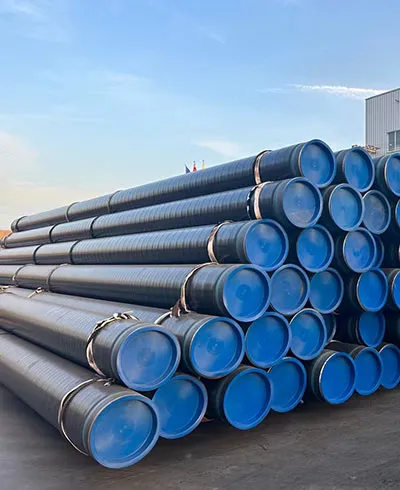
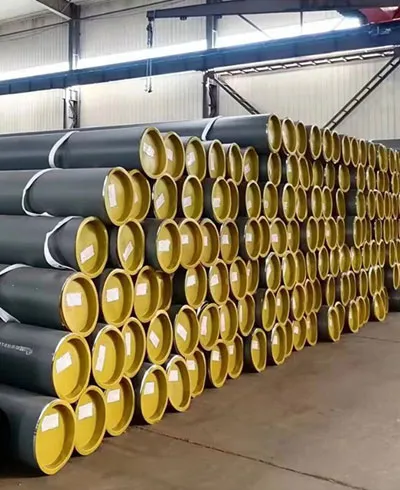
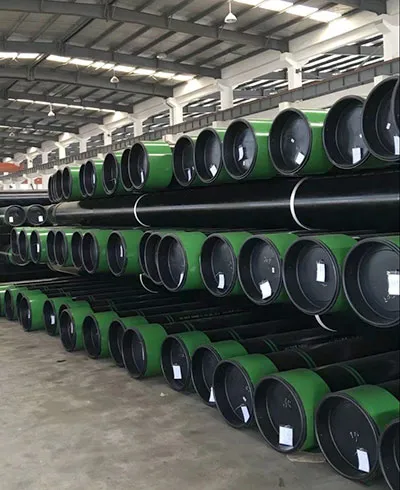
Three-layer polyethylene (3LPE) coating suits buried pipelines operating within the qualified temperature and mechanical limits of the proposed coating system. For hotter service beyond that range, three-layer polypropylene (3LPP) coating may be suitable. Selection also depends on handling temperature, local contact loads and the performance of the field-joint coating.
3PE coated steel pipe combines an epoxy primer, adhesive and polyethylene jacket. 3LPP coated steel pipe uses a polypropylene jacket with compatible underlying layers. Each layer contributes to corrosion protection or mechanical performance, and defects at their interfaces can affect the complete coating.
The coating is a bonded composite. The epoxy forms the corrosion barrier at the prepared steel surface. The adhesive transfers the bond between that primer and the outer polyolefin. The thick PE or PP jacket provides the main mechanical shield. A thicker jacket cannot compensate for contamination at the steel surface or poor bonding between layers.
|
Layer |
Function in the system |
Potential failure |
|
Epoxy at the steel |
Establishes the bonded corrosion barrier. |
Contamination or poor application can undermine adhesion even when the outer jacket looks sound. |
|
Adhesive tie layer |
Connects epoxy to the PE or PP jacket. |
An incompatible or poorly processed interface can separate under service or installation stress. |
|
PE / PP topcoat |
Resists mechanical exposure and limits moisture access. |
Impact, abrasion or local indentation can damage the jacket and expose lower layers. |
ISO 21809-1:2018 covers plant-applied three-layer PE and PP external coatings for buried or submerged pipeline transportation systems. A system specification therefore needs both material identity and application requirements. A topcoat datasheet alone leaves out the steel preparation, epoxy cure and bond interfaces that determine the behaviour of the finished pipe.
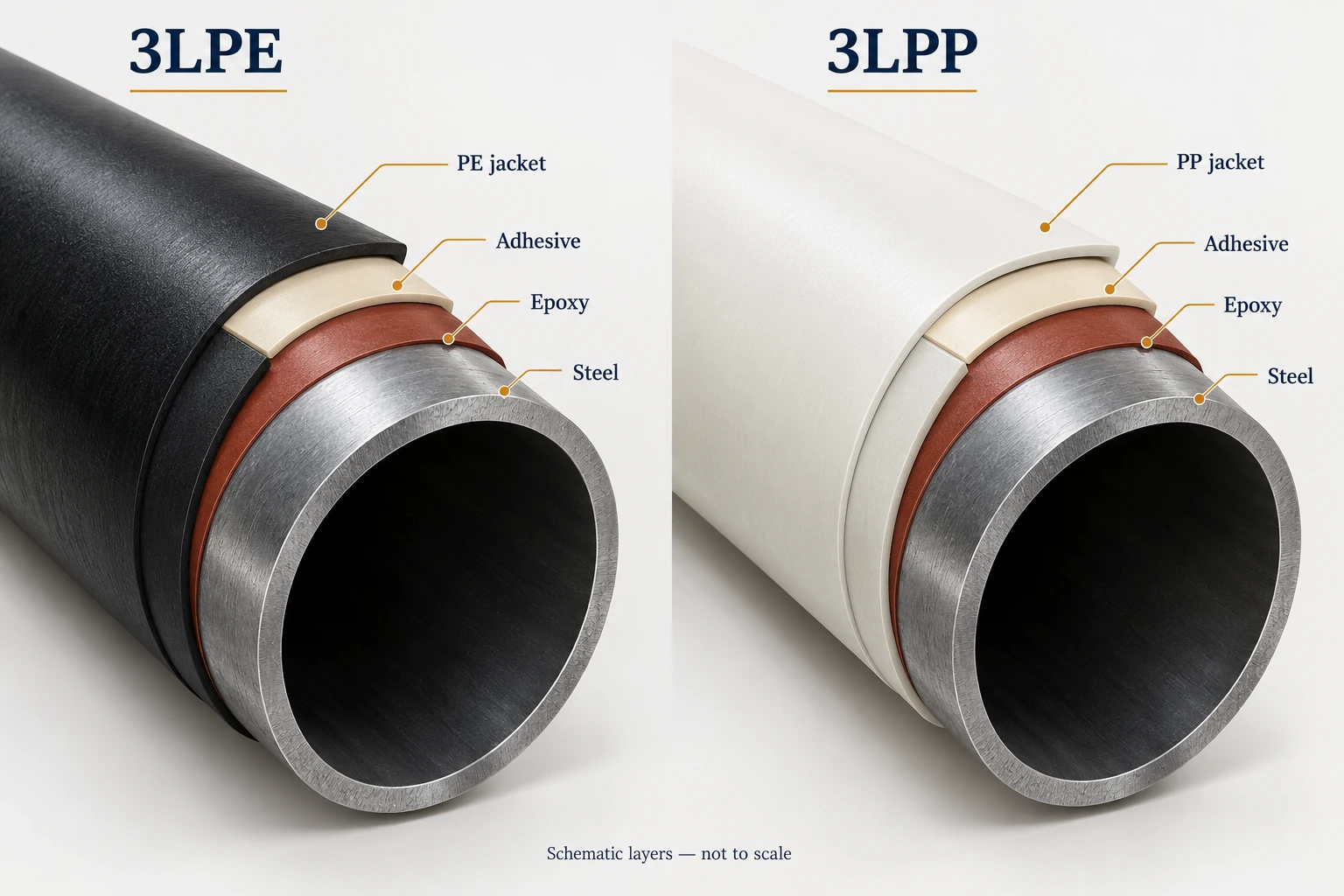
Three-layer PE and PP coatings over steel. AI-generated schematic; layers are not to scale.
|
Temperature condition |
Required information |
Qualification check |
|
Continuous operation |
Temperature at the external pipe-coating interface. |
Confirm the complete coating system covers sustained service. |
|
Operating excursion |
Peak temperature, duration and frequency. |
Review ageing and adhesion under the specified excursion. |
|
Transport and installation |
Minimum handling temperature and bending conditions. |
Check impact resistance and allowable bending strain. |
A coating specification needs separate limits for operation and installation. The range on an outer-jacket resin data sheet does not establish the qualified range of the epoxy, adhesive and jacket together. Obtain the complete system qualification and the field-joint procedure for the proposed materials.
A polymer jacket can deform under sustained contact pressure at temperatures well below its melting point. Sharp stones, pipe supports and installation rollers concentrate force over a small area. Indentation testing therefore specifies the load, temperature and duration to represent the intended exposure.
For example, a 100 N force distributed over 100 mm² produces an average pressure of 1 MPa. Reducing the contact area to 25 mm² raises that pressure to 4 MPa without increasing the force. Local contact geometry affects the protection needed during backfilling and trenchless installation. These calculated pressures are loading examples, not allowable coating limits.
Cold installation creates a different problem: the coating must tolerate bending and impact while cold. In a Pipeline Technology Conference paper, Borealis describes how unsuitable epoxy, adhesive and PP topcoat combinations can suffer transport damage before reaching the construction site. Cold-handling limits depend on the formulation and the complete layer system. Source: Borealis low-temperature PP coating paper.
Borealis publishes the following typical properties for Borcoat BB108E-1199, a PP topcoat material. The July 2022 data sheet reports typical resin properties under specified test conditions. They are not guaranteed limits for a complete coating system.
|
Property |
Published typical value |
Meaning for selection |
|
Melting temperature |
162°C |
A material transition; not a pipeline service rating. |
|
Vicat softening temperature |
145°C; ISO 306, A50 (10 N) |
A specified softening test, not a complete-system qualification. |
|
Notched Charpy impact strength |
25 kJ/m² at 23°C; ≥3 kJ/m² at −20°C |
Temperature and test method matter; these are not coating impact values in J/mm. |
Source: Borcoat BB108E-1199 product data sheet, edition 4. Using the 162°C melting value to approve a 120°C pipeline would skip adhesion, ageing, loading and system compatibility. Equally, converting the resin’s Charpy result into a coating impact acceptance limit would compare different test geometries and units.
Consider an illustrative project with a coating design temperature of 95°C, a 105°C excursion and a 5°C minimum service temperature. Assume two hypothetical bids: a PE system qualified from −40°C to 90°C and a PP system qualified from −20°C to 120°C. These ranges are example inputs, not product ratings. The PE bid falls 5°C short at normal design temperature and 15°C short during the excursion.
The PP bid covers the assumed temperatures, with 25°C between design temperature and its upper limit and 15°C between the excursion and that limit. Those differences do not establish a design safety factor. Approval still depends on the specified excursion duration, frequency, adhesion performance and field-joint qualification.
The temperature basis must refer to the coating at the pipe surface. If 95°C is the fluid temperature, use the project thermal calculation to establish the external pipe-coating interface temperature for the relevant operating condition.
For a second illustrative project, assume 60°C operation and unloading or bending at −30°C. Both hypothetical bids cover the operating temperature. The PP bid’s stated minimum is −20°C, while the PE bid’s is −40°C. Separate impact and bending qualification at −30°C is still needed: an operating range alone does not qualify cold installation.
Assess the proposed system against the handling procedure, bending strain and impact requirements at the minimum installation temperature. Depending on the qualification results, the work may require a different formulation or controls on handling and installation temperature.
Production begins with steel surface preparation and heating, followed by epoxy application, the adhesive layer and extrusion of the outer polymer. The coated pipe is then cooled and inspected. Timing matters because the final interfaces are created during application. Changing the epoxy or adhesive can require different processing conditions even when the outer polymer remains unchanged.
OCAS investigated residual dust and salt on blasted panels before applying 3LPE. In that study, cathodic disbondment testing used −1.5 V at 80°C for 28 days, with a stated 15 mm criterion. Reducing residual dust improved the result within the tested conditions. The results link surface cleanliness to resistance against disbondment. The stated test conditions and criterion belong to this study; project acceptance requirements may differ. Source: OCAS surface-preparation study.
|
Test or measurement |
Property assessed |
Variables to compare |
|
Thickness measurement |
Coating build at the measured location. |
Total versus individual layer thickness, location and class. |
|
Holiday detection |
Electrically detectable coating discontinuities. |
Instrument setup and voltage appropriate to the coating. It is not an adhesion test. |
|
Peel / adhesion assessment |
Resistance to separation at the bonded interface. |
Test temperature, specimen geometry and failure interface. |
|
Indentation / impact |
Resistance to local or sudden loading. |
Temperature, loading, duration or impact method. |
|
Cathodic disbondment |
Loss of adhesion under specified electrochemical conditions. |
Potential, electrolyte, time, temperature and measurement method. |
ASTM D5162 describes holiday testing as discontinuity testing and stresses the relationship between detection voltage, film thickness and dielectric strength. A higher voltage is not automatically a better test. For the detailed release procedure, see the pipe coating inspection guide.
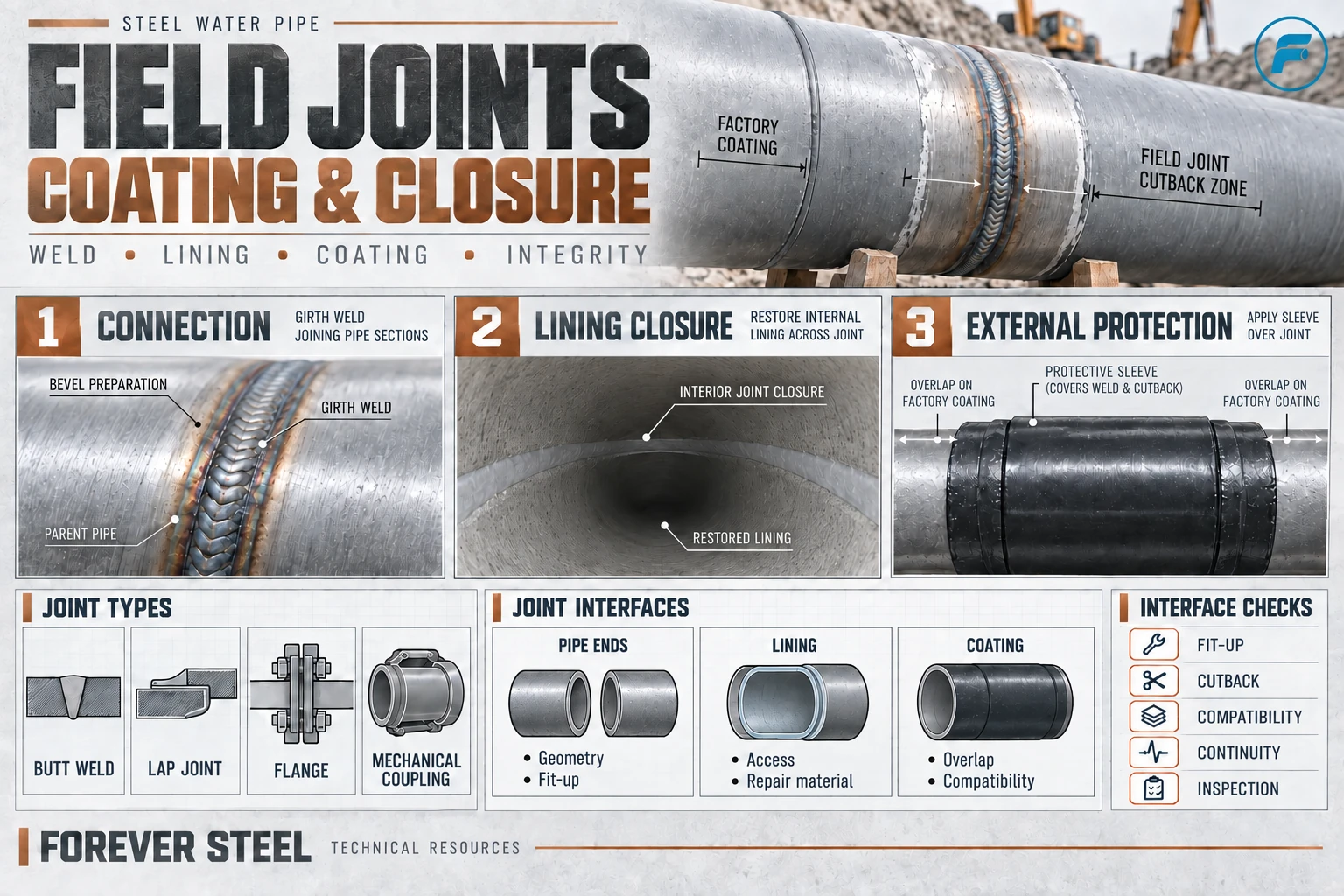
Factory coating stops short of the pipe ends so the girth weld can be made. The field-applied system must protect the exposed steel and bond to the parent coating. For a PP jacket, specify a compatible joint system and verify the preparation and overlap procedure. ISO 21809-3 covers field-joint coatings; the applicable system and project requirements govern qualification and inspection.
Consider 1,000 straight lengths, each 12 m long and 508 mm in outside diameter. If the cutback is 150 mm at each end, one joint has approximately 300 mm of exposed axial length. Bare joint area is π × 0.508 × 0.300 = 0.479 m². Joining the lengths in one string creates 999 intermediate joints: approximately 478 m² of exposed joint area before allowing for overlap onto the parent coating.
That is about 2.5% of the string’s outside surface area, treated through nearly a thousand separate site applications. Field-joint coating should therefore be priced as part of the installation scope. Terminal ends, fittings, weld profile and overlap add to or modify this simplified quantity.
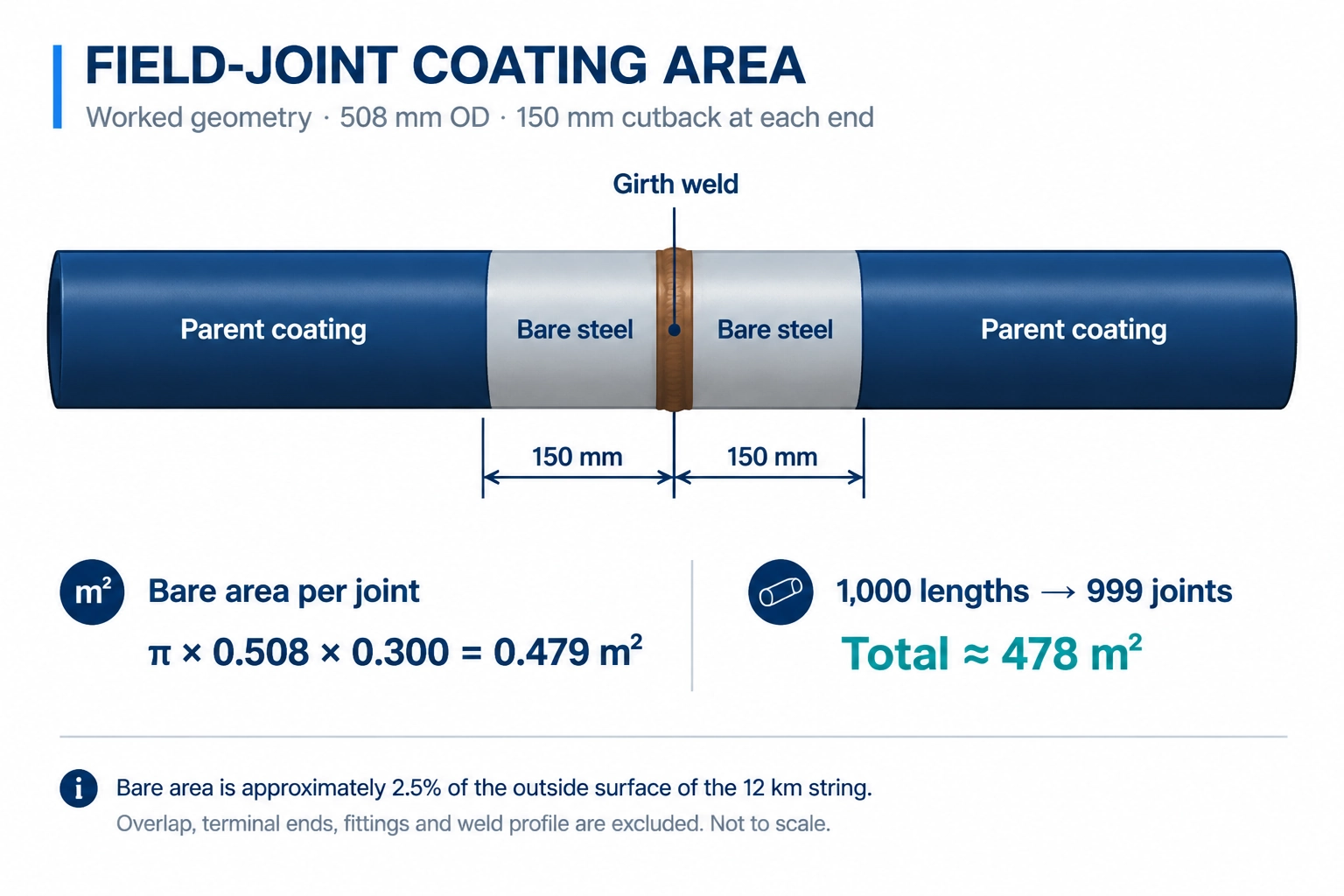
Calculated bare area across 999 joints. Weld profile, coating overlap, fittings and terminal ends are excluded.
|
Project condition |
Coating option |
Qualification needed |
|
Moderate-temperature buried line |
Qualified 3LPE system |
No temperature-driven PP upgrade is indicated if service, installation and mechanical requirements are covered. |
|
Hot line above the offered PE range |
Qualified 3LPP system |
Evaluate sustained thermal/mechanical performance and the matching joint system. |
|
Cold-weather transport or bending |
Either, with demonstrated cold performance |
Maximum hot-service temperature does not predict cold impact or bending behaviour. |
|
Rocky backfill / trenchless crossing |
Mechanically qualified system and installation protection |
Thickness alone does not establish abrasion or indentation performance. |
|
Subsea heat-retention duty |
Separate insulation design |
An anticorrosion 3LPP jacket is not, by its name, a thermal-insulation design. |
The commercial comparison should cover factory coating area and thickness, qualification work, inspection, field joints, repairs, handling and any separate mechanical protection. A coating price per metre does not include those items unless the scope says so. The price difference between PE and PP systems depends on diameter, quantity and the specified work.
Send the pipe schedule, coating specification, interface temperature envelope, minimum installation temperature, laying method and field-joint scope with the enquiry. Ask the supplier to identify each layer material, provide the relevant qualification reports and price any deviations from the specification.
1. Anti-Corrosion Coating Standards for Steel Pipes: ISO, DIN, CSA, AS/NZS and GOST Compared
2. Pipe Coating Inspection Before Shipment: Thickness, Adhesion, Holiday Test and Repair Records
1. Borealis — Borcoat BB108E-1199 product data sheet, 20 July 2022
2. ISO 21809-1:2018 — Plant-applied three-layer PE and PP coatings
3. ISO 21809-3:2016 — Field-joint coatings
4. Borealis / Pipeline Technology Conference — Low-temperature PP coating performance
5. OCAS — Surface preparation and 3LPE cathodic disbondment
6. ASTM D5162-21 — Discontinuity testing of nonconductive coatings