+8615674993216
 sales@forever-steels.com

 English
 العربية


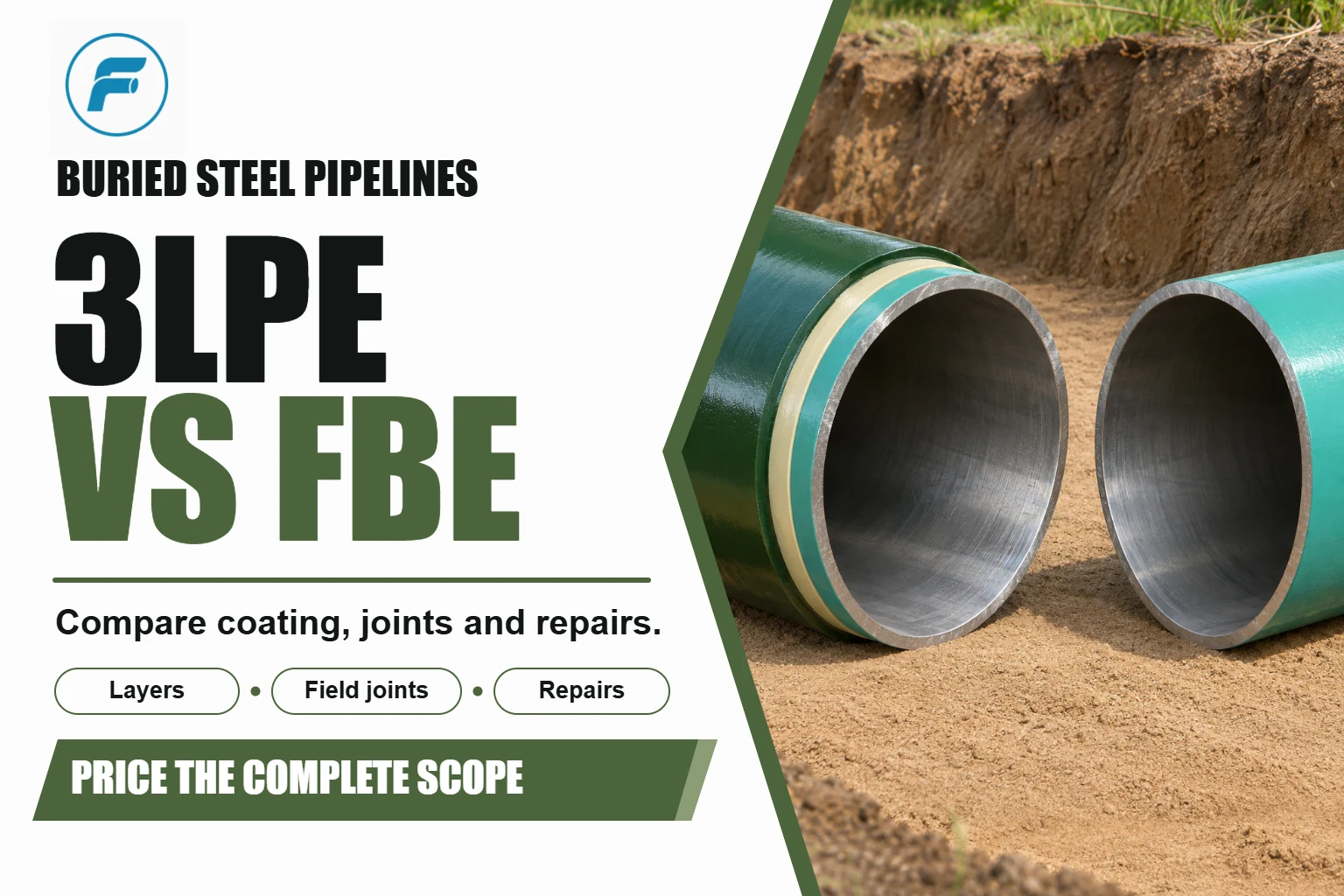

A 3LPE coating PQT (procedure qualification trial or test) is a trial in which a coating plant applies a specific three-layer polyethylene system and the results are tested against the specification before production starts. It qualifies only what was actually run: the line, the materials, the application procedure revision and the pipe size. Before releasing production, match the report to the offered order and obtain written disposition for any difference.
· Ask for the approved application procedure specification (APS), inspection and test plan (ITP) and complete trial report as a set.
· Separate the tested configuration, the approved coverage and the configuration offered for the purchase order (PO).
· When they differ, obtain written disposition before releasing production. The contract governs whether review, additional evidence, a new trial or another qualification step is needed.
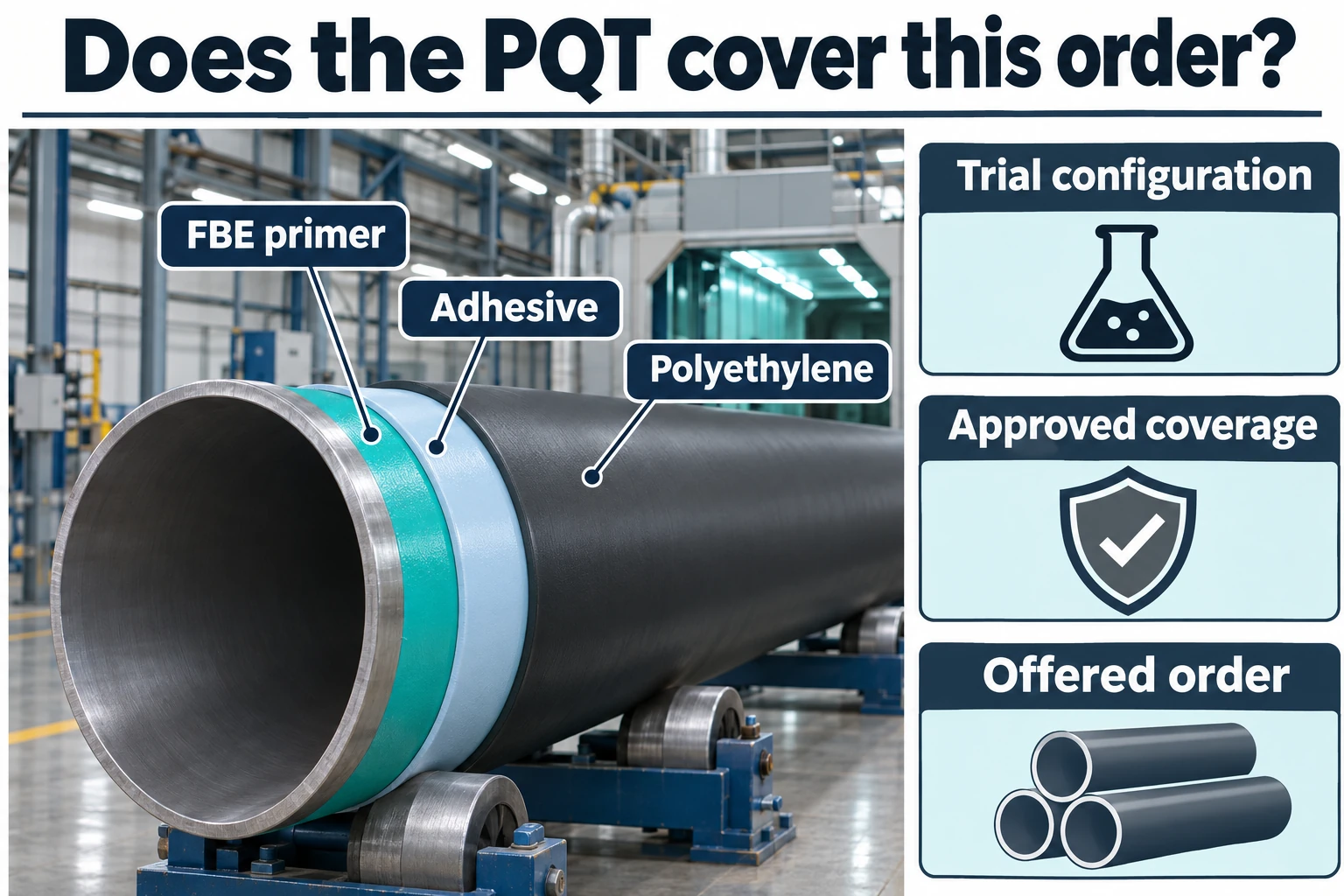
Figure 1. The 3LPE cutaway sits beside the three scopes a buyer compares before release. Match the trial configuration and approved coverage to the offered order. Layer widths and colors are illustrative.
ISO 21809-1:2018 covers plant-applied three-layer polyethylene and polypropylene external pipeline coatings. In this article, PQT refers to the trial or tests used to qualify how the plant applies the selected coating system. It is sometimes called a procedure qualification test. The APS states the process to run. The ITP states what will be checked, when, against which requirement and by whom. The PQT report records what was actually run and measured. Check the terms and approval sequence used in the project documents. [1]
A PQT is not automatically required. The public preview of an earlier ISO 21809-1 edition lists the APS, an optional PQT and the ITP as parts of coating system qualification. Whether a PQT applies to your order depends on the ordered edition, the owner specification and the contract. [5]
|
Document or activity |
Buyer question it answers |
Evidence to retain |
|
Application procedure specification (APS) |
How will this applicator produce the coating on the proposed line? |
Approved revision, products, line and operating ranges. |
|
Inspection and test plan (ITP) |
Which checks apply, who attends and who can release the next stage? |
Inspection stages, referenced methods, acceptance limits and signed hold-point release where required. |
|
Procedure qualification trial or tests (PQT) |
What configuration was run, what results were obtained and which scope did the purchaser approve? |
Line and pipe IDs, material batch traceability, signed results and written scope or approval. |
|
Pre-production trial (PPT) |
If the contract requires a PPT, has the applicator demonstrated readiness for the current production run? |
Current line, crew, setup and production-representative checks as specified, plus the release decision. |
Start with the contract's own terms. A witness point and a hold point can lead to different release decisions. Use the ITP to confirm what happens if the buyer's inspector is absent and which sign-off is required before the line runs. Record the decision beside the relevant approval, where the next shift can find it.
Put thetrial configuration,approved production coverageandproposed orderside by side. The trial report is evidence for a particular run. A purchaser may approve a broader envelope in writing when the contract permits it. For example, when Line B is offered, compare its actual identity, equipment and proposed process to the coverage record. A certificate carrying the same applicator name leaves this check unresolved.
The test list and acceptance values come from the ordered edition of ISO 21809-1 or the owner specification, and from the contract. The public preview of an earlier ISO 21809-1 edition names the applied-coating tests below. Confirm the list in the edition you ordered. [5]
|
Test |
What it checks |
What to look for in the report |
|
Layer thickness |
Epoxy, adhesive and total coating thickness |
Raw readings with pipe ID, axial station, clock position and instrument identity. |
|
Holiday (continuity) |
Discontinuities in the coating |
The voltage basis, the layer tested and the instrument used. |
|
Peel strength |
Adhesion of the coating to the steel |
Specimen ID, test temperature, location on the pipe and result. |
|
Epoxy degree of cure |
Whether the FBE primer cured fully |
The method (thermal analysis such as DSC is common), specimen location and result.[6] |
|
Impact |
Resistance of the coating to impact |
Energy basis, temperature and number of impacts against the criterion. |
|
Indentation |
Resistance of the polyethylene to indentation |
Load, temperature, duration and measured result. |
|
Cathodic disbondment |
Disbondment around an intentional holiday under cathodic polarization |
Duration, temperature, potential and measured disbonded radius.[6] |
|
Flexibility and hot-water immersion |
Behavior under bending and after immersion, where specified |
Whether the test is required by the ordered edition, and the acceptance basis. |
The ITP should state which of these tests are done for the PQT and which are repeated on production lots. Link every result to a specimen ID and the trial pipe it came from.
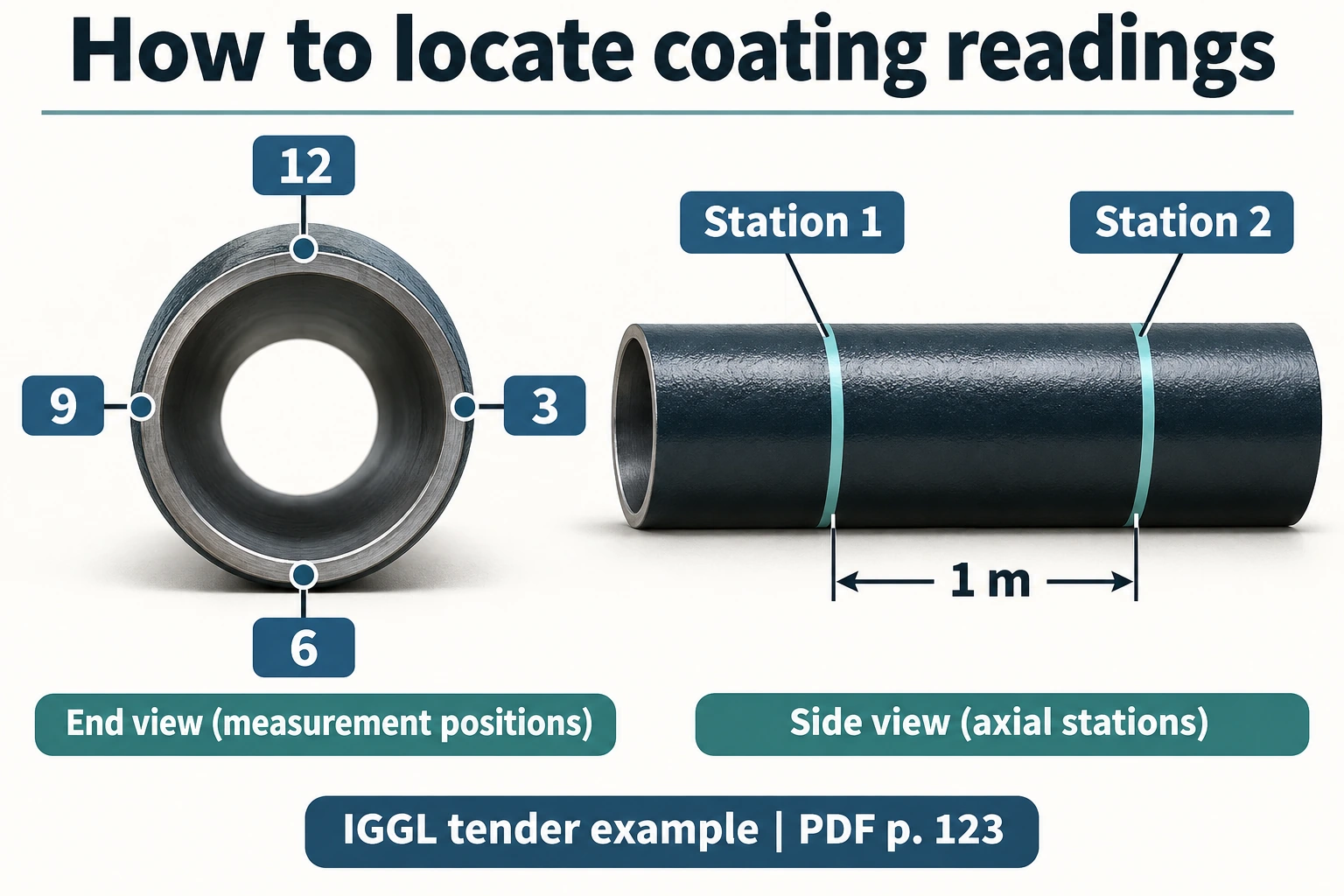
Figure 2. The IGGL tender example specifies readings at 3, 6, 9 and 12 o’clock and axial stations 1 m apart for the specified layer checks. See the tender PDF, p. 123. The drawing shows the locations schematically.
|
Check |
Pull from the report and its attachments |
Buyer disposition |
|
Applicator and line |
Site, line identification, trial date, APS revision and approved production line |
A proposed move to another line goes to the approval authority with a documented coverage review. |
|
Coating materials |
Epoxy primer, adhesive and PE product identifiers, trial batch records and approved substitution provisions |
A new batch of an approved product follows the project's batch control. A different product needs its own documented disposition. |
|
Pipe envelope |
Trial pipe OD, wall and surface condition, plus the written basis for coverage of the offered size |
Ask for the approved coverage or a project-specific decision when the offered dimensions differ. |
|
Coating requirements |
Ordered class or thickness basis, recorded process settings, specimen IDs, test conditions and results |
Check each result against the contract and link it to the trial pipe or specimen. |
|
Release status |
Signed review, open exceptions, retest records and any pre-production trial requirement |
Record who may clear the exception and release the next step. |
Illustrative only. A report shows a trial on Line A with a 508 mm OD pipe and materials listed in APS Rev 2. The new offer names Line B, 610 mm OD and APS Rev 3. Even if the stated coating class matches, three scope fields need a written disposition. Ask for the approved coverage of Line B and the larger pipe, a revision comparison for the APS, and the applicable qualification requirement. If the owner requires a new trial, confirm its timing and document submission in the quote. Keep production release open until the designated authority clears the items.
Public tender data.Indradhanush Gas Grid Limited's North East Gas Grid Phase III bid specifies a typical15-pipecoating trial batch, withat least seven pipesselected for qualification tests andseven working days'notice for witnessing. The same clause calls for stripping and recoating the seven test pipes after a successful trial. Section 8.2 ties the trial scope to diameter and owner-selected maximum wall, pipe type, material combination and plant. On this bid, a buyer reviewing the quotation would check that the schedule and price include trial stock, witnessing and recoating. [2]
The IGGL tender provides a concrete check on raw records. In §§8.5.1.2 to 8.5.1.3, the epoxy and adhesive layer thickness checks each usetwo pipes, readings spaced1 mapart and measurements at3, 6, 9 and 12 o'clock. Section 8.5.1.4 specifies5 V per µmof minimum specified epoxy thickness for the epoxy-coated portion used in that trial check. These are tender-specific settings. The final three-layer coating has its own inspection basis. [3]
If a trial summary says "pass" but gives one thickness average per pipe, ask for the raw sheet showing pipe ID, axial station, clock position, layer being measured, instrument identity and result. Check which readings belong to the epoxy-only zone and which belong to the adhesive check. The record must explain the measurement basis so an average from fully coated pipe does not stand in for a layer check.
·Missing evidence.A test result exists but its specimen cannot be linked to a trial pipe. Request the specimen register or signed traceability evidence.
·Different basis.The test sheet lists a different coating class or method. Ask the purchaser's technical authority to determine comparability before accepting the result.
·Failed result.Keep the original result, investigation, permitted retest or corrective action, and the signed final disposition together. Ask which production or trial material the decision covers.
Before the trial.Ask the applicator to cross-reference the PO and its applicable standard edition, the APS revision, the proposed line and materials, and the ITP. List witness and hold points where the contract requires them.
After the trial.Read the test report alongside the recorded line settings, test conditions and specimen identification. If a peel, impact, thickness or other test is required, record the method and acceptance criterion beside the result. Where a pre-production trial (PPT) is specified, record its separate approval. Once production starts, the PO and ITP still govern routine lot checks and release records. Surface preparation before coating also affects the result, so review steel pipe surface preparation before coating alongside the PQT.
Identify the proposed coating applicator and line, the coating material system and the offered size range. List the APS and ITP revisions and the PQT record supporting that scope. State any difference from the trial configuration, the proposed approval or qualification action, its lead time and whether it is included in the quote. Identify the documents required before production release.
For a 3PE coated steel pipe quotation, send the line-pipe dimensions, coating class or thickness basis, applicable standard edition, and any approval or witness requirements. Ask the supplier to identify the coating applicator and list qualification as a separate line item if its scope is still open.
PQT usually stands for procedure qualification trial or procedure qualification test. It is the trial that shows a coating plant can apply a specified system to the required standard before production.
Not by default. The public preview of an earlier ISO 21809-1 edition lists the PQT as optional alongside the APS and ITP. Whether it is required depends on the ordered edition, the owner specification and the contract. [5]
The PQT qualifies the coating procedure and configuration. A pre-production trial (PPT), where the contract requires one, checks that the applicator is ready for the current production run on the current line, crew and setup.
Use it as supporting evidence. Acceptance depends on the new contract, the documented scope and the purchaser's decision. Ask for the report, its approval record and a mapping of differences to the new order.
Follow the governing specification and written approved coverage. A diameter-specific trial rule in one bid should be applied to that bid. For another order, ask for its applicable rule and the written basis for covering the proposed diameter.
Field joints have a separate qualification and application scope. Confirm responsibility and compatibility with the factory coating at the cutback. For relevant oil and gas pipeline projects, ISO 21809-3 addresses field-applied coating after the pipes are joined. [4]
· Steel pipe surface preparation before coating
· Pipe coating inspection before shipment
· 3LPE vs 3LPP pipe coating selection
· FBE powder coating for steel pipe: cure window and application limits
· Field joints and field joint coating for steel water pipe
[1]International Organization for Standardization. ISO 21809-1:2018. Part 1, polyolefin coatings (3-layer PE and 3-layer PP). Public scope. Open source
[2]Indradhanush Gas Grid Limited. North East Gas Grid Phase III, Supply of Bare and Coated Pipes, Technical Volume II. VPC-SS-PP-2003 Rev 03, §8.2, PDF p. 120. Trial triggers, sample quantities and witness notice. Open source
[3]Indradhanush Gas Grid Limited. Same tender, VPC-SS-PP-2003 Rev 03, §§8.5.1.2 to 8.5.1.4, PDF p. 123. Layer thickness and epoxy holiday inspection settings. Open source
[4]International Organization for Standardization. ISO 21809-3:2016. Part 3, field joint coatings. Public scope. Open source
[5]ISO 21809-1:2011 (withdrawn, replaced by the 2018 edition). Public preview via iTeh Standards. Coating system qualification (APS, optional PQT, ITP) and applied-coating test list. Confirm against the ordered edition. Open source
[6]Element Materials Technology. Pipeline coating testing sales sheet. Cathodic disbondment and thermal analysis (DSC) testing. Open source