+8615674993216
 sales@forever-steels.com
 English
 العربية

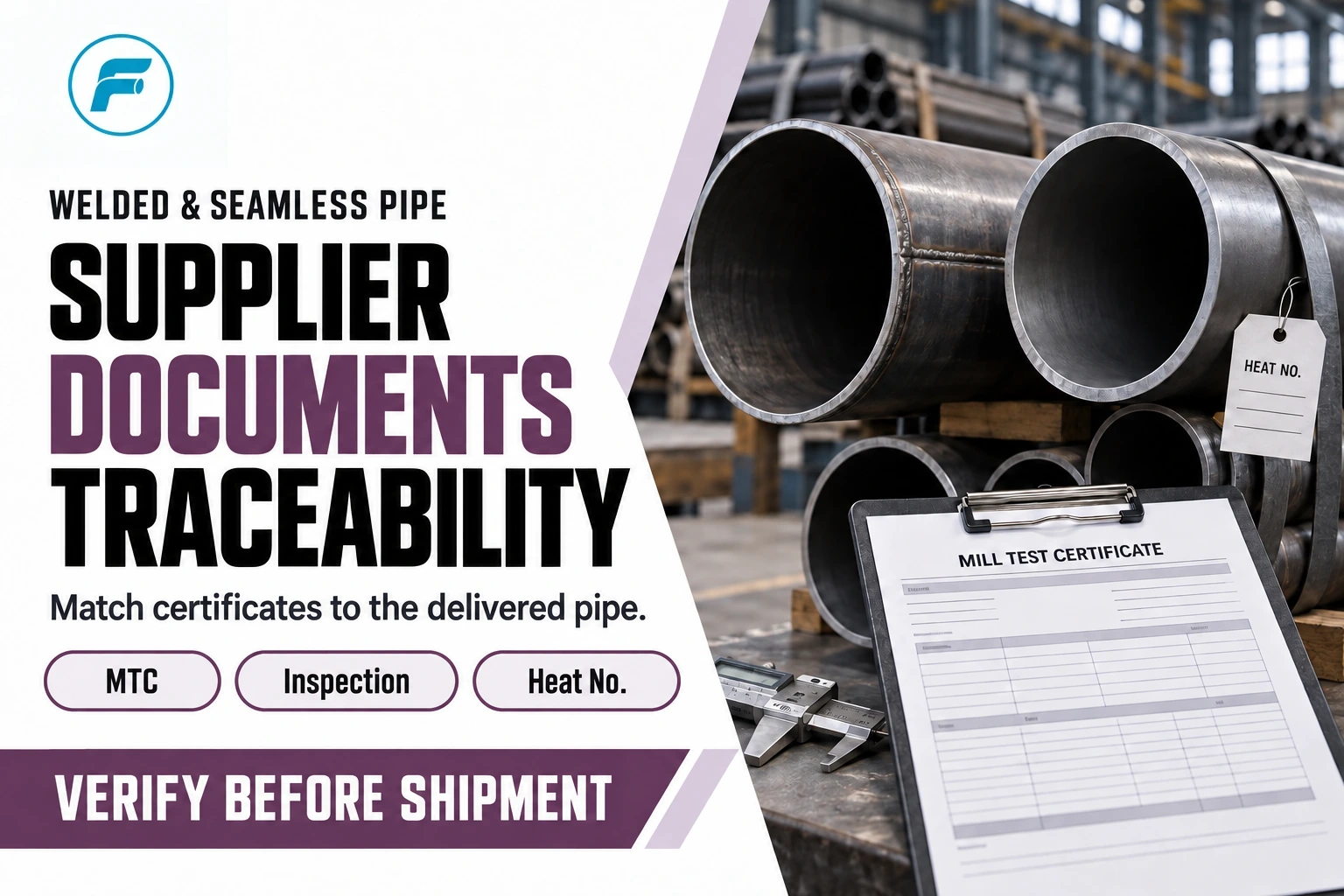
What must an API 5CT casing and tubing order define before quotation? State the product function, OD, nominal weight, wall, drift, grade/type, connection, service environment, design loads, inspection scope and records. Casing supports the well structure while tubing carries production or injection fluids; neither product is selected safely from a grade name alone. Forever Steel supplies these products for international oilfield projects, subject to the approved well and purchase specification.
Forever Steel supplies API 5CT casing pipe and API 5CT tubing pipe for international oilfield projects. This guide explains the main procurement decisions while leaving final string design and service qualification to the operator, EPC or responsible well engineer.
API Specification 5CT is issued by the American Petroleum Institute for casing, tubing, pup joints, couplings, coupling stock and related materials. It establishes technical delivery requirements covering grades, manufacturing routes, heat treatment, dimensions and masses, end finishes, inspection, testing, marking and documentation.
Edition control is part of the purchase specification. API Spec 5CT 11th Edition was published in December 2023. API subsequently issued Addendum 1 in May 2025 and lists Errata 3 dated June 2026. The 11th Edition removed the former product specification level framework, so a new purchase order should not automatically repeat PSL1 or PSL2 wording carried over from older templates. State the governing edition and any applicable addenda or errata in the inquiry, quotation and purchase order.
Procurement note: API 5CT defines product requirements; it does not replace the well designer's responsibility for casing-string or tubing-string design, connection selection, collapse/burst/tension calculations, corrosion assessment or field running procedures.
For specifications carried over from an earlier purchase, review edition changes before fixing the purchase specification and record the governing edition, addenda and errata.
|
Item |
Casing |
Tubing |
|
Position |
Installed as a wellbore structural and pressure barrier |
Installed inside casing as the production or injection conduit |
|
Primary function |
Supports the wellbore, isolates formations and carries structural loads |
Carries produced or injected fluids and supports completion operations |
|
Installation |
Normally cemented in place; liners may be hung rather than run to surface |
Normally retrievable during workover, subject to completion design |
|
Common applications |
Conductor, surface, intermediate and production strings or liners |
Production, injection, disposal and workover service |
|
Main design focus |
Collapse, burst, axial tension/compression, cementing and formation loads |
Pressure, axial load, corrosion/erosion, connection sealing and intervention access |
|
Standard connection families |
STC, LTC and BTC, plus qualified proprietary connections |
NUE, EUE and integral-joint options, plus qualified proprietary connections |
Casing and tubing may share certain grades and outside diameters, but they are not interchangeable. Their load cases, connection families, handling practices, drift requirements and acceptance records must be reviewed separately.
|
Parameter |
Why It Matters |
What the Buyer Should Confirm |
|
Product role |
Determines whether the tubular is a structural barrier or a flow conduit |
Casing string/liner or tubing service; well section and operating duty |
|
OD and nominal weight |
Identify the standard size and mass designation |
Inch and metric units; plain-end or threaded-and-coupled mass basis |
|
Wall thickness and ID |
Affect load capacity and available internal bore |
Specified wall, nominal ID and tolerance basis |
|
Drift diameter |
Controls minimum tool and equipment clearance |
Required drift diameter, mandrel basis and acceptance record |
|
Grade and type |
Control strength, heat treatment and service limitations |
J55/K55, N80 type, L80 type, C90/T95, P110 or other approved grade |
|
Manufacturing route |
May change availability, NDT scope and project approval |
Seamless or electric-welded route permitted by the PO and project specification |
|
End finish/connection |
Controls joint strength, sealability and running compatibility |
API connection or exact proprietary connection, coupling and thread requirements |
|
Length range |
Affects tally, transport, running time and handling |
R1/R2/R3 or project-specific length distribution |
|
Service environment |
Can control grade, hardness, metallurgy and qualification |
H2S, CO2, chlorides, temperature, pressure, injection chemistry and corrosion strategy |
|
Inspection/documents |
Defines what evidence must be reviewed before release |
MTC, NDT/hydrotest scope, dimensions, drift, threads, marking, tally and packing records |
For combined casing, tubing and accessory sourcing, see Forever Steel's OCTG Products overview. A supplier's available range still needs to be checked against the final item description and approved manufacturing source.
|
Grade / Type |
Minimum Yield Strength |
Procurement Consideration |
|
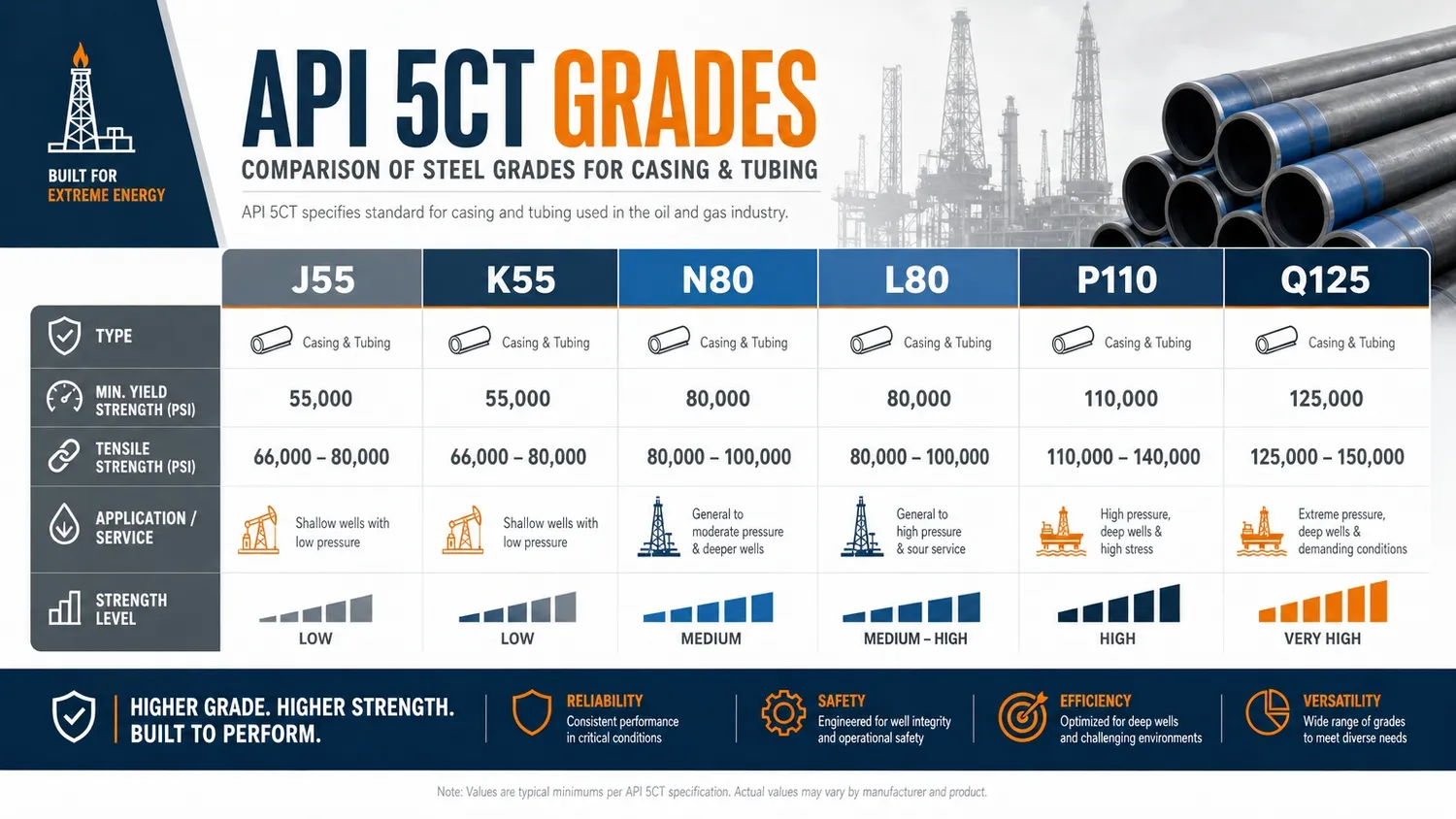
J55 / K55 |
55 ksi |
Common lower-strength routes; do not treat the two grades as automatically interchangeable because tensile requirements, end-finish availability and project approvals can differ. |
|
N80-1 / N80-Q |
80 ksi |
Strength is similar, but heat-treatment condition and resulting properties differ. State the required N80 type rather than ordering only 'N80'. |
|
L80-1 |
80 ksi |
Restricted yield/hardness route often considered for defined sour-service conditions; qualification still depends on the governing project and ISO 15156/NACE requirements. |
|
L80 9Cr / 13Cr |
80 ksi |
Used where corrosion resistance is required, but metallurgy must be selected from the actual fluid chemistry, temperature and compatibility limits. |
|
C90 / T95 |
90 / 95 ksi |
Controlled-strength grades for defined demanding or sour-service applications; confirm hardness, chemistry, heat treatment and qualification requirements. |
|
P110 |
110 ksi |
Common high-strength route for deeper or higher-load wells; high strength alone does not demonstrate sour-service suitability. |
|
Q125 |
125 ksi |
Very high-strength route for demanding load cases; requires engineering confirmation and careful service qualification. |
Is C95 an API 5CT grade? No. The API Spec 5CT 11th Edition Addendum 1 scope lists C90, R95 and T95, but not C95. If C95 appears in an inquiry, confirm whether it is a typo, a proprietary designation or a project-specific material before quoting.
Can J55 and K55 be treated as interchangeable? No. They share the same minimum yield strength, but tensile requirements, permitted product forms, end finishes and project approvals may differ. Quote the specified grade unless an approved substitution is documented.
Is N80-1 the same as N80-Q? No. Both use an 80 ksi minimum yield level, but the type and heat-treatment route are part of the product definition. The RFQ and PO should identify N80-1 or N80-Q rather than using only N80.
Does L80 automatically qualify for sour service? No. L80 type, hardness, chemistry, manufacturing route and the actual H2S environment must be checked against the project requirements and the applicable ISO 15156 qualification route.
Is P110 or Q125 always the better choice because it is stronger? No. Higher strength can help a defined load case, but it may change hardness, toughness, connection behavior, sour-service suitability, availability and cost. Selection remains an engineering decision based on the full service envelope.
A higher grade is not automatically a better grade. Well loads, yield-strength limits, hardness, corrosion mechanism, temperature, connection performance and material qualification must be considered together. The purchase order should state the full grade and type, not only a commercial shorthand.
|
Connection / Delivery Form |
Product Family |
Buyer Confirmation |
|
Plain end |
Casing or tubing before threading / special processing |
End preparation, further processing responsibility and protection |
|
Threaded and coupled |
Standard coupled casing or tubing |
Exact thread, coupling grade/type, handling tightness, protectors and thread compound |
|
STC / LTC / BTC |
Casing |
Connection size, coupling, thread inspection, joint strength and whether the design requires enhanced leak resistance |
|
NUE / EUE / IJ |
Tubing |
Upset/integral configuration, coupling details, drift and completion compatibility |
|
Premium / proprietary |
Casing or tubing |
Exact licensed design, approved threading source, drawing, gauges, qualification, make-up procedure and field compatibility |
Connection performance depends on more than the thread name. Leak resistance and running reliability can be affected by geometry, material pairing, machining control, thread inspection, compound, storage, protector condition, make-up torque and field handling. A premium connection should therefore be specified by exact licensed designation, not by the generic word 'premium'.
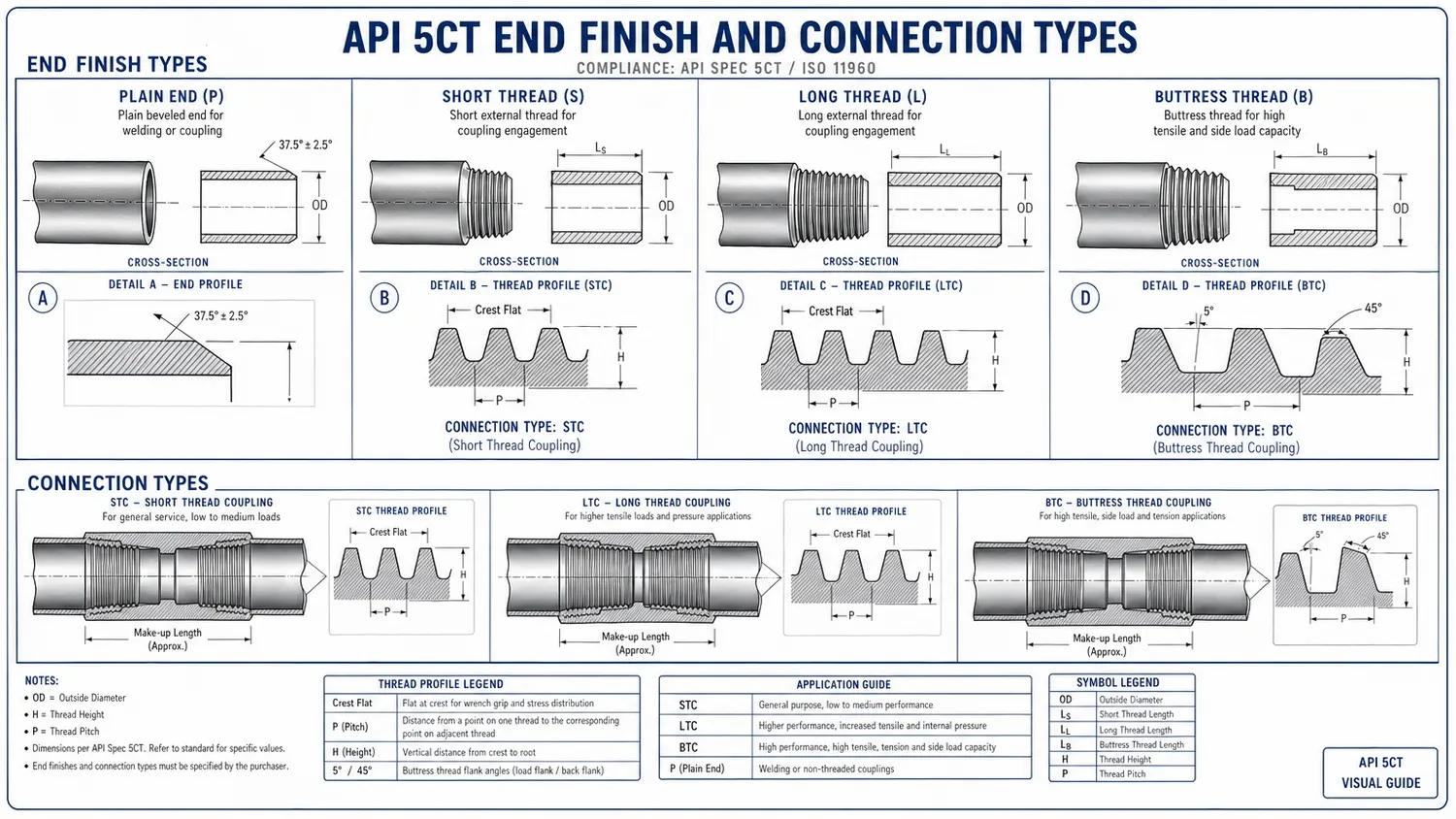
For demanding connection requirements, compare API threads and premium connections against the required clearance, joint performance and qualification documents.
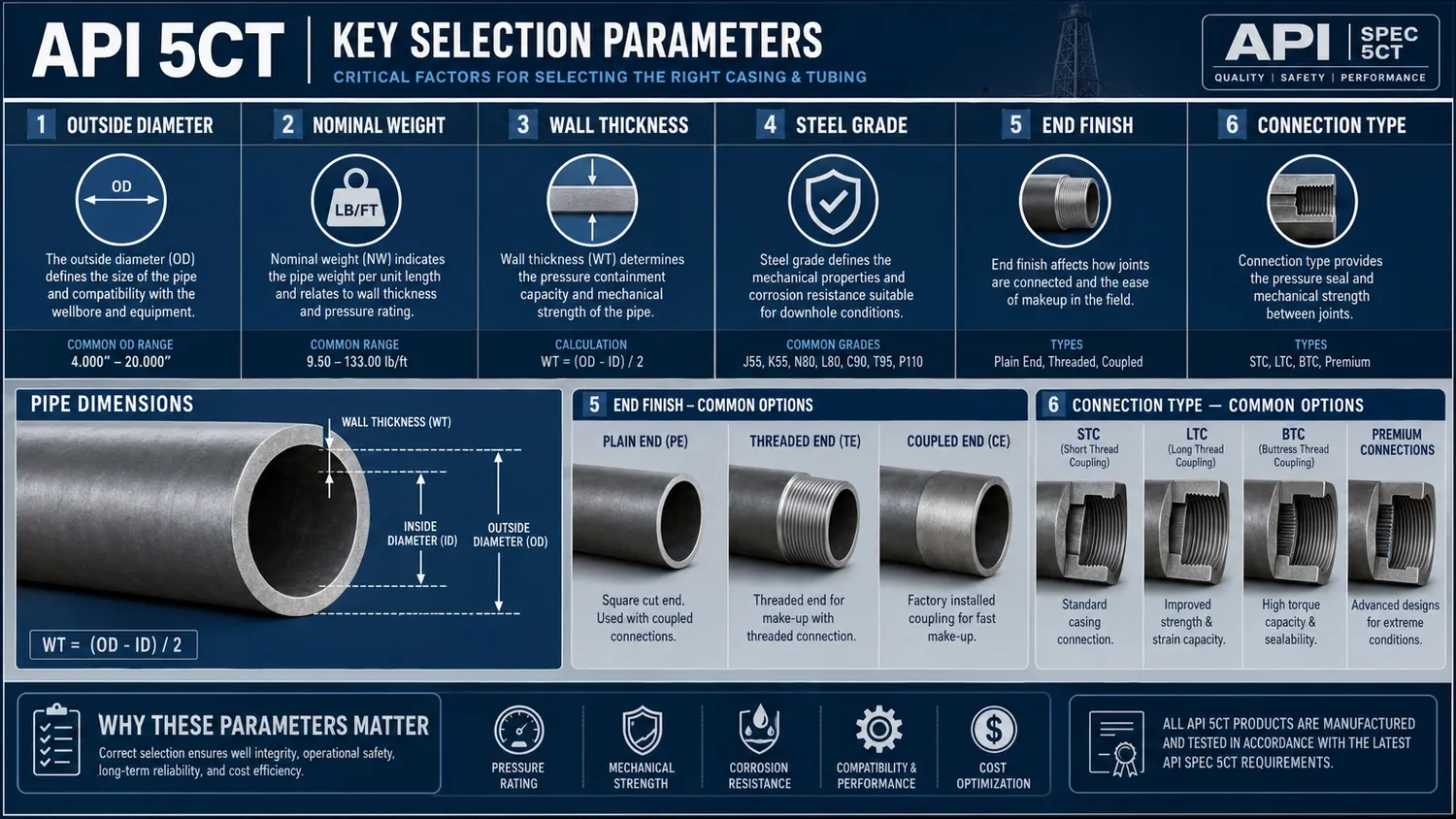
OD and nominal weight identify the standard tubular line item, while wall thickness and nominal inside diameter describe the pipe body geometry. Nominal ID can be approximated from OD minus twice the wall thickness, but it is not the same as the guaranteed drift clearance. Drift diameter is the acceptance value used to confirm that the specified mandrel or downhole tool can pass through the product.
· Do not size completion tools from nominal ID alone; specify and verify the applicable drift requirement.
· Confirm whether quoted mass is plain-end mass or threaded-and-coupled mass before comparing suppliers.
· Request coupling OD and length when handling clearance, rack layout, container loading or wellsite storage depends on overall dimensions.
· State both imperial and metric units in the quotation schedule to prevent conversion errors.
· Record the data source and governing standard edition for any size/weight table used in the PO.
1. Define the product role and well section. Identify surface, intermediate or production casing, liner, production tubing, injection tubing or workover service before requesting a grade.
2. Provide the design and service envelope. Include depth, pressure, temperature, collapse/burst/tension requirements, H2S/CO2, chlorides, injection chemistry and expected intervention conditions.
3. Confirm dimensions as one controlled line item. State OD, nominal weight, wall thickness, nominal ID, drift, length range and tolerance requirements using consistent units.
4. Specify grade and manufacturing route. Name the full grade/type and state whether seamless or electric-welded supply is permitted by the project.
5. Specify the connection and coupling package. Separate casing connections from tubing connections and identify licensed proprietary connections precisely.
6. Agree the inspection and release package before production or stock release. Late requests for thread gauging, witness points, drift evidence or packing records are costly to recover after bundling.
The inspection plan should follow the product family, manufacturing route, grade/type, end finish, governing API 5CT edition and the approved PO or ITP. The buyer should be able to trace each release record back to the supplied heat, lot, joint or bundle as required by the project.
|
Control / Evidence |
What It Should Confirm |
Buyer Release Use |
|
Manufacturing route and heat treatment |
Seamless or electric-welded route, heat-treatment condition and consistency with the approved source and grade/type. |
Confirms that the quoted and produced route matches the PO. |
|
MTC / material certificate |
Heat number, grade/type, chemistry, mechanical properties, heat treatment and traceability. |
Material approval and receiving verification. |
|
Dimensional report |
OD, wall thickness, length, straightness, mass and tolerances as applicable. |
Confirms that the supplied item matches the ordered line item. |
|
Drift record |
Required mandrel or clearance basis and the recorded result. |
Tool passage and bore acceptance. |
|
Hydrostatic and NDT records |
Applicable method, product coverage, acceptance basis, calibration and result. |
Verifies the agreed standard and PO inspection scope. |
|
Thread and coupling inspection |
Thread form and gauging, coupling condition, cleanliness, compound and protectors. |
Connection release before final packing. |
|
Marking and tally |
Joint identity, heat or lot traceability, length and bundle mapping. |
Receiving, inventory and installation control. |
|
Packing and loading evidence |
Protectors, bundling, lifting arrangement and container or vessel loading. |
Transport protection and final-payment release. |
|
NCR or concession record |
Nonconformance, disposition, responsible approval and closeout status. |
Prevents unapproved deviations from being hidden in shipment. |
NDT and hydrostatic testing should be described according to the governing standard, manufacturing route, grade and purchase-order requirements. Avoid blanket statements such as '100% NDT' unless the method, coverage and acceptance basis are actually defined and documented.
· Product role: casing string/liner or tubing service and well section.
· Governing standard: API Spec 5CT edition plus applicable addenda/errata; API Spec 5B or exact proprietary connection specification where relevant.
· Dimensions: OD, nominal weight, wall thickness, ID/drift requirement, length range and unit basis.
· Material: complete grade/type, heat-treatment condition and permitted manufacturing route.
· Connection package: thread designation, coupling type/grade, protectors, compound and premium-connection license/source if applicable.
· Service data: design pressure/temperature, H2S, CO2, chlorides, fluid chemistry, injection or production duty and corrosion-control strategy.
· Design requirements: collapse, burst, tension/compression, connection capacity and any project-specific performance criteria supplied by the responsible engineer.
· Inspection plan: witness/hold points, dimensions, drift, hydrotest/NDT scope, thread gauging and third-party inspection.
· Document package: MTC, inspection reports, tally, marking list, packing list, photos and deviation/NCR closeout.
· Logistics: bundle limits, lifting points, protectors, corrosion protection, container/vessel restrictions and delivery sequence.
When preparing the accessory list, include couplings, pup joints and crossovers in the order with their matching sizes, grades, connections and inspection requirements.
Use the well programme to distinguish the roles of casing strings and liners. For the production or injection conduit, review the tubing enquiry and service-condition checks before choosing size, grade and connection.
A complete API 5CT order connects dimensional data with the required grade, connection and load decisions. The final purchase line must bring those decisions together without treating one reference value as a complete design.
| Order block | Required entries | Related decision |
| Product | Casing or tubing, OD, nominal weight, range and quantity | Geometry and tally |
| Material | API 5CT edition, grade and type, heat treatment | Service and load review |
| Ends | Thread designation, coupling, special clearance or approved proprietary connection | Compatibility and performance |
| Release | MTC, drift, hydrotest, NDT, thread inspection, marking and packing records | Inspection dossier |
Forever Steel can reconcile this controlled line item against the API 5CT casing or API 5CT tubing supply scope before quotation. Well design, corrosion suitability and connection performance remain engineering approvals, not assumptions made from the grade name.
API 5CT casing and tubing selection requires a controlled chain from well duty to product description, dimensions, grade/type, connection, inspection and release evidence. Correctly defining those items reduces quotation gaps, unsuitable substitutions, thread incompatibility, drift problems and document delays at shipment.
Forever Steel supports international oil and gas projects with API 5CT casing, tubing and related OCTG accessories. Quotations can be prepared against the buyer's confirmed edition, dimensions, grade/type, connection, service condition, inspection scope, document package and export-packing requirements.
Continue with these closely related Forever Steel technical resources:
API Specification 5CT, 11th Edition — Casing and Tubing — American Petroleum Institute.
API Specification 5B — Threading, Gauging and Inspection of Casing, Tubing and Line Pipe Threads — American Petroleum Institute.
ISO/TR 10400:2018 — Formulae and Calculations for the Properties of Casing and Tubing — International Organization for Standardization.
ISO 13679:2019 — Procedures for Testing Casing and Tubing Connections — International Organization for Standardization.
ISO 15156-2:2020 — Cracking-Resistant Carbon and Low-Alloy Steels for H₂S-Containing Oil and Gas Environments — International Organization for Standardization.
Casing Structural Integrity and Failure Modes in a Range of Well Types: A Review — peer-reviewed research examining casing loads, grades, connection failures, corrosion and well-integrity risks.
Internal Corrosion in Oil and Gas Wells During Casing and Tubing Service — peer-reviewed review supported by ADNOC and the National Research Foundation of Korea.
A Comprehensive Review of Well Integrity Challenges — peer-reviewed research covering casing connections, threaded-joint failure, corrosion, pressure and thermal loading.