+8615674993216
 sales@forever-steels.com
 English
 العربية

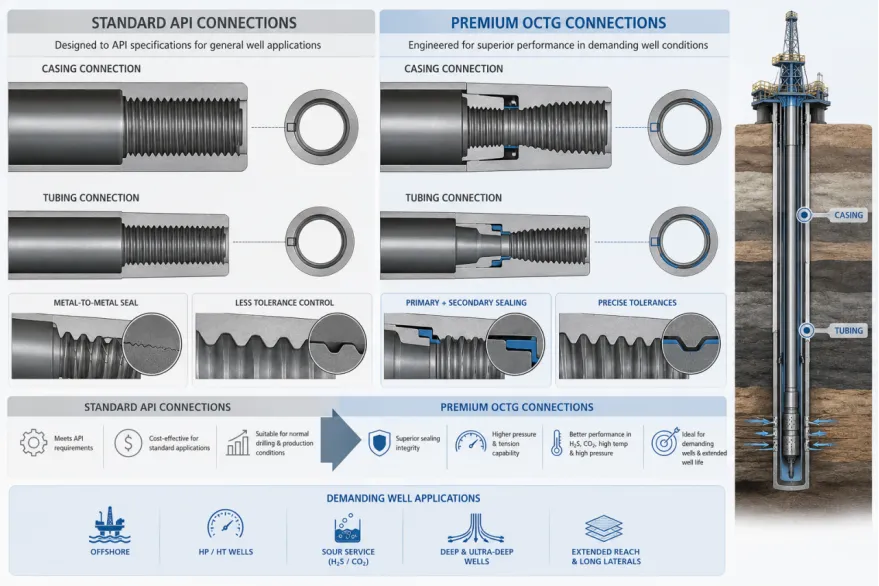
API 5CT connection types in this guide include standard casing threads (STC, LTC and BTC), standard tubing connections (NUE and EUE), and proprietary premium connections. Standard does not mean unsuitable, and premium does not mean universally stronger. Use the connection whose documented seal, load, clearance and running performance meets the approved well design.
Move from an API-standard thread to a premium OCTG connection when a defined gas-tight, combined-load, torque, cyclic or special-clearance requirement is not demonstrated by the proposed standard assembly. Forever Steel reviews these inputs for API 5CT casing pipe and API 5CT tubing pipe before the connection is quoted.
| Connection | Product family and configuration | What to confirm |
|---|---|---|
| STC / SC | Short round-thread casing. | Approved size/weight and coupling; joint strength and leak-resistance requirements for the defined casing load cases. |
| LTC / LC | Long round-thread casing. | Connection geometry and coupling; documented performance and any enhanced leak-resistance requirements specified by the project. |
| BTC / BC | Buttress-thread casing. | Applicable connection rating, coupling, handling and make-up requirements; a buttress designation alone is not proof of a gas-tight service envelope. |
| NUE / NU | Non-upset tubing. | Exact thread/coupling, joint performance, drift and compatibility with the completion and tools. |
| EUE / EU | External-upset tubing. | Upset and coupling envelope, connection rating, drift, clearances and permitted mating components. |
| Proprietary / premium | Exact manufacturer-defined casing or tubing connection. | Licensed designation, qualified size/weight/grade coverage, approved threading source, performance envelope and running procedure. |
SC/LC/BC and NU/EU terminology appears in standards; STC/LTC/BTC and NUE/EUE are common commercial descriptions. Confirm the precise designation and governing specification in the PO. A change in thread family is a technical substitution, not merely an alternative supplier description.
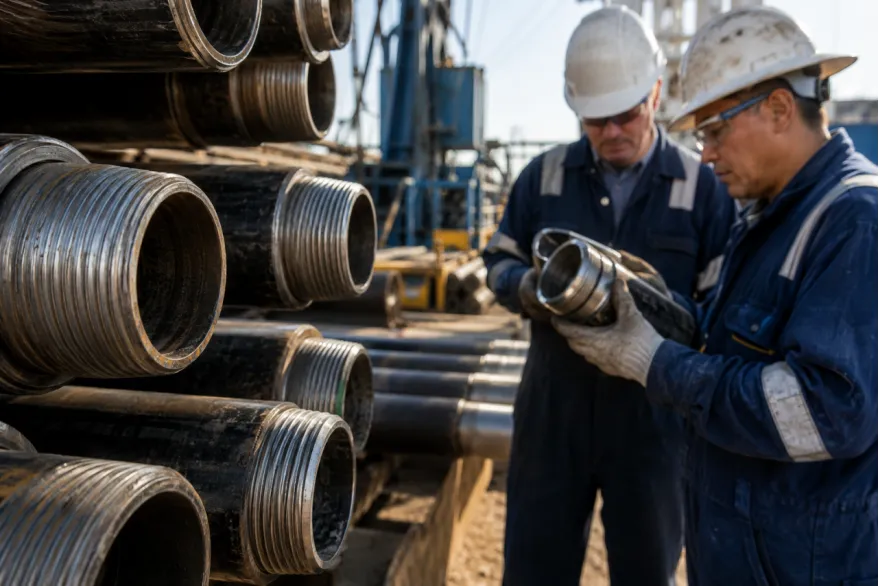
Start with the engineer-approved pressure, temperature, axial and sealing requirements, then compare the documented performance of the proposed assembly. The following conditions justify a closer review; none automatically proves that every well needs a premium connection.
| Design/service condition | Question requiring evidence |
|---|---|
| Gas containment or stringent leak limits | Does the proposed assembly demonstrate the required leakage acceptance under the relevant pressure/load sequence and test medium? |
| High combined loads | Do pressure, tension/compression, bending and temperature act together outside the documented connection envelope? |
| Thermal or pressure cycling | Is cyclic performance demonstrated for the planned operating, shut-in and intervention sequence? |
| Torque, rotation or difficult running | Is the connection approved for the required operational torque and field procedure, rather than assuming make-up torque is a rotation limit? |
| Tight completion or annular clearance | Do upset/coupling OD and bore/drift meet the actual clearance requirements? A slim profile must still have the required performance. |
| Existing proprietary completion | Is the offered connection exactly compatible with the installed design, drawings, accessories and approved source? |
Do not compare only maximum ratings in isolation. A headline pressure rating may not remain available under simultaneous axial or bending load. Ask for the relevant combined-load envelope and the basis used by the responsible engineer. Body strength and connection strength are related but separate checks.
Thread gauging and inspection verify that the supplied threads meet the required dimensional and inspection criteria. They do not, by themselves, demonstrate sealing and structural performance throughout a well-specific operating envelope.
ISO 13679:2019 addresses connection testing for galling tendency, sealability and structural integrity and supplements API RP 5C5:2017. Its scope does not cover every possible service condition; corrosive-fluid effects are specifically outside that test scope. A qualification report therefore cannot substitute for a sour-service materials assessment.
Where qualification is required, identify the test protocol/version, connection assessment level where applicable, tested size/weight/grade, sample/configuration and loading sequence. Have the engineer assess whether the evidence covers the offered item or whether additional validation is needed. A named qualification level is not a blanket rating for every size, grade or corrosive environment.
“Premium” is not an adequate line-item designation. A quotation should identify the exact connection name/version and tie its supporting data to the proposed tubular size, weight, grade and manufacturing/threading source.
| Evidence | Buyer acceptance check |
|---|---|
| Connection identity and drawing | Exact designation/version, pin/box and coupling configuration, upset/coupling OD, bore and mating-component requirements. |
| Performance data | Relevant pressure, axial, compression, bending, torque and temperature envelope; distinguish pipe-body values from connection values. |
| Qualification report | Applicable protocol and tested configuration; engineering acceptance of the coverage claimed for the offered size/weight/grade. |
| Approved supply source | Required license/authorization and approved threading/inspection facility. Do not assume a trader or mill can supply every proprietary design. |
| Manufacturing release | Material traceability, required thread inspection/gauge control and agreed inspection/ITP records. |
| Running package | Current approved procedure, compound or coating system, make-up limits, torque-turn criteria where applicable, handling restrictions and protector requirements. |
Manufacturers publish different connection geometries and performance envelopes for different duties. Such catalog data is a reference for evaluating an exact design, not evidence that Forever Steel supplies a particular licensed connection. Confirm actual availability and authorization before accepting a proprietary designation.
Only after a documented technical review and the required purchaser/engineering approval. Similar strength claims, a shared CAL designation or a similar thread appearance do not establish mating compatibility or full functional equivalence.
Check the offered drawing, seal system, coupled dimensions, performance envelope, qualification coverage, materials, accessories and field running requirements. Do not mix pin/box components or apply torque values from another design unless explicitly permitted by the connection owner and approved by the project. Use the premium-connection equivalency and running guide for the detailed review rather than accepting “premium equivalent” as a complete specification.
A tubing connection review must include production or injection conditions and the completion envelope, not only casing-style structural questions. Check maximum assembly OD against the available casing clearance and required bore/drift against the intervention tools. Confirm the specified coupling, accessories, compound and protector package.
The tubing dimensions, weight, drift and coupling-OD database helps identify the reference assembly data. For service inputs and grade/type control, see the production, injection and corrosive-service tubing checklist. Those checks should feed into the Tubing product inquiry as approved requirements, not unresolved assumptions.
For release of the ordered assembly, use the API 5CT pre-shipment inspection checklist. A manufacturing hydrotest, dimensional thread check and a connection qualification test are different evidence items; specify the required scope rather than treating one as a substitute for the others.
An API-standard thread has standardized geometry, gauging and inspection requirements. A premium connection is a proprietary system with manufacturer-specific thread, seal, shoulder, performance ratings and running procedure. The word premium is not proof that a proposed size, grade or service is qualified.
Use a premium connection when the approved design requires sealing, combined-load, compression, torque, cyclic or clearance performance that the proposed API-standard connection cannot document. Depth or high pipe grade alone is not a sufficient selection rule.
No single label proves the required strength for every order. LTC generally has longer round-thread engagement than STC, while BTC uses a buttress form, but the buyer must compare the documented connection rating for the exact casing size, weight, grade and load case.
Not automatically. EUE has an external upset and a different connection and coupling envelope; NUE is non-upset and may provide a slimmer outside profile. Confirm joint performance, maximum OD, drift, completion clearance, accessories and the approved mating components before changing the end finish.
No. Grade changes pipe material properties, but the connection geometry, seal, coupling and combined-load performance still require separate confirmation against the design.
No. BTC is a casing connection family; NUE and EUE are tubing configurations. Specify the exact product and connection rather than accepting a mixed casing/tubing description.
No. Obtain the underlying qualification coverage and assess service/material limits separately. ISO 13679 connection testing does not evaluate corrosive-fluid effects.
Treat the pipe body, pin, box or coupling, thread compound, make-up procedure and running equipment as one connection system. A name without manufacturer data, service envelope and assembly controls is not a complete selection. Forever Steel can coordinate the approved casing or tubing route through its OCTG product range, subject to actual manufacturing availability and project acceptance.
| Selection input | Standard connection review | When premium evidence may be needed |
| Loads | Axial and pressure duty within accepted ratings | Combined load, bending or compression envelope |
| Seal | Thread/compound sealing basis | Qualified metal-to-metal gas seal requirement |
| Geometry | Coupling OD, drift and clearance | Special-clearance or high-torque design |
| Operations | Approved gauging and make-up controls | Connection-specific torque turns and licensed support |
Forever Steel can quote standard casing and tubing connections with the required inspection records, or coordinate an approved proprietary route when specified. The operator or well engineer must accept the connection performance basis for the intended service.