+8615674993216
 sales@forever-steels.com
 English
 العربية

This API 5CT tubing selection guide begins with the operating envelope rather than a grade name. Before ordering tubing for production, injection or corrosive service, confirm the full grade and type, OD and nominal weight, connection, completion clearances and release documents. A grade label alone cannot establish pressure capacity, corrosion resistance or connection suitability.
For API 5CT tubing pipe procurement, the useful starting point is an approved line-item specification supported by the well engineer and materials specialist. Separate confirmed requirements from items still awaiting engineering approval; the supplier can then quote a defined product rather than infer the service from the word “production” or “injection”.
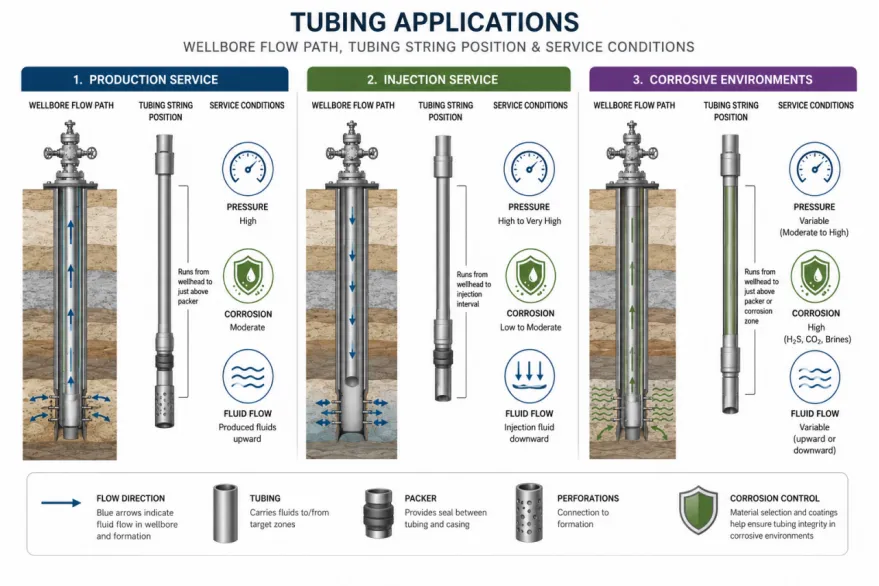
Production tubing carries fluids from the producing interval; injection tubing carries the specified injection fluid into the well. The same nominal size or grade can appear in both duties, but the pressure cycle, fluid chemistry, temperature profile and completion hardware may differ. Neither duty automatically requires a higher-strength grade or a premium connection.
| Service | Inputs to provide | Procurement consequence |
|---|---|---|
| Production | Expected fluid phases and rates; tubing and annulus pressures; operating/start-up/shut-in temperatures; sand; planned interventions. | Confirm bore/drift for tools, erosion/corrosion assessment, load cases and connection requirements. |
| Water or chemical injection | Fluid composition, dissolved gases and oxygen where relevant; treatment chemicals; maximum differential pressure; cycling and injection temperature. | Check material compatibility and pressure/thermal loading; do not substitute a grade based only on the injection label. |
| H2S/CO2-containing or other corrosive duty | H2S and CO2 partial pressures where relevant, water presence, pH, chlorides, temperature and the corrosion-control plan. | Obtain a documented materials assessment and applicable qualification requirements before accepting a grade or alloy. |
Depth is not a complete selection rule. The engineer should identify installation, operating, shut-in, pressure-test and intervention load cases, including internal/external pressure and axial loading where applicable. State the approved design requirements in the RFQ rather than asking the supplier to choose a grade from depth alone.

N80 Type 1 and N80Q are distinct material types, not different thread names. API 5CT Addendum 1 expressly identifies both within the N80 family. A purchase description that says only “N80 EUE” leaves the type unresolved: EUE defines the end configuration, not whether the tubing is Type 1 or Q.
| Item | N80 Type 1 / N80-1 | N80Q / N80-Q |
|---|---|---|
| Heat-treatment distinction | Normalized, or normalized and tempered. | Quenched and tempered. |
| Ordering description | State N80 Type 1 and the approved governing specification. | State N80Q and the approved governing specification. |
| Release evidence | Certificate identifying the type, heat-treatment condition, heat number and required test results. | Certificate identifying the type, heat-treatment condition, heat number and required test results. |
| Substitution control | Do not accept a change to N80Q solely because the quotation says “N80”. | Do not accept a change to Type 1 without the required technical and purchaser approval. |
Compare quotations against the same OD, nominal weight, wall, length range, connection and inspection scope before comparing price. Neither N80 type is automatically qualified for sour service, and a heat-treatment designation does not replace the corrosion or well-load assessment. Impact, hardness and other acceptance requirements must follow the governing edition, grade/type and purchase agreement.
Do not use “L80 for corrosion” or “P110 for higher pressure” as automatic selection rules. The complete grade/type, material condition and actual environment matter. Higher strength does not demonstrate resistance to sulfide stress cracking, CO2 corrosion or other damage mechanisms.
For H2S-containing service, have the responsible materials specialist define the applicable ISO 15156/NACE requirements and environmental limits. ISO 15156-2 addresses environment-related cracking of carbon and low-alloy steels, not general or localized metal-loss corrosion. For CO2-containing service, review water chemistry, temperature, corrosion allowance or inhibition strategy and alloy suitability. A corrosion-control plan and an approved material specification are different requirements; both may be needed.
NUE is non-upset tubing; EUE has an external upset at the end. Connection selection affects more than the pipe-body OD: review upset and coupling dimensions, connection performance, drift and compatibility with the completion equipment. Do not assume that equal pipe OD makes NUE and EUE assemblies interchangeable.
Use the API 5CT tubing dimensions, weight and drift database to check the relevant size/weight line and coupling-OD reference. Confirm the final values against the governing specification and supplied connection drawing. Nominal ID is a geometry value; it is not a substitute for the required drift clearance.
| Evidence | What the buyer should verify |
|---|---|
| MTC and traceability | Specified edition, grade/type, heat-treatment condition, heat/lot identity and required chemical/mechanical results match the PO. |
| Dimensions and drift | OD, wall, length/mass basis and agreed drift requirement match the approved line item; retain the applicable inspection results. |
| Hydrostatic test and NDT | Method, scope, acceptance basis and results meet the governing product and PO requirements. Body testing alone does not qualify a connection for every well load. |
| Thread and coupling inspection | Correct designation, gauge/inspection basis, coupling condition, component identity and protector condition. |
| Tally and packing | Joint lengths/identities, bundle mapping, protectors, packing limits and loading evidence agree with receiving and handling needs. |
| Deviations | Close nonconformances and approve any substitutions or concessions before shipment. |
Agree hold/witness points before manufacture or stock release. For a detailed release sequence, use the API 5CT pre-shipment inspection checklist; do not add vague blanket requirements such as “100% NDT” without defining the method, coverage and acceptance basis.
Provide: quantity; API 5CT edition and applicable addenda/errata; OD; nominal weight and mass basis; wall; required drift; full grade/type such as approved N80Q; permitted manufacturing route; length range/distribution; exact NUE/EUE or proprietary connection; coupling/accessory scope; protectors; inspection/ITP requirements; document package; delivery location and packing limits. Attach the approved service/material requirements where applicable.
If the standard is API 5CT 11th Edition, do not carry over an unexplained PSL1/PSL2 label from an older template. API removed the former PSL framework; additional requirements must be stated against the selected edition and purchase agreement. Keep unresolved design conditions clearly identified rather than using a generic grade as a placeholder.
The two types should not be treated as an uncontrolled substitution. Clarify the required type and obtain the purchaser/engineering approval before order placement; make the quotation, PO, certificate and supplied markings consistent.
No. The approved connection must meet the actual pressure, axial, thermal and sealing requirements. Conversely, the word “injection” alone does not justify a premium connection. Specify and compare the required performance and supporting evidence.
It establishes specified product compliance, not blanket fitness for every corrosive well environment. Service approval also needs the environmental data and applicable materials/qualification assessment.
A tubing order should translate the operating envelope into a product description that purchasing, the supplier and the well engineer read the same way. The minimum review links service conditions to size, grade and type, connection, completion clearance, testing and the release dossier.
The table below shows which operating inputs must be resolved before a quotation can be compared on a like-for-like basis.
| Input | Procurement effect | Approval owner |
| Production or injection duty | Fluid, pressure, temperature and operating-cycle basis | Well or production engineer |
| CO2, H2S, chlorides and water chemistry | Materials review, corrosion allowance, inhibition or CRA decision | Materials or corrosion engineer |
| Depth and mechanical loads | Grade, nominal weight and burst, collapse and tension checks | Completion or well engineer |
| Completion geometry | OD, drift, coupling OD, tool clearance and accessory compatibility | Completion engineer |
| Connection duty | NUE, EUE or approved proprietary connection and gauging scope | Well engineer and connection owner |
| Release package | MTC, tally, drift, hydrotest, NDT, thread inspection and marking records | Buyer inspection authority |
Corrosive service cannot be accepted from the grade name alone. The environment, stress state, temperature, material condition, connection and the project’s governing corrosion standard must be reviewed together. Items awaiting engineering approval should remain visibly open rather than being inferred by the supplier.
When Forever Steel reviews an API 5CT tubing pipe inquiry, a complete line item includes OD, nominal weight, grade and type, range, connection, quantity, service limits and required records. That line item can then be checked against the well design before production release.