+8615674993216
 sales@forever-steels.com

 English
 العربية


L80 Type 1 and L80 13Cr share an 80 ksi minimum yield-strength designation, but they are different material systems. Super 13Cr is a family of manufacturer-specific materials, not one uniform API 5CT grade. Equal or higher strength does not establish interchangeability: the proposed tubing must also meet the corrosion, cracking, connection and operating requirements of the well. [1–4]
For an API 5CT tubing pipe inquiry, specify the full grade and type before comparing quotations. An offer stating only “L80” or “13Cr equivalent” leaves important material requirements unresolved. This guide explains what changes the choice and what a buyer should request before approving a replacement.
The useful question is not which material is universally best. It is whether a named material, in the supplied condition, has a documented basis for the expected exposure throughout the well life. Keep material approval separate from dimensional conformity and from the commercial availability of the proposed item.
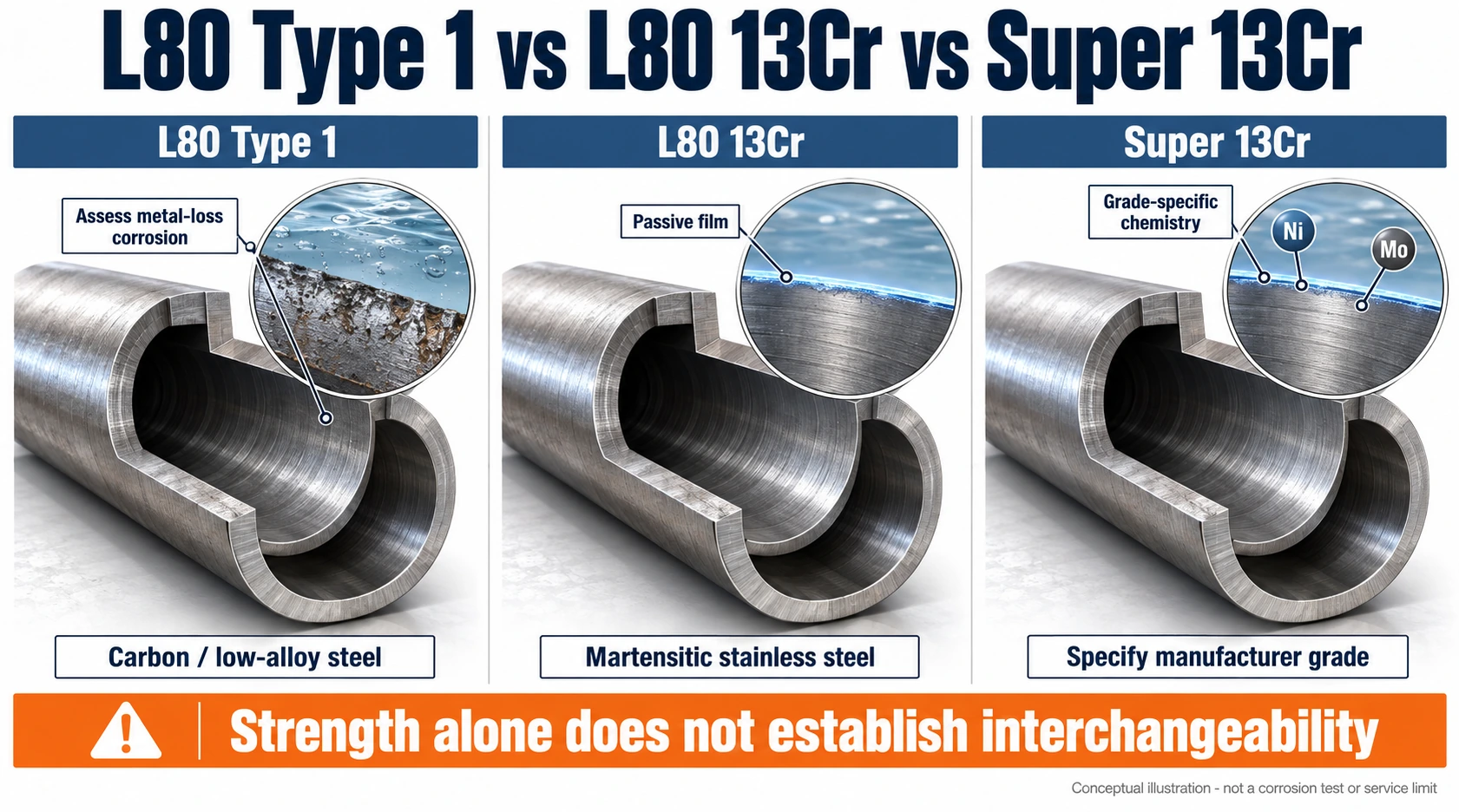
Figure 1. Conceptual illustration, not comparative test specimens; the passive-film sketch does not imply immunity to corrosion. [1–4]
| Comparison | L80 Type 1 | L80 13Cr | Super 13Cr |
|---|---|---|---|
| Material identity | Carbon or low-alloy steel route | Conventional martensitic stainless steel | Proprietary alloy family; identify the manufacturer grade |
| Strength basis | 80 ksi minimum yield | 80 ksi minimum yield | Grade-specific; do not assume 80 ksi |
| Corrosion decision | Assess metal loss and the corrosion-control plan separately | Assess wet CO₂ conditions and limits for local attack or cracking | Check the named material against all environmental conditions |
| Specification | API 5CT edition and exact type | API 5CT edition and exact type | Manufacturer specification plus applicable product standard |
| Substitution evidence | Approved material condition and project requirements | Environment-specific acceptance basis | Exact grade, qualification evidence and purchaser approval |
Table 1. Comparison framework, not an approval matrix. API strength data are reported by Nippon Steel; proprietary designations and performance remain manufacturer-specific. [1–4]
Table 2 gives the usual starting logic for a shortlist. It narrows the options; it does not replace the project’s materials assessment.
| Material | Typically considered when | Confirm before purchase |
|---|---|---|
| L80 Type 1 | Corrosion can be managed with a corrosion allowance, inhibition or another approved control plan | Metal-loss prediction, the corrosion-control plan and the approved material condition |
| L80 13Cr | Wet CO₂ service where conventional 13Cr has a documented basis | Chloride, temperature and H₂S exposure against the supplier’s qualified range |
| Super 13Cr (named grade) | Chloride or temperature conditions beyond the evaluated range of conventional 13Cr | Exact manufacturer grade, qualification evidence and purchaser approval |
Table 2. Starting logic for a material shortlist, not an approval matrix. [2–4]
The L80 designation describes a strength class within the applicable specification. It does not make Type 1 and 13Cr the same metallurgy. Nippon Steel lists L80-1 and L80-13Cr with the same 80–95 ksi yield range, while its SM13CRS-110 sheet specifies 110–125 ksi. These are identified product values, not a common strength range for every Super 13Cr material. [1,3]
A stronger pipe body cannot compensate for an unqualified corrosion environment.
Do not assume that “modified” and “super” mean the same thing. Nippon Steel identifies SM13CRM as Modified 13 Chrome and SM13CRS as a separate material series. Vallourec likewise separates Modified 13Cr and Super 13Cr in its portfolio. Ask the supplier to translate the commercial description into an exact designation and controlled data sheet. [2–4]
The distinction is not simply “more chromium.” Vallourec describes nickel and molybdenum enrichment in its Super 13Cr series relative to Modified 13Cr. That chemistry is part of the reason for different corrosion behavior. Compare the named alloy and supplied condition, not only the Cr percentage on the certificate. [4]
Product-standard compliance and environmental suitability answer different questions. For a proprietary CRA offer, obtain the proposed standard, material category, manufacturer specification and revision rather than insisting that every alternative must be described as an API 5CT L80 type. Review edition wording through the API 5CT 11th vs 10th edition changes article. [7]
Wet CO₂ exposure can cause general or localized corrosion. Conventional 13Cr relies on a protective passive film, but chloride concentration and temperature affect its performance. Nippon Steel developed SM13CRM to extend the application domain beyond conventional L80-13Cr; this does not establish a universal boundary for all modified alloys. [2]
For procurement, request conditions as a set. A CO₂ percentage without the pressure basis, or a chloride result without its units and sampling context, is not enough to reproduce an assessment. Record water availability, pH basis, gas partial pressures and the temperature profile. Identify what can change after water breakthrough or during later field life.
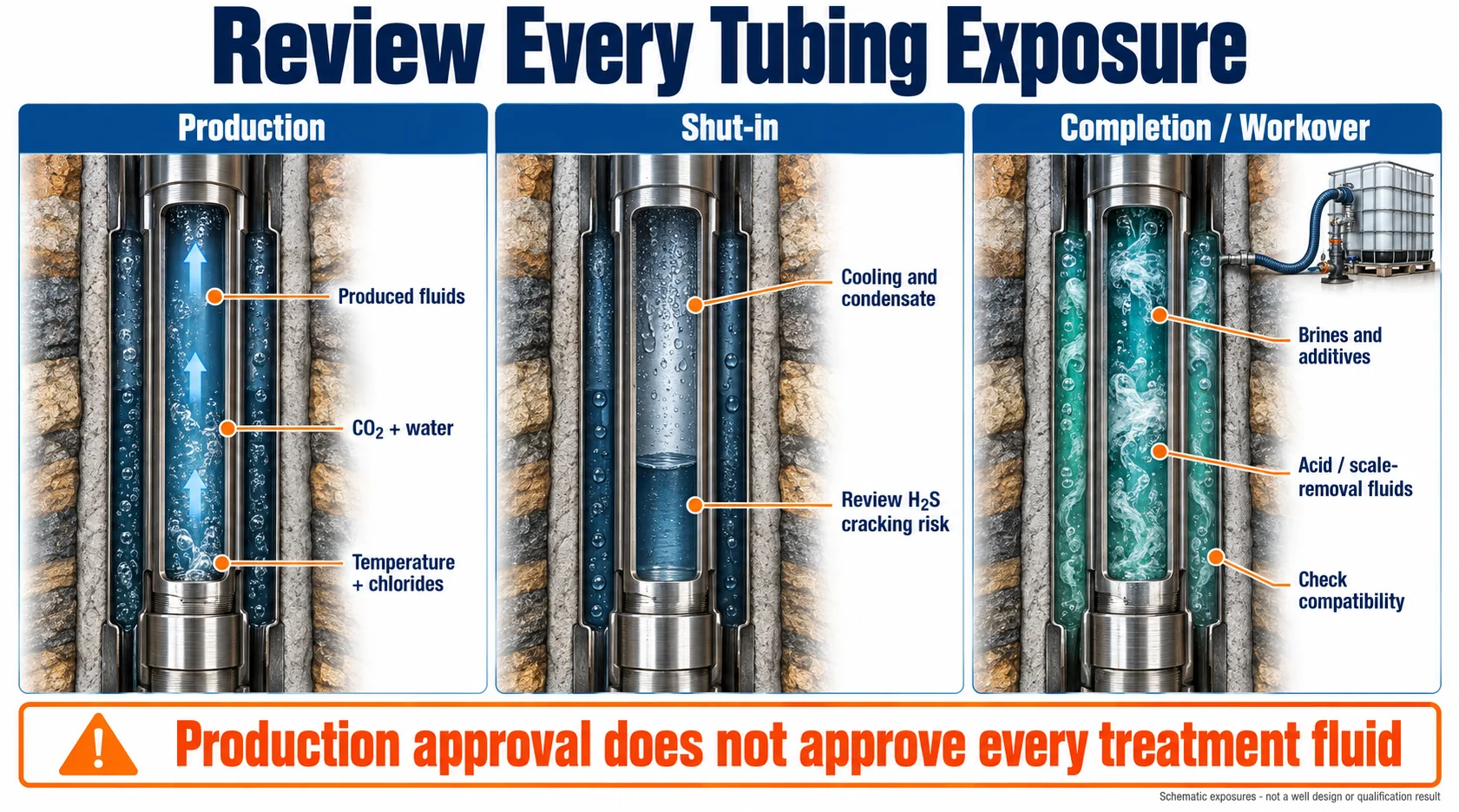
Figure 2. Production, shut-in and intervention exposures require separate review. Fluid paths and equipment are schematic; the panels do not prescribe a completion design or a fluid program. [3–5]
Suppose L80 13Cr was approved using an early water analysis, but an updated forecast predicts a higher chloride concentration. The purchasing action is to reopen the environmental review against the revised forecast. Do not simply add “Super” to the purchase line. Request the specific candidate grade, its supporting evidence and any operating restrictions before accepting a revised offer.
Keep the original load calculation and the revised materials assessment together so a change in one does not silently invalidate the other.
A supplier may send a graph showing good performance at a particular temperature. Before using it as an acceptance value, establish whether it reports a typical result, a qualification test or a contractual guarantee. The graph must describe the material and relevant exposure conditions; a temperature copied without that context is not a service limit.
| Check on the source | What to record |
|---|---|
| Material | Exact grade, strength level, condition and manufacturer |
| Environment | Water or brine composition, concentration units, gas partial pressures and pH basis |
| Exposure | Temperature, duration, applied stress and test method where relevant |
| Result | Mass loss, maximum/local attack or cracking result; do not interchange endpoints |
| Acceptance | Criterion, qualification scope, restrictions and approving authority |
Table 3. Checks on a supplier’s published limit or chart before using it as an acceptance value.
Nippon Steel’s SM13CRS sheet describes a comparison using 5% NaCl, 3.0 MPa CO₂ and 0.001 MPa H₂S. It discusses performance up to 180°C against a 0.1 mm/year corrosion-rate criterion. Those conditions belong to that manufacturer’s comparison. They do not establish 180°C as a guaranteed operating limit for every Super 13Cr product or every brine. [3]
If the underlying test duration, specimen condition or other qualification details are absent from a public chart, request them before relying on the result. A low average mass-loss rate alone does not answer a separate question about pits or cracking.
If none of the proposed materials has an acceptable basis for the well, the next step is a revised engineering selection. That may involve a different CRA family or a different corrosion-control approach. The buyer should record the unresolved condition rather than accept “the highest alloy available” as a substitute for qualification.
Resistance to wet CO₂ metal loss does not establish resistance to H₂S-related cracking. ISO 15156-3 addresses cracking-resistant CRAs and other alloys; its scope does not cover general or localized metal-loss corrosion. A “NACE compliant” statement therefore needs its material, environmental and qualification basis, as well as a separate corrosion assessment. [6]
Vallourec distinguishes high-temperature production risks from lower-temperature shut-in conditions, including condensate exposure. That is a useful reason to ask for both operating and shut-in cases: a review made only at bottomhole production temperature can omit a different controlling exposure elsewhere in the string. [4]
Nippon Steel specifically calls for compatibility checks with completion and packer brines, additives, acidizing fluids and scale dissolvers. Its handling guidance also flags oxygen-plus-chloride exposure and iron contamination. These are separate considerations from the nominal tubing grade. [3,5]
The RFQ table later in this guide lists the fluid, gas and treatment information to request. Do not infer a safe or unsafe verdict from a salt name alone, or assume that an inhibitor makes every treatment acceptable; obtain the fluid supplier’s and materials specialist’s documented basis for the actual package.
A proposed alternative should be assessed as a complete tubing item. The review must preserve the required well function, not merely match the printed grade number. Use a written deviation request so the original requirement, proposed change and approving parties remain traceable.
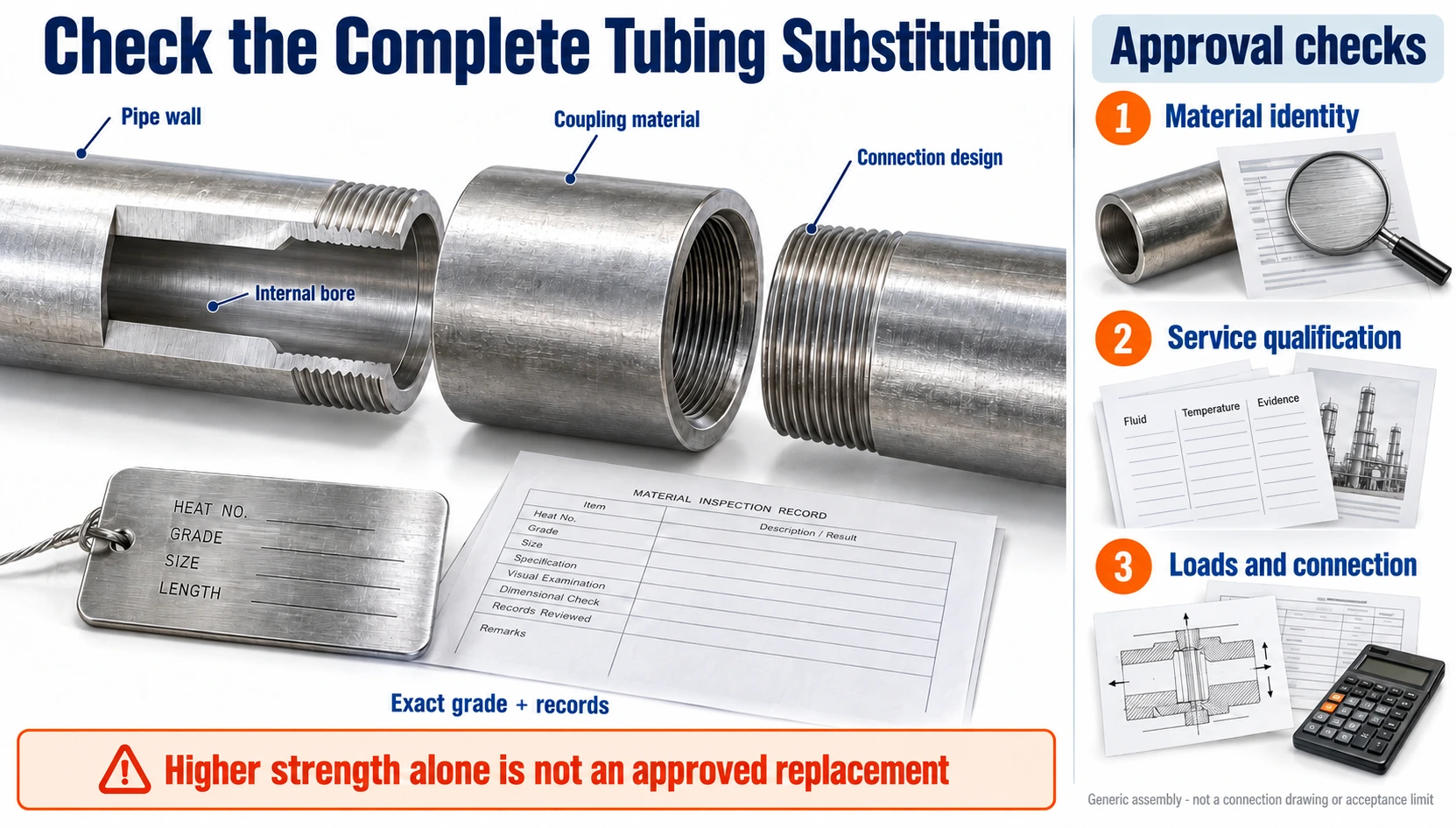
Figure 3. Review pipe body, coupling, connection and supporting records together. The generic assembly is not a connection drawing or an approval of interchangeability.
| Review area | Evidence to compare |
|---|---|
| Material identity | Manufacturer designation, specification revision, heat treatment and material certificate |
| Service qualification | Applicable corrosion and cracking evidence for the actual environmental envelope |
| Mechanical design | Required strength range, temperature basis and approved burst, collapse and axial-load checks |
| Connection and assembly | Exact connection, coupling/accessory materials, dimensions, qualification and running requirements |
| Release control | Written approvals, amended PO, inspection scope and traceable shipment documents |
Table 4. Evidence to compare when reviewing a proposed tubing substitution.
Use the tubing dimensions and drift database for the dimensional review and the premium and equivalent connection thread types guide for the connection discussion. Equal nominal OD does not establish the same complete assembly or tool clearance.
Send the approved material requirement with a service-data attachment. Where a condition is still being established, identify it as pending and name the responsible approval owner. This lets the supplier distinguish a budgetary option from a technically approved order.
| RFQ field | What the buyer should state |
|---|---|
| Product line | Quantity, OD, nominal weight or wall, mass basis, length range and required drift |
| Material | L80 Type 1, L80 13Cr or the exact proprietary designation; governing specifications and revisions |
| Fluid and water | Produced/injected fluid, water phase, chloride concentration with units, pH basis and relevant contaminants |
| Gas exposure | CO₂ and H₂S partial pressures, pressure basis and expected variation |
| Operating cycle | Production, shut-in, restart and intervention temperature/pressure cases; expected service life |
| Treatment fluids | Completion/packer brines, additives, acids or scale-removal fluids and contact conditions |
| Connection package | Exact connection, coupling and accessory requirements; approved drawings where applicable |
| Evidence and release | Required material and qualification records, inspection plan, traceability and approval of deviations |
Table 5. RFQ fields that make tubing offers comparable.
A useful commercial comparison keeps dimensions, connection, approved source, testing and delivery scope constant. Ask each bidder to state what is included and what remains conditional. Otherwise a lower pipe price can conceal a different connection, incomplete qualification evidence or an excluded inspection package.
Do not assume a fixed percentage premium for Super 13Cr without comparable live quotations. Nor should a longer service life be assumed from the alloy label alone. The economic decision should use the project’s corrosion-control costs, intervention consequences and approved life assumptions.
For the wider ordering sequence, see the tubing selection for production, injection and corrosive service guide.
No. Their API yield-strength range can match, but the material types are distinct. Specify the full type and assess environmental suitability separately. [1]
Super 13Cr is a manufacturer-specific family, while L80 13Cr is the conventional martensitic stainless type. Vallourec describes nickel and molybdenum enrichment in its Super 13Cr series relative to Modified 13Cr, and strength levels are grade-specific; Nippon Steel’s SM13CRS-110, for example, is specified at 110–125 ksi yield. Compare the exact manufacturer grade and its data sheet rather than the family name. [3,4]
Do not use it as one. It is a family description that needs an exact manufacturer designation and applicable specification. Check the offered strength level and qualification basis. [3,4]
Not universally. Nippon Steel and Vallourec distinguish modified and super series. Use the manufacturer’s data sheet rather than assuming commercial names are equivalent. [2–4]
A grade name alone cannot answer that. Review the specific material and its qualified environment under the applicable cracking-resistance requirements, together with the separate metal-loss assessment. [6]
There is no single value. Conventional 13Cr performance depends on chloride concentration, temperature and the rest of the exposure set, and manufacturers publish limits against specific test conditions. Request the data sheet and qualification basis for the exact grade and have the responsible materials engineer check it against the well forecast. [2,3]
There is no single value that this family name establishes. Ask for the boundary applicable to the exact grade, temperature, pH, gas exposure and acceptance criteria. Do not transfer a test value between alloys. [3,4]
Do not assume so. Recheck the full brine/additive or treatment package against the new material and planned contact conditions. A production-service approval is not a completion-fluid approval. [3,5]
Choose tubing from the approved service envelope, then verify the complete product. L80 Type 1, L80 13Cr and a specified Super 13Cr material should only be compared after their identities, corrosion requirements, strength basis and connection scope are clear. Resolve changes in water chemistry, shut-in exposure and treatment fluids before approving a substitution.
Send Forever Steel the approved grade/type, dimensions, connection, quantity and required records for a defined API 5CT tubing inquiry. If a proprietary CRA is specified, include its exact designation and qualification requirements so the proposed supply scope can be checked before quotation. Final materials selection remains with the responsible project engineers.
API 5CT Casing and Tubing Complete Guide
API 5CT Couplings Pup Joints and Crossovers
[1] Nippon Steel — API material grades
L80-1 and L80-13Cr mechanical-property reference.
[2] Nippon Steel — SM13CRM-110 material data sheet
Modified 13Cr identity and comparison with conventional L80-13Cr.
[3] Nippon Steel — SM13CRS-110 material data sheet
Specific Super 13Cr grade, environmental considerations and illustrative test conditions.
[4] Vallourec — 13Cr and Super 13Cr
Grade-family distinctions and production/shut-in corrosion mechanisms. Legacy PSL wording on this page is not used as current API 5CT ordering guidance.
[5] Nippon Steel — Handling and Running Best Practices for High Alloy Materials
G2593R9, August 2015. Handling, contamination and fluid-compatibility context; obtain the applicable current procedure for supply.
[6] ISO 15156-3:2020 — Cracking-resistant CRAs and other alloys
Scope of CRA selection and qualification for H₂S-related cracking; not a general/localized corrosion guarantee.
[7] API — Specification 5CT 11th Edition
Product-standard reference; orders must state their governing edition and applicable updates.
Sources checked 18 October 2026. Illustrations are original explanatory schematics, not test data. Manufacturer examples do not constitute Forever Steel supply guarantees or project-specific material approval.