+8615674993216
 sales@forever-steels.com

 English
 العربية


Seamless steel pipe is made by creating and working a hollow steel product without a longitudinal manufacturing weld. Rotary piercing followed by rolling is one important route; extrusion and other hot-working systems provide alternatives. Cold drawing or cold pilgering may then refine a previously formed hollow. The final product must still meet its ordered dimensions, material condition and inspection requirements.
For procurement, the useful question is how a proposed route will produce the required pipe, not which mill name sounds most advanced. A route affects the available diameter and wall combinations, dimensional consistency, surface condition, processing passes and delivery schedule. It does not independently establish compliance with ASTM A106, ASTM A335, API 5L or an EN product specification. State the standard, grade, dimensions, delivery condition and testing when requesting seamless steel pipe.
Three different questions are often mixed in a quotation. How was the hollow created? How was it elongated and sized? What happened after hot working? A description such as cold drawn answers the third question, but may leave the starting hollow and final heat treatment unspecified. Conversely, PQF identifies a rolling technology; it does not describe the complete delivery condition.
Use the process chain below to separate these stages. Some plants combine operations or use different reheating and finishing arrangements. A supplier should identify the actual proposed route rather than copying every available process into one manufacturing description.
Table 1. Manufacturing stages and the evidence a buyer should request.
|
Stage |
Manufacturing purpose |
Information useful to the buyer |
|
Steelmaking and billet preparation |
Provide suitable chemistry, soundness and a traceable starting product |
Heat identity, grade, billet source and approved starting-material route |
|
Heating and hollow formation |
Bring the material into a suitable working condition and form the bore |
Piercing, extrusion or another specified route; associated process controls |
|
Elongation and wall reduction |
Convert the hollow into a longer tube with the required section |
Mandrel, plug, push-bench or other rolling arrangement |
|
Sizing and optional cold finishing |
Establish final dimensions and surface condition |
Hot-finished, cold-drawn or cold-pilgered route and dimensional basis |
|
Final treatment and release |
Establish delivered properties and demonstrate conformity |
Required heat treatment, straightening, tests, markings and records |
Figure 1 illustrates a conceptual pierced-and-rolled route. JFE describes piercing, mandrel or plug rolling, and subsequent sizing or stretch reduction in its own seamless production sequence. This is evidence of a real industrial arrangement, not a requirement that every seamless pipe use identical equipment. [1]
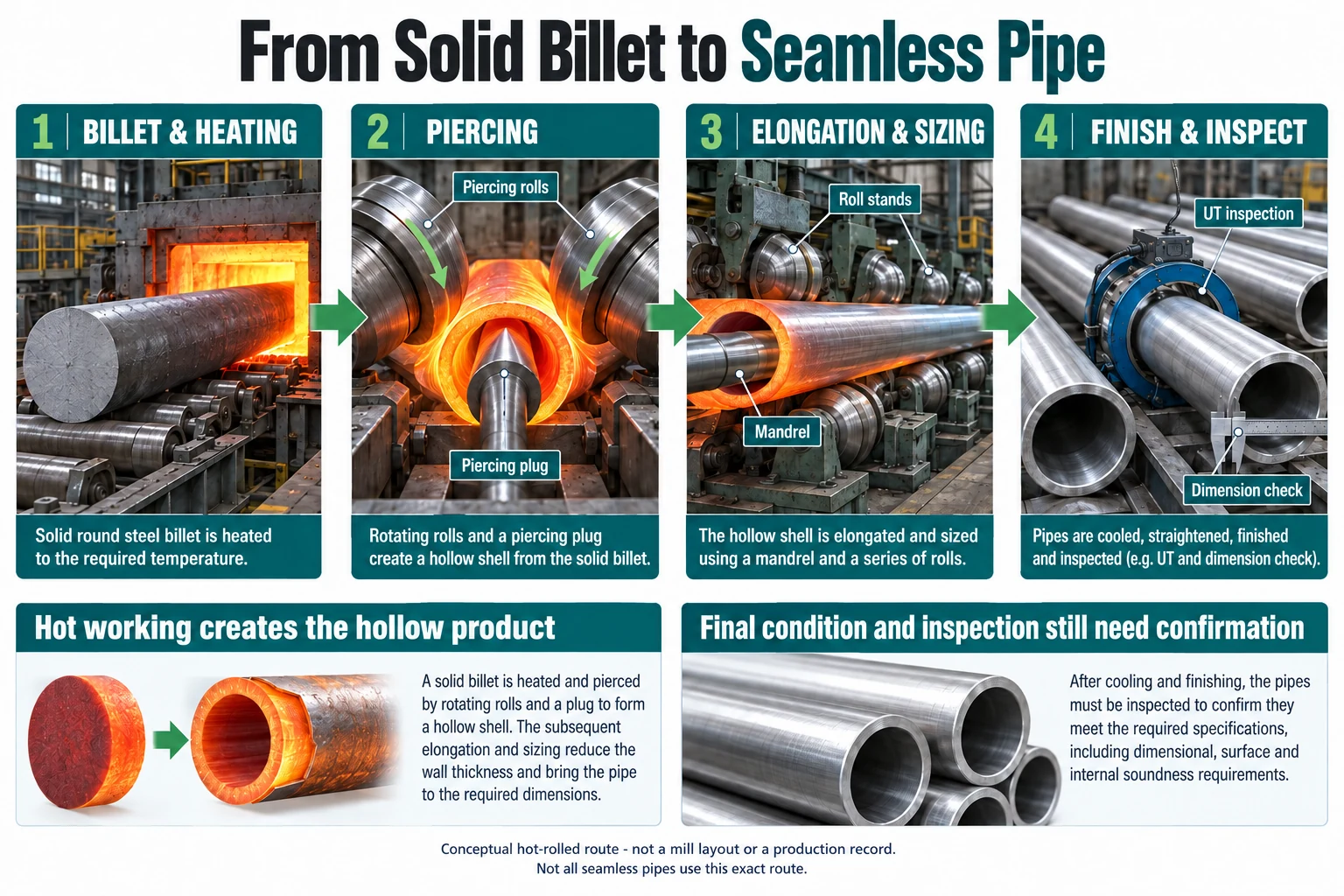
Figure 1. A simplified hot-rolled seamless route. Intermediate reheating, cooling, heat treatment and examination depend on the actual manufacturing plan and ordered product. The illustration is not a production record or an equipment drawing.
In rotary piercing, the heated round billet is worked by rotating rolls while a piercing tool helps form its central cavity. Control of billet temperature, alignment, deformation and tooling matters because the operation establishes the initial inside surface and distribution of material around the bore. The pierced shell is an intermediate product rather than a finished pressure pipe.
Buyers should distinguish a solid billet from a purchased hollow shell. Both can be valid inputs to an agreed supply chain, but the manufacturer, subcontracted operations and traceability records must remain clear. If the quotation names only the finishing company, ask who produced the starting hollow and how heat identity will be retained through subsequent processing.
Surface appearance alone cannot establish the piercing history or prove soundness. Internal folds, local wall variation or other indications require examination against the applicable requirements. A photograph of a bright bore cannot replace dimensional and nondestructive examination records. For defect evaluation, keep the manufacturing route connected to the inspection plan rather than treating them as separate sales attachments.
After piercing, rolling reduces the shell section and increases its length. In a mandrel mill, internal tooling supports the bore while external roll stands deform the shell. The equipment arrangement, roll settings, mandrel condition and temperature influence how the material flows. Final sizing or stretch reduction forms another stage in the route.
PQF and MPM are not interchangeable names for all hot rolling. SMS identifies PQF as Premium Quality Finishing and describes its three-roll mandrel technology; the same supplier lists mandrel mills alongside several other seamless plant types. Those descriptions help identify the proposed manufacturing system. They do not grant an automatic tolerance, fatigue-life rating or project approval to every product made on that system. [2][3]
SMS describes a PQF mill with up to six stands, each containing three driven rolls, compared with the conventional two-roll arrangement of MPM, meaning Multistand Pipe Mill. These are equipment characteristics, not the number of heat-treatment cycles or cold-working passes. Its description also distinguishes final sizing and stretch reduction: diameter reduction occurs without an internal tool, while the speed and tension arrangement differs between the two operations. The elongation mill and the final sizing system therefore belong in separate fields of a manufacturing description. [2]
When a bid specifies a particular process, ask why it matters. The requirement may reflect an approved manufacturing procedure, prior qualification or a dimensional capability needed by the project. If a different route is offered, require a stated deviation and supporting product evidence. Replacing an approved route with a mill brochure is insufficient, even where the final nominal size is unchanged.
A plug-mill route uses internal support during rolling, but its equipment sequence and tooling differ from a continuous mandrel arrangement. A push-bench route pushes the hollow over internal tooling through successive working stands. Neither name should be translated into a universal statement about better steel or lower rejection rates without comparable production evidence.
Extrusion forces heated material through a die around bore-forming tooling. It is used in industrial seamless tube production, including stainless and special-alloy applications. It should not be described as a method reserved exclusively for alloys that cannot be pierced: the available route also depends on plant capability, material, dimensions and production economics. Alleima publicly identifies hot extrusion and cold pilgering within its integrated tube production. [4]
The practical comparison is therefore configuration-specific. A route available for one alloy and section does not prove availability for another. Long, thin-wall precision tubing, thick-wall mechanical stock and large-diameter process pipe can demand different starting hollows, tooling and finishing sequences. Ask the supplier to review the full grade by diameter by wall by length combination.
Table 2. How the principal hot manufacturing routes differ.
|
Route or operation |
What the description identifies |
What it does not establish by itself |
|
Rotary piercing |
One method of making the initial hollow |
Finished wall tolerance or final material properties |
|
PQF or MPM rolling |
A mandrel-based elongation and reduction system |
Compliance with every standard or delivery condition |
|
Plug mill or push bench |
Alternative hot-working equipment arrangements |
Automatic technical equivalence to an approved route |
|
Hot extrusion |
Hollow formation and deformation through die and internal tooling |
A universal suitability limit for a material family |
|
Hot expansion |
Enlargement of an existing tube or pipe |
Permission to substitute the final product without review |
Hot-finished pipe is dimensioned through hot-working operations and any associated finishing steps. Its final delivery condition depends on the product specification and subsequent treatment. Hot finished is not a synonym for normalized, and a pipe that has passed through a furnace is not necessarily documented as having received the ordered heat treatment.
Cold drawing pulls a prepared hollow through a die. Internal tooling may be used to control the bore and wall, depending on the drawing method. The supplier must select a suitable incoming hollow, reduction schedule, lubrication and intermediate treatment. More than one draw can be needed; the nominal ordered diameter does not reveal how many operations will occur.
Cold pilgering reduces tube section using reciprocating rolling tools and internal support. It is a cold-working process, even though its feedstock has previously undergone hot manufacture. SMS identifies cold pilgering as a production route for seamless stainless tubes, while manufacturers also employ drawing according to the required product. Neither finishing method removes the need to specify the final treatment and surface. [4][5]
Cold working can change dimensions, strength and residual stress. Buyers machining an asymmetric part or bending a tube should therefore identify the delivered condition, not simply request a cold-worked product with the highest strength. Use the existing EN 10305-1 delivery-condition guide for the meaning of +C, +LC, +SR, +A and +N in that specification.
Table 3. Hot finished, cold drawn and cold pilgered tube compared.
|
Purchase question |
Hot-finished route |
Cold-drawn route |
Cold-pilgered route |
|
What section is available |
Confirm hot-mill size combinations |
Confirm suitable hollow and draw schedule |
Confirm mill and tooling envelope |
|
What dimensions control acceptance |
Ordered OD, wall and applicable tolerances |
Agreed OD, ID or wall basis and final condition |
Agreed dimensions after final processing |
|
What affects the surface |
Hot-working scale and subsequent treatment |
Hollow preparation, tooling, lubrication and cleaning |
Tooling, working sequence and subsequent cleaning |
|
What must be stated separately |
Required final heat treatment |
As-drawn or specified treated condition |
As-worked or specified treated condition |
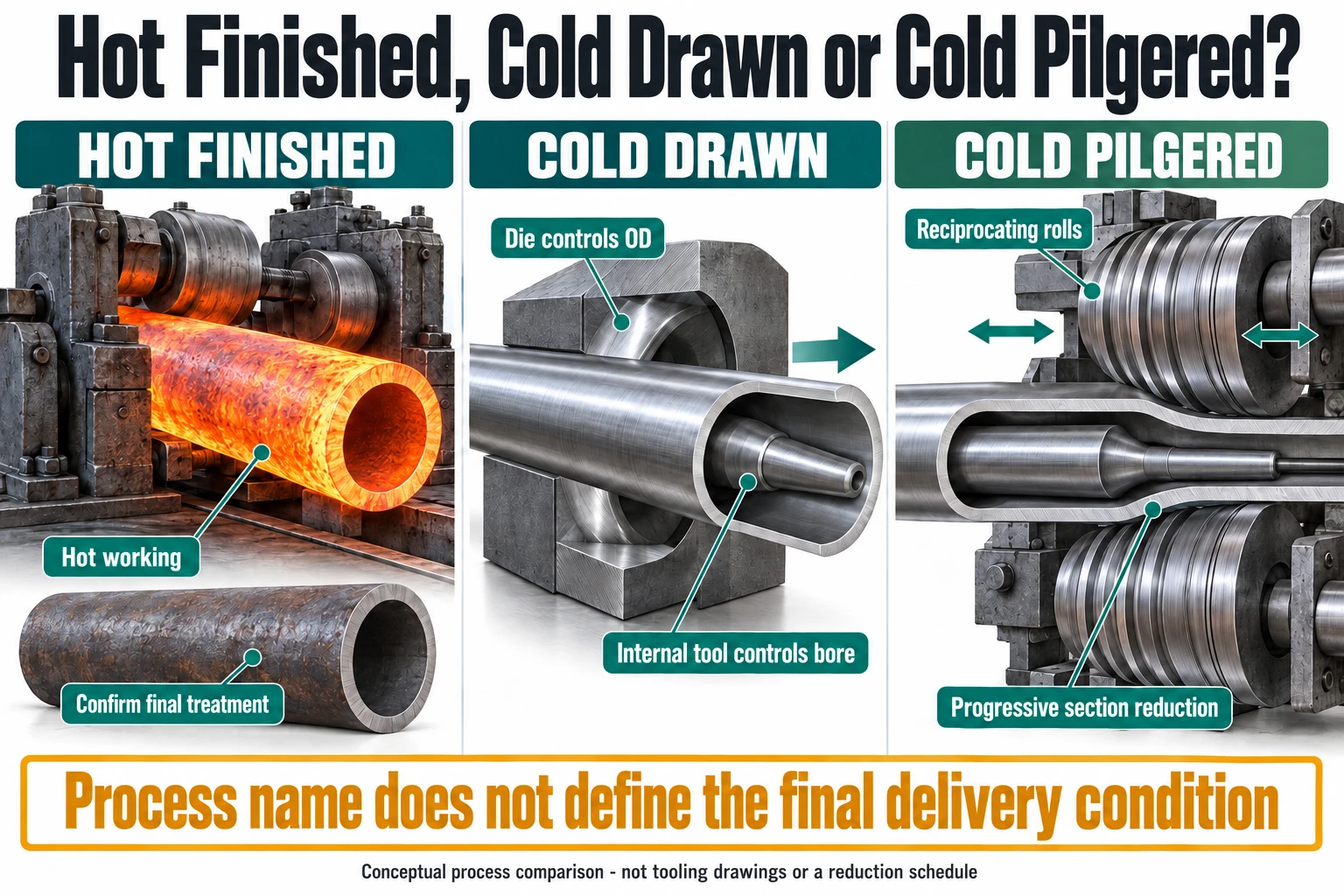
Figure 2. Three processing descriptions with different meanings. The conceptual drawings explain the distinction; they do not prescribe a reduction schedule, tooling geometry or dimensional acceptance value.
Hot expansion enlarges an existing hollow or pipe and can provide a route to diameters or wall combinations outside a particular mill's direct rolling range. It is another operation in the chain, not a different meaning of seamless. The final size, wall distribution, shape, treatment and examination still require review.
Bri-Steel publishes a thermal expansion range of 12 to 36 inches OD with walls up to 3.25 inches, equivalent to 82.55 mm. These are that manufacturer's published capabilities, not a range guaranteed by every thermal expansion mill or by Forever Steel. Its example shows why buyers should distinguish route availability from final product approval. [6]
For a proposed hot-expanded seamless pipe, identify the starting tube, final dimensions, manufacturing procedure, final condition and release testing. If the project specification restricts expansion or identifies an approved manufacturing route, resolve that point before placing the order. A larger catalogue range cannot override a project restriction.
Process selection should end in a defined delivered condition. Depending on the material and specification, the final product may require annealing, normalizing, normalizing and tempering, or another treatment. The route description should identify whether treatment follows the last significant working operation. A certificate should connect that condition to the correct heat and test unit.
Inspection must address the actual requirements. Dimensional checks establish size and shape; specified NDE addresses selected imperfections; mechanical tests establish properties of the sampled material under the relevant rules. Hydrostatic testing addresses pressure integrity under its defined conditions. None should be represented as independently proving every other requirement. ASTM A106's public scope concerns seamless carbon steel pipe for high-temperature service, rather than a general approval for every seamless product and application. [7]
Where a mill sends material to another facility for drawing, treatment, testing or machining, ask how identification is transferred. The order should define the responsible manufacturer, approved processors, records and treatment of mixed or unidentified material. A seamless bore does not provide this documentary continuity.
The cross-sectional area of a uniform round tube is A = pi × t × (D − t), with outside diameter D and wall thickness t in the same units. Ignoring losses and assuming unchanged density, length varies inversely with metal area. This volume relationship is useful for understanding elongation; it is not a rolling schedule or a guaranteed yield.
Assume an illustrative hollow of 88.9 mm OD by 8.0 mm wall and a final tube of 60.3 mm OD by 5.0 mm wall. Their calculated metal areas are approximately 2,033.24 mm² and 868.65 mm². The area ratio is 2.341. A 12.0 m starting length would therefore correspond to about 28.09 m of ideal final length if the full volume were retained at the same density.
Table 4. Ideal metal-area and length calculation.
|
Calculated quantity |
Starting hollow |
Final tube |
|
Outside diameter |
88.9 mm |
60.3 mm |
|
Uniform wall thickness |
8.0 mm |
5.0 mm |
|
Metal cross-sectional area |
2,033.24 mm² |
868.65 mm² |
|
Length under the stated ideal assumptions |
12.00 m |
28.09 m |
The approximately 57.28% section-area reduction in this example does not mean the supplier can complete it in one cold-working pass. Material ductility, equipment load, tooling, intermediate treatment and product requirements govern the actual sequence. Scaling, end cropping, test material, rejected portions and other losses also reduce saleable output. The calculation explains why process planning and finished yield affect quotation and lead time.
For a real purchase, compare finished accepted length or mass against the required quantity. Do not use a theoretical volume calculation to reject a mill solely because its incoming and outgoing weights differ. Request the agreed quantity basis, final tally and traceability records; investigate differences against the actual manufacturing route and contract.
Define the required product before requesting a particular production method. An order that controls bore clearance may need a different dimensional review from one controlling external fit. An order for stock to be machined should identify the finished-part drawing and datum. The A519 Grade 1026 tolerance guide covers that machining-stock decision in more detail.
Table 5. Manufacturing information to include in an RFQ.
|
RFQ item |
State in the inquiry |
|
Product identity |
Standard, edition, grade, application and any approved route restriction |
|
Geometry |
OD or NPS, wall basis, length, quantity and functional ID requirement |
|
Route and delivered condition |
Required or proposed hot-working and cold-finishing sequence, plus final treatment |
|
Verification |
Dimensional scope, NDE method and coverage, mechanical tests and inspection documents |
|
Downstream operations |
Bending, machining, threading, welding or expansion after delivery |
|
Commercial assumptions |
Stock or mill production, MOQ, deviations, lead time and delivered quantity basis |
A useful inquiry asks the supplier to identify the proposed route and final condition, list departures from the specification, and confirm the associated test records. It should not demand all possible manufacturing processes. If approval depends on a route, the acceptance decision belongs in the reviewed manufacturing plan before production begins.
No. PQF identifies a hot mandrel-rolling technology. Cold pilgering and cold drawing describe subsequent cold-working routes. State both the relevant manufacturing route and final delivery condition rather than substituting one label for the other. [2][3][5]
No. The relevant comparison includes dimensional needs, surface, machining allowance, final properties, residual stress, available size and cost. A tighter intermediate size does not automatically reduce total processing cost or make the delivered condition suitable for bending.
No. It removes a longitudinal manufacturing weld, but does not eliminate surface imperfections, wall variation or material and treatment requirements. The ordered product and agreed inspection plan determine the evidence required for release.
Only after reviewing the governing product specification, project restrictions, qualification basis and proposed final condition. Equal grade names and nominal dimensions are insufficient where the order controls the manufacturing route.
Select a manufacturing route that can deliver the required grade, section, condition and evidence. For an ASTM A106 seamless pipe inquiry, or another seamless product, send Forever Steel the complete dimensional and service requirements. Ask for the proposed supply route, deviations and inspection scope together so the offer can be evaluated as one product.
• Seamless vs Welded Steel Pipe
• Steel Pipe Heat Treatment Guide
• ASTM A106 Pipe Procurement Guide
• Seamless Steel Pipe Defects and Inspection
• Seamless Steel Pipe Cost Breakdown
• Seamless Pipe Workshop: Size Ranges and Inspection Framework
• EN 10305-1 Tube Delivery Conditions
[1] JFE Steel Seamless Casing and Tubing catalogue. Manufacturer-specific piercing, mandrel or plug rolling, sizing and inspection sequence.
[2] SMS group Seamless Tube Plants. Plant and hot-working route classification; equipment descriptions are not product acceptance criteria.
[3] SMS group New Horizons for Seamless Tube Production. PQF three-roll mandrel technology.
[4] Alleima Advancing American Industry through Materials Technology. Manufacturer description of integrated hot extrusion and cold pilgering.
[5] SMS group Cold Pilger Mill. Cold-pilger equipment and seamless-tube applications.
[6] Bri-Steel Thermal Pipe Expansion. Published manufacturer capability example, not a universal seamless pipe limit.
[7] ASTM A106/A106M-26 official catalogue. Product scope and edition identity; purchased specifications govern contractual requirements.