+8615674993216
 sales@forever-steels.com

 English
 العربية




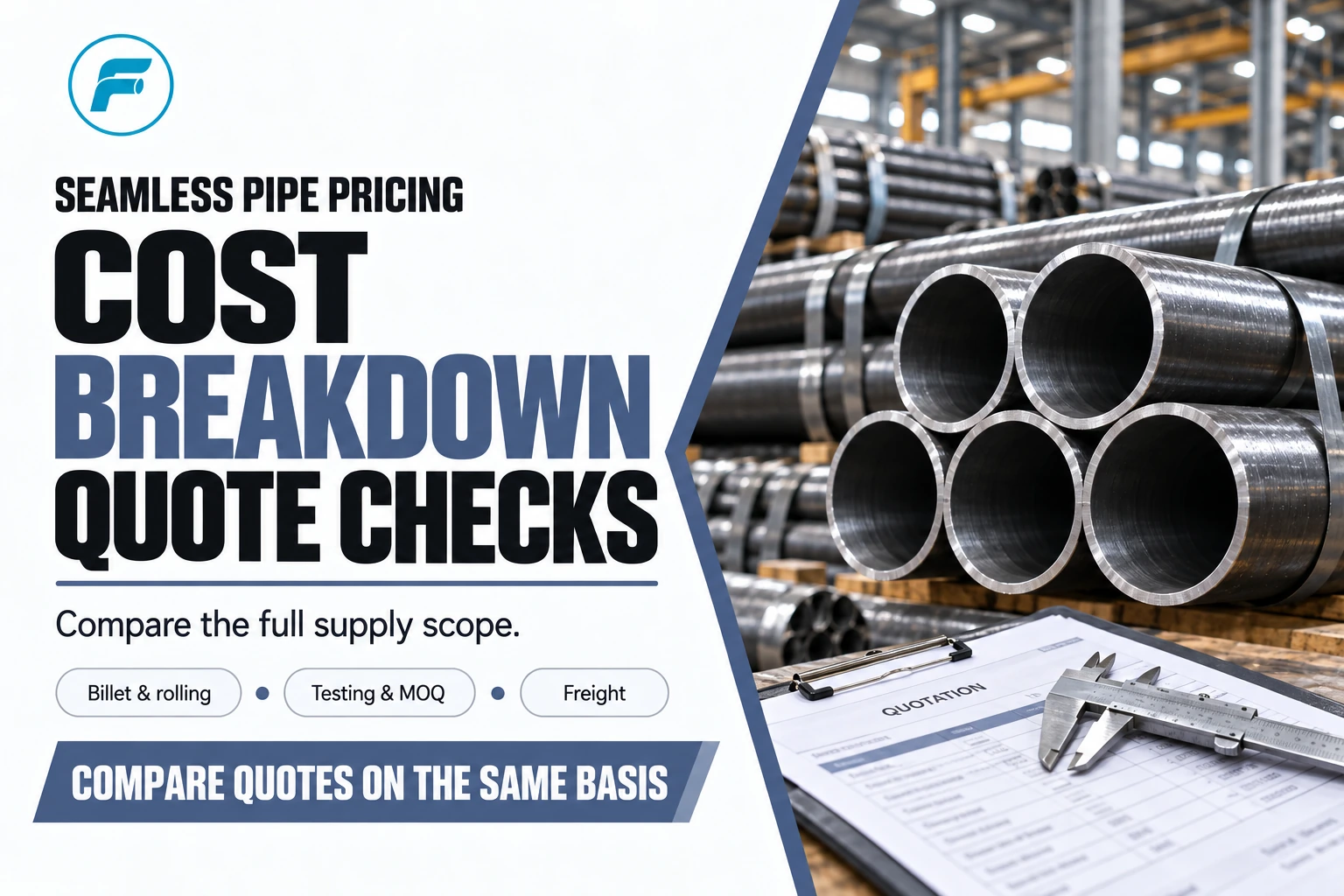
A seamless pipe quotation combines material input, conversion losses, manufacturing operations, final condition, inspection, finishing, commercial overhead and delivery costs. The balance changes with grade, OD, wall, length, quantity and route. Compare offers on the same accepted product and quantity basis before treating a lower price per ton as a saving.
This guide explains how to review a quotation for seamless steel pipe. Its numerical examples use explicitly assumed prices, yields and charges to make the calculations auditable. They are not live steel prices, typical industry cost percentages or Forever Steel quotations. A real offer requires a date, validity period, approved specification and named delivery term.
The billet does not simply become an equal mass of saleable pipe. Heating and processing can create scale, end crops, samples and rejected portions. The accepted product also carries the costs of the selected hot-working route, any cold finishing, treatment and examination. Scrap recovery can offset part of material losses, but its treatment must be consistent within a cost model.
Table 1. Cost elements and the requirement that changes them.
|
Cost element |
Why it changes |
Evidence or quotation detail to request |
|
Billet or purchased hollow |
Grade, chemistry, source, size, order timing and minimum heat or batch |
Starting-material route and any stated material surcharge |
|
Hot conversion |
Piercing, rolling, sizing, reheating, tooling and campaign setup |
Proposed manufacturing route and size availability |
|
Cold finishing |
Draw or pilger passes, preparation, lubrication and intermediate treatment |
Required tolerances, finish and final condition |
|
Heat treatment |
Required cycle, furnace loading, handling and verification |
Treatment scope and included records |
|
Inspection and documents |
Method, coverage, tests, witnesses and certification route |
Included tests, frequencies, hold points and deliverables |
|
Finishing and packing |
Cutting, bevels, coating or oiling, caps and identification |
Final length basis, end condition and packing scope |
|
Delivery and commercial costs |
Inland transport, freight, insurance, finance and contractual allocation |
Named Incoterm location, exclusions and validity |
JFE's published manufacturing sequence includes hollow formation, rolling, sizing and inspection. That sequence helps explain why conversion is a series of operations rather than one universal rolling charge. Different manufacturers and product routes allocate these costs differently. The table above is a review structure, not a request for a supplier to disclose confidential internal accounts. [1]
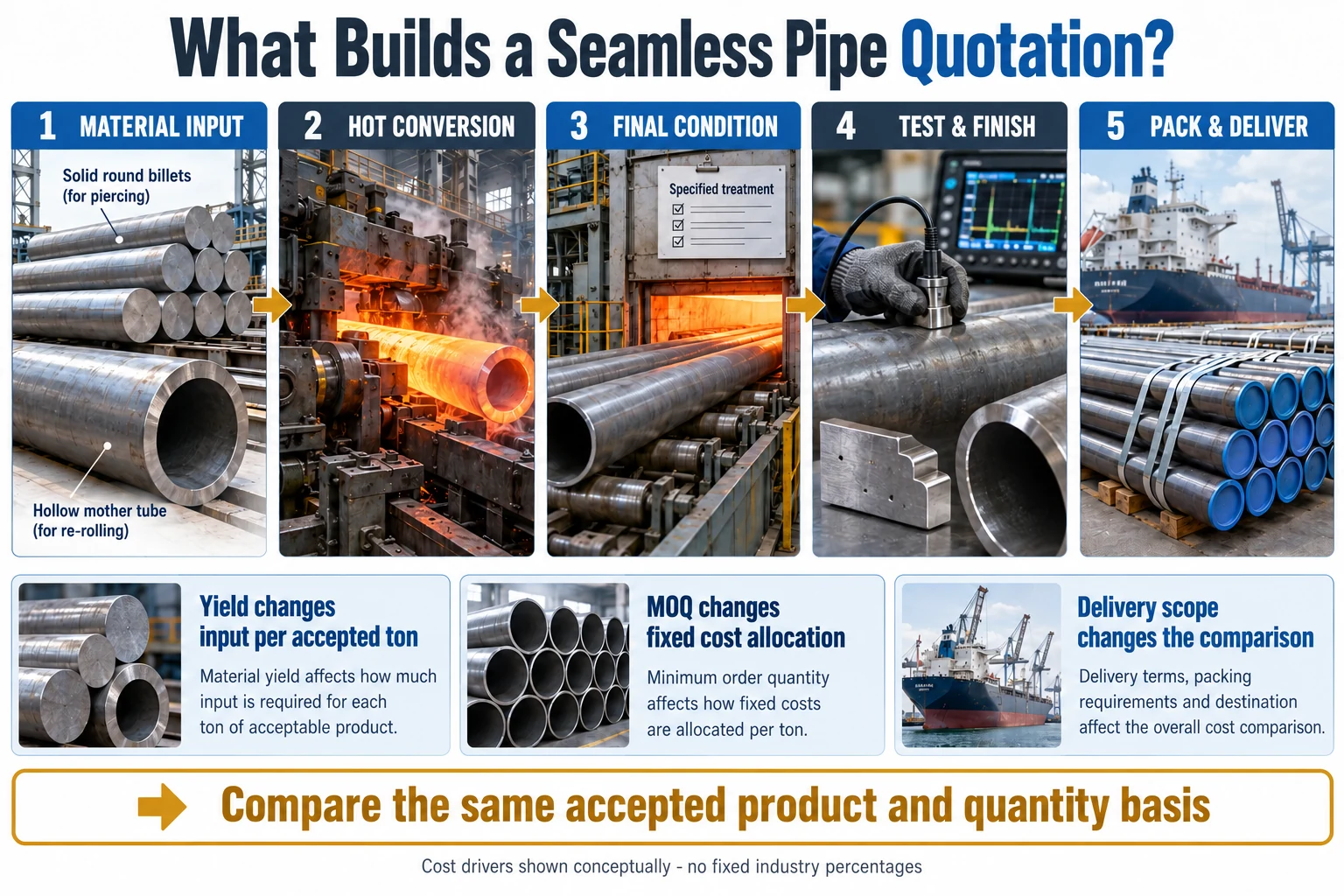
Figure 1. Physical operations and delivery scope that can contribute to a seamless pipe quotation. The illustration assigns no fixed percentage to any cost element and does not represent one manufacturer's accounting system.
For a simplified gross-input model, material cost per accepted ton equals input price per ton divided by finished yield. If the assumed input price is USD 600/t and accepted yield is 90%, one accepted ton requires 1.111 t of input and carries USD 666.67 of gross material cost. The difference is a material-balance effect, not automatically a supplier's profit.
Table 2. Illustrative yield sensitivity at a fixed input price.
|
Assumed accepted yield |
Input required for 1 accepted ton |
Gross material cost at assumed USD 600/t input |
|
85% |
1.176 t |
USD 705.88/t accepted |
|
90% |
1.111 t |
USD 666.67/t accepted |
|
95% |
1.053 t |
USD 631.58/t accepted |
These yield values are teaching assumptions, not benchmark performance for any mill. A full accounting model would distinguish recoverable scrap, scale, samples, rejected output and the commercial value of each return stream. If credit is included, use net input cost after the defined credit rather than silently mixing a gross-input model with a net-cost offer.
Grade and section can also affect the starting-material route. A carbon pipe, an alloy pipe requiring controlled heat treatment and a stainless precision tube need not begin with the same input cost or processing burden. Compare the exact ordered grade and condition; a generic billet index cannot by itself explain the final quote for every seamless family.
A common hot-working route forms a hollow and then elongates and sizes it. Tool changes, setup, reheating and campaign scheduling can become significant for an uncommon size or a short order. A requested OD and wall may fall within a catalogue range but outside a mill's convenient scheduled combination. Ask for the actual route and production availability.
Cold drawing or cold pilgering introduces additional operations where the product needs the corresponding dimensions, surface or condition. The price difference should be evaluated against the downstream task. Paying more for tighter stock can be sensible if it avoids enough machining or scrap; paying for an unnecessary restriction can add cost without improving the finished component.
Heat treatment is similarly specification-dependent. Compare whether the offer includes the required treatment after relevant working operations, the associated handling and the traceable records. A lower quotation that omits required final treatment is not a cheaper version of the same supply. Neither should an unnecessary additional cycle be demanded solely because a more elaborate process description sounds safer.
For precision stock, connect this decision to the A519 Grade 1026 machining and tolerance guide. It explains why OD, bore, wall variation, datum and stock allowance affect part yield. A cost comparison becomes useful only when the accepted tube can actually produce the specified part.
The phrase inspection included can mean anything from the basic product test package to additional full-body NDE, purchaser witnesses and extra destructive samples. State the method, coverage, applicable acceptance basis, required reports and witnessing arrangements. Otherwise, a comparison can penalize the bidder that included the requested evidence.
voestalpine's pressure-tube information lists several separate examination methods and notes that availability depends on size and product requirements. This supports reviewing the actual test package rather than treating UT, electromagnetic examination and pressure testing as one uniform service. It does not establish the cost of those methods at another mill. [2]
Additional testing can also affect finished quantity. Destructive samples and cropping can consume length; witnessed tests can add coordination or waiting time. The supplier should identify whether these consequences are included in delivered quantity, separately charged, or handled through manufacturing allowance. An invoice line called testing alone does not answer those questions.
Inspection documents need their own definition. A purchaser may require a particular certificate, traceable test results, third-party involvement or a specific approval route. Agree the deliverable and responsible parties before ordering. A certificate label cannot be assumed to include every laboratory test, inspection visit or project-specific document requested later.
The following model uses a 90% accepted yield and USD 600/t input only to demonstrate addition of cost elements. Each processing number is assumed. The heat-treatment and inspection lines represent the defined scope for this hypothetical product; there is no suggestion that all seamless pipe needs the same operations or charge.
Table 3. Illustrative cost model per accepted metric ton.
|
Model component |
Assumed USD per accepted ton |
Calculation or scope |
|
Gross material input |
666.67 |
USD 600/t divided by 0.90 yield |
|
Hot conversion |
150.00 |
Assumed included hot-working operations |
|
Required final heat treatment |
70.00 |
Assumed defined treatment package |
|
Inspection and records |
35.00 |
Assumed agreed examination and reports |
|
Finishing and packing |
30.00 |
Assumed ends, protection and identification |
|
Allocated overhead and margin |
85.00 |
Assumed combined allowance, not an industry norm |
|
Model goods subtotal |
1,036.67 |
Sum before delivery charges below |
|
Inland transport and export handling |
45.00 |
Assumed separately identified scope |
|
Main freight |
90.00 |
Assumed freight rate for this calculation |
|
Model total before other stated exclusions |
1,171.67 |
Excludes import charges, insurance and taxes unless added |
At 50 accepted tons, this model gives approximately USD 58,583.33 before the stated exclusions, using unrounded arithmetic. Multiplying rounded line items can create a small rounding difference. In an actual quotation, confirm which commercial term and named place the price covers; the modeled total above is not presented as a CIF, DAP or landed-price offer.
The exercise reveals where a bid can differ. If another supplier excludes treatment or reports, its goods price may be lower while the complete compliant scope costs more. If the same requirement can be achieved with fewer operations, the saving may be legitimate. Request a compliance and exclusion schedule rather than assuming that every price gap signals either poor quality or excessive profit.
A minimum order can reflect a material heat, a starting hollow, tooling, a treatment batch or the economics of opening a production campaign. It is not always the same constraint. Ask whether the MOQ applies per grade, size, wall, length, heat or complete order, and whether available stock can meet the specification without creating a technical deviation.
For a separate illustrative sensitivity calculation, assume a fixed setup cost of USD 1,500 allocated across accepted production. It adds USD 300/t to a 5 t order, USD 150/t to a 10 t order and USD 30/t to a 50 t order. These figures are not an additional charge to the previous model; they independently show how one fixed cost changes with quantity.
Reducing the number of unique sizes, coordinating release dates or accepting a suitable existing production slot can sometimes improve economics. Such options require supplier confirmation and engineering review. Do not change wall thickness, material condition or test scope simply to cross an MOQ threshold without checking the consequence for the required product.
Where payment uses actual net mass, more metal per meter can offset a lower price per ton. For a uniform round pipe, theoretical mass per meter is pi × density × 0.000001 × t × (D − t), with dimensions in millimeters and density in kg/m³. Use measured mass and length for an actual shipment rather than extrapolating a single wall reading.
The next comparison assumes OD 114.3 mm, uniform walls as shown and an illustrative density of 7,850 kg/m³. Both offers are hypothetical and all other scope is held constant. The geometry must still be acceptable; this arithmetic does not approve a thicker pipe for a real order.
Table 4. Controlled quotation comparison per ton and per meter.
|
Comparison item |
Illustrative offer A |
Illustrative offer B |
|
Uniform wall used in calculation |
6.02 mm |
6.62 mm |
|
Calculated mass per meter |
16.0755 kg/m |
17.5797 kg/m |
|
Assumed actual-net-mass price |
USD 1,000/t |
USD 960/t |
|
Calculated material cost per meter |
USD 16.0755/m |
USD 16.8766/m |
|
Calculated cost for 10,000 m |
USD 160,755 |
USD 168,766 |
Offer B has a 4% lower price per ton but an approximately 4.98% higher material cost per meter under these assumptions. It also requires more mass to deliver the same length, which can affect transport. If the order is instead for fixed tons, the consequence is fewer delivered meters. Define the purchased unit before comparing bids.
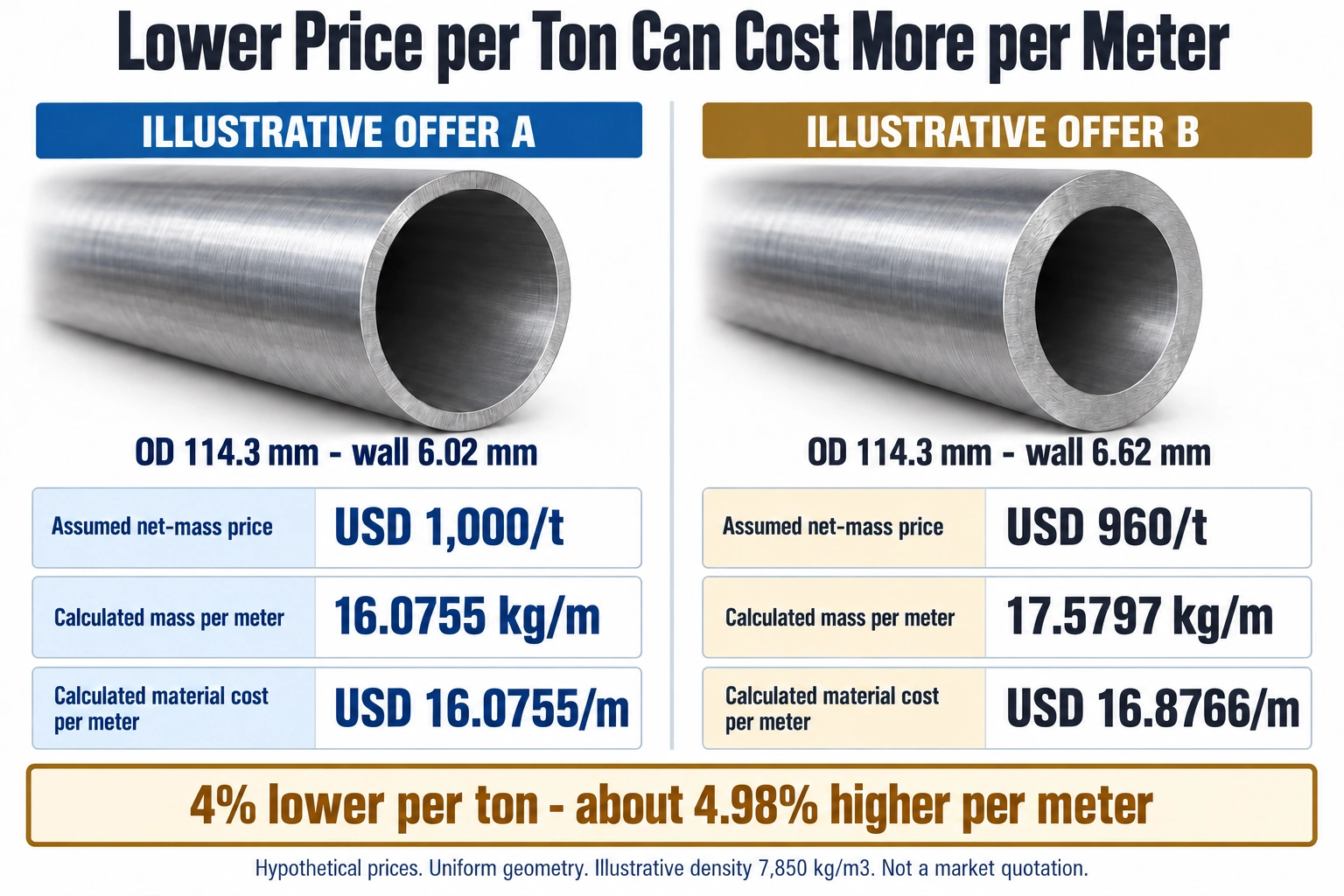
Figure 2. A controlled numerical comparison, not a market quotation. Both pipes use the stated ideal geometry and illustrative density; actual payment follows the agreed mass and quantity basis.
Use the steel pipe weight formula guide for the calculation framework. For disputes involving excess wall, bore and invoice quantity, the A335 wall thickness tolerance guide explains why technical acceptance and commercial settlement must be checked separately.
Freight depends on the shipment configuration, not only its nominal tonnage. Length, bundle geometry, gross mass, packaging, handling and available service affect transport arrangements. A load can reach its practical dimensional limit before its theoretical mass limit. Confirm the carrier and loading plan instead of assuming a standard container count from steel mass alone.
In an isolated freight example, a reserved transport movement costing USD 2,400 carries an effective USD 120/t at 20 t and USD 200/t at 12 t. These are assumed loads, not payload guarantees or current freight rates. The calculation shows how unused capacity can raise unit freight even when the transport invoice is unchanged.
Keep net pipe mass separate from packing and gross shipping mass. Ask whether caps, saddles, crates and other protection are included in the quotation and transport calculation. For long or precision material, avoiding damage or contamination can justify a packing requirement, but its cost and acceptance description should be agreed rather than added after booking.
Incoterms identify important divisions of transport obligations, cost and risk. They do not replace the product specification or settlement basis. ICC distinguishes CIF and CIP insurance provisions and the transport modes for which the rules are intended. State the rule, named place or port and version, then identify charges and exclusions. A CIF price should not be casually described as including import duty and all destination costs. [3][4]
An inquiry stating A106 Grade B, SCH 40 and 50 tons can still leave important differences. Suppliers may offer different length distributions, material conditions, test packages, certificates, packing or delivery boundaries. One offer may use theoretical mass, another actual net mass. Apparent price competition can therefore conceal a different quantity or technical scope.
Normalize the product description first. State the standard and edition, grade, OD or NPS, wall basis, length, quantity, ends, surface protection, testing and documents. Where the manufacturing route or mill must be approved, include that restriction. The existing ASTM A106 procurement guide provides the technical order fields; this article focuses on their cost consequences.
Ask whether the material is finished stock, stock requiring additional processing, an available production campaign or a new mill order. A stock offer can avoid some setup and waiting costs but may fail a fixed-length or inspection requirement. A mill offer can match the specification more closely while requiring a quantity commitment. Compare the complete executable scope rather than the label stock or factory price.
Create a short comparison sheet before negotiating. Mark each item included, excluded, conditional or deviating. A blank is not evidence that the supplier included the requirement. Resolve technical differences first, then normalize the commercial total for the quantity that will be usable at the required destination.
Table 5. Questions to resolve when normalizing quotations.
|
Comparison field |
Question to resolve |
|
Product and route |
Are standard, edition, grade, manufacturing route and final condition the same |
|
Quantity basis |
Are both offers for accepted meters, pieces, theoretical mass or actual net mass |
|
Length and yield |
Will the delivered lengths satisfy the cut plan after required end preparation |
|
Tests and records |
Are required methods, coverage, witnesses and documents included |
|
Packing and freight |
Are protection, loading, gross mass assumptions and transport scope comparable |
|
Commercial validity |
Are named delivery point, payment, quote validity and exclusions stated |
Request the price consequence of an optional test or alternative length separately. This keeps the base comparison intact and makes the procurement decision reviewable. If a supplier proposes a substitute grade, route or delivery condition, process it as a deviation; do not bury the change in a revised price sheet.
There is no reliable universal percentage for all grades, sections, routes and delivery terms. Input price, finished yield, processing and test scope change the proportion. A percentage without its product and cost basis is unsuitable for judging a real quotation.
Fixed setup, material minimums, tooling, furnace or campaign scheduling and transport utilization may be spread over fewer accepted tons. Ask which constraint sets the MOQ and whether a compliant stock or scheduled-production option exists. Do not assume the same explanation applies to every supplier.
Only if the specified dimensions, surface, condition or downstream processing benefit requires that route. Evaluate total finished-part cost and acceptance, including machining and rejection exposure, rather than comparing the raw tube price alone.
Not necessarily. Confirm insurance, destination and import charges, local transport and the allocation in the contract. Also check accepted quantity and product scope. Delivery terms cannot correct a comparison between different grades, lengths or test packages.
For a seamless pipe quotation, send Forever Steel the specification and edition, grade, sizes, wall and quantity basis, lengths, final condition, tests, documents, packing and named delivery point. Ask for deviations and exclusions alongside the price. That creates a basis for comparing the cost of the required accepted product rather than the cheapest incomplete description.
• ASTM A106 Pipe Procurement Guide
• Steel Pipe Length Guide for Global Buyers
• Steel Pipe Export Packing and Marking Guide
• LSAW Pipe Quotation Cost Breakdown
• Seamless Steel Pipe Manufacturing Process: From Billet to Finished Pipe
• Steel Pipe Weight: Formula, Reference Chart and Shipping Estimates
• How to Calculate Steel Pipe Shipping Volume
[1] JFE Steel Seamless Casing and Tubing catalogue. Manufacturer process sequence supporting the identification of physical conversion stages; not a cost-percentage source.
[2] voestalpine Tubes and Pipes for Pressure Applications. Separate examination options and product-dependent availability; no inspection cost benchmark is inferred.
[3] ICC Incoterms 2020. Official overview of trade rules and insurance differences.
[4] ICC Incoterms 2020 Checklist and Flowcharts. Named transport and delivery responsibilities; use the agreed rule and contract for an actual shipment.