+8615674993216
 sales@forever-steels.com
 English
 العربية

LSAW pipe cost should be treated as a cost model, not a single USD-per-tonne number. The buyer must separate plate basis, material utilization, forming and welding conversion, inspection scope, documentation, coating, packing, freight, schedule and commercial assumptions. ERW is useful as a comparison baseline only after both routes are normalized to the same size, grade, PSL, tests and delivery scope.
|
Quick answer:LSAW commonly costs more because it starts from individual plate, uses slower forming and multi-pass submerged arc welding, and is frequently ordered in larger diameter, heavier wall, higher grade or stricter inspection scopes. ERW benefits from continuous coil-fed production and higher line speed. |
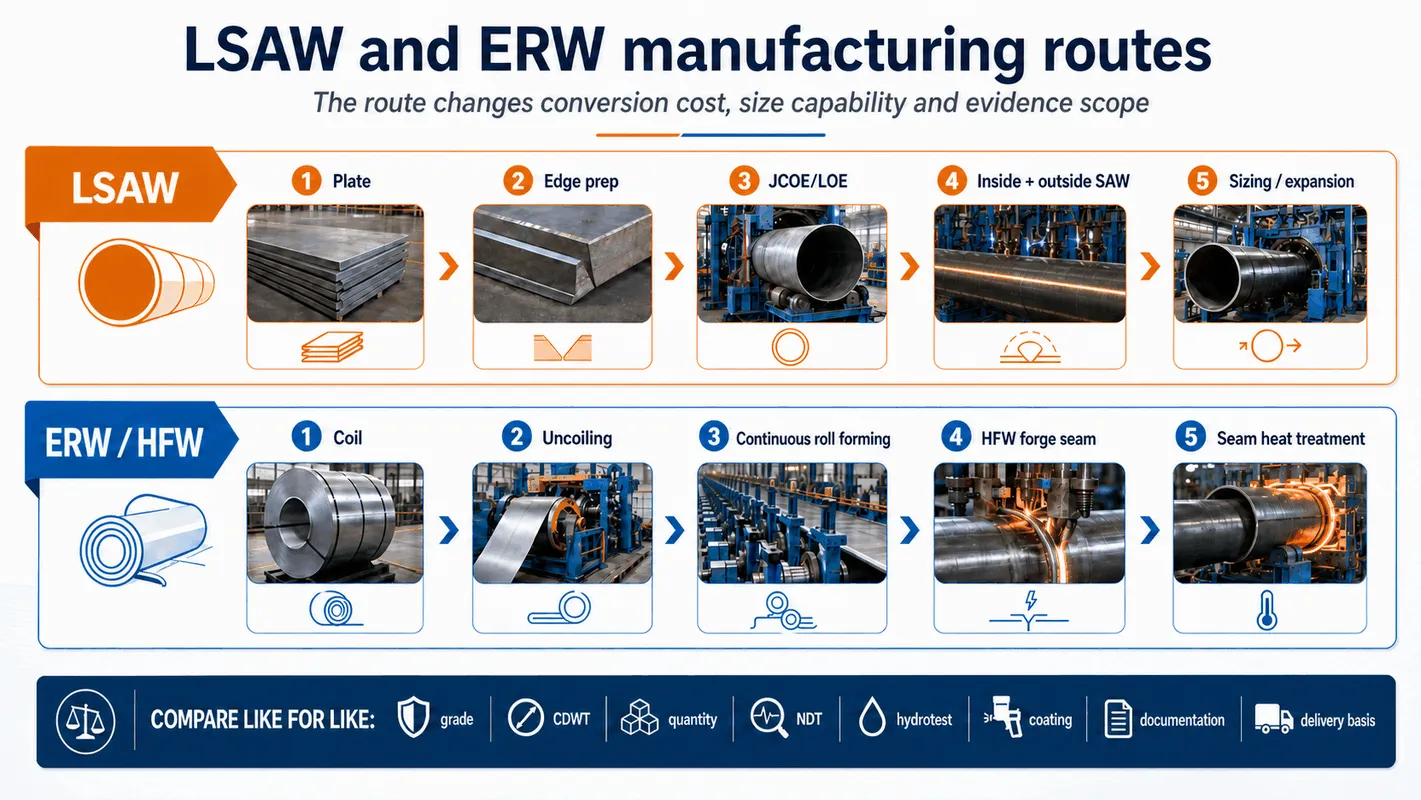
Figure 1. LSAW and ERW use different raw-material, forming, welding and thermal-control routes.
|
Cost driver |
LSAW |
ERW |
|
Starting material |
Cut-to-length steel plate |
Hot-rolled coil |
|
Purchasing effect |
Plate grade, width and individual plate utilization |
Continuous coil availability and mill campaign |
|
Yield loss |
Edge preparation, trimming and plate remnants |
Coil-head/tail and line setup losses |
|
Typical sensitivity |
Heavy wall, high strength, wide plate and small lot |
Coil availability, OD/WT combination and campaign size |
Start by identifying the exact steel basis included in the offer: mill/source, grade, delivery condition, plate width and thickness, test requirements, purchase quantity, yield loss and surcharge validity. Plate is not automatically dearer than coil in every project. Availability, special rolling campaigns and usable yield can reverse the expected relationship, so the quotation should state assumptions rather than hide them inside one material rate.
LSAW forming changes a plate into an open pipe through staged JCOE or UOE operations, followed by closing, welding, sizing or expansion as specified. ERW production continuously forms coil through roll stands before high-frequency welding. The higher ERW line speed can reduce conversion cost when the size and quantity fit the line.
|
Item |
LSAW effect |
ERW effect |
|
Seam creation |
Internal and external SAW passes may use wire and flux |
Resistance seam normally uses no filler wire or flux |
|
Speed |
Multiple controlled operations |
Continuous high-frequency line |
|
Thermal control |
Pass sequence, heat input and possible expansion controls |
Power/speed window and local seam heat treatment |
|
Rework exposure |
Arc-weld repair governed by approved route |
Seam interruptions and repair limitations require defined disposition |
Inspection is a cost line only after the scope is measurable. Compare seam NDT coverage, hydrotest, mechanical and supplementary tests, third-party intervention, traceability, calibration evidence, MTC format and final data-book index. A product-standard minimum offer and a project-ITP offer are not commercially equivalent even if both are described as API 5L pipe.
· Confirm whether 100% seam UT/RT or another NDT route is required.
· Align hydrostatic-test pressure, hold time and recording requirements.
· Align impact-test temperature, hardness mapping and sampling frequency.
· Include coating, cutback, end preparation, marking and packing.
· Compare MTC, data book, ITP, third-party inspection and document-review costs.
A small project quantity can carry setup, tooling, qualification and document costs across fewer tonnes. Conversely, a large repeat order can improve plate purchasing, nesting, line utilization and inspection efficiency. Ask suppliers to identify minimum campaign assumptions and the cost effect of splitting sizes or grades.
|
Project condition |
More likely route to evaluate |
Reason |
|
Large diameter beyond ERW range |
LSAW |
Plate forming supports large OD and heavy wall combinations |
|
High-strength transmission line with strict seam evidence |
LSAW or qualified ERW |
Owner specification and mill capability decide |
|
Medium diameter, stable long quantity |
ERW |
Continuous production may offer cost and delivery advantage |
|
General utility/structural service |
ERW if permitted |
Avoid paying for an unrequired heavy project route |
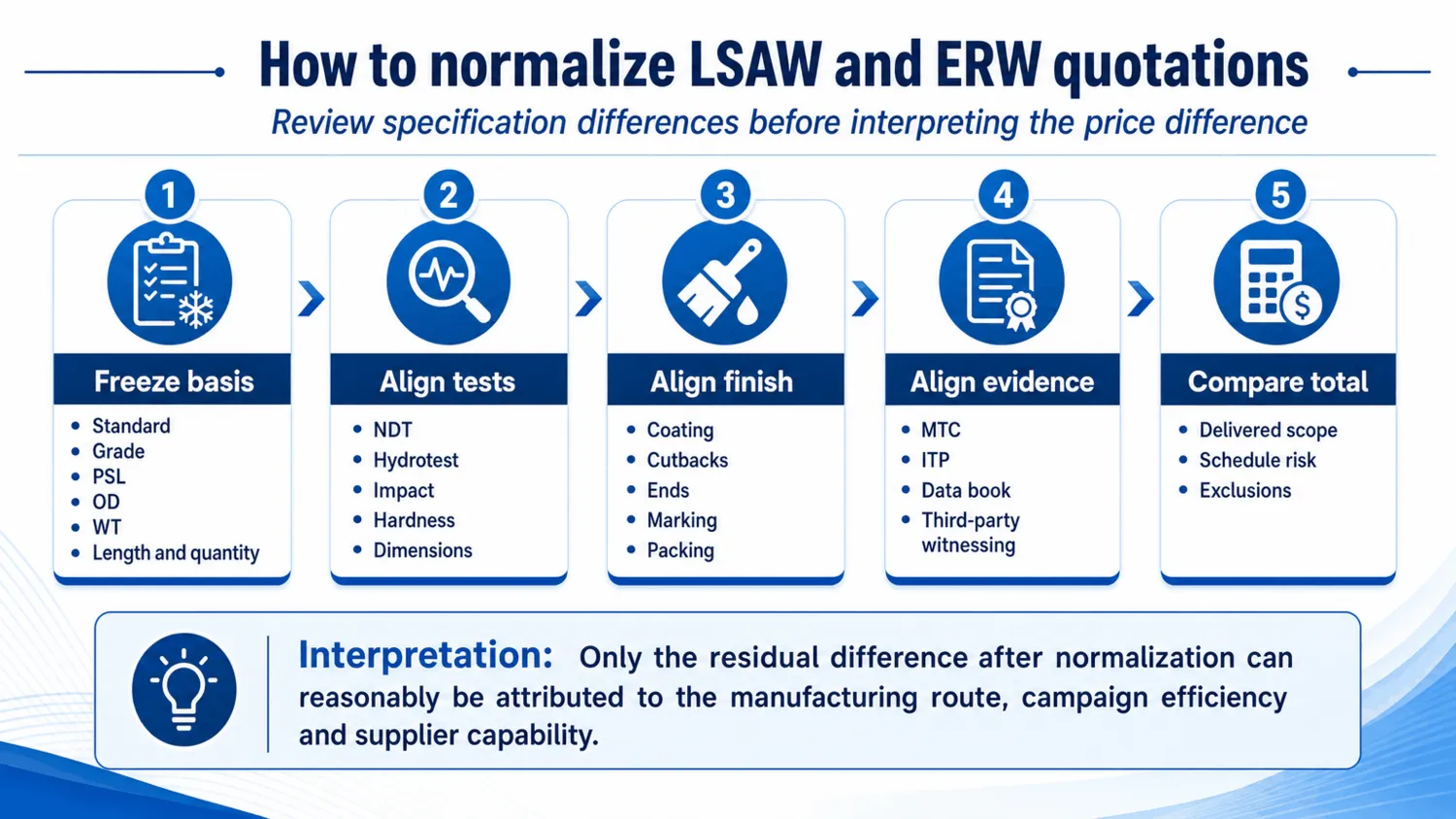
Figure 2. Quote normalization separates manufacturing-route cost from differences in tests, coating, evidence and delivery scope.
A process comparison is meaningful only when both routes can actually make the ordered pipe. Diameter, wall thickness, grade, plate or coil availability, dimensional tolerance, delivery condition and owner restrictions can remove one route before cost is considered. Ask each mill for its qualified manufacturing range and any project-specific restrictions. A lower ERW conversion cost has no value if the requested size is outside the line or the project specification requires SAWL.
Route capability also changes with mill equipment. Two suppliers using the label LSAW may have different presses, edge-milling capacity, welding heads, mechanical expansion capability and NDT systems. ERW lines likewise differ in forming range, high-frequency equipment, seam heat treatment and online inspection. Do not use generic market ranges as a substitute for the named mill's capability statement.
A transparent comparison does not need a universal chart claiming that steel is a fixed percentage of price. The proportions move with steel markets, grade, quantity, energy, exchange rate, testing and freight. Instead, separate the quotation into cost layers and ask what commercial assumption controls each layer. This approach explains the premium without publishing numbers that will be wrong for the next project.
|
Cost layer |
LSAW questions |
ERW questions |
|
Raw material |
Plate mill, width, thickness, grade, delivery condition and plate utilization |
Coil mill, width, thickness, grade, campaign availability and coil utilization |
|
Conversion |
Edge milling, staged forming, tack/continuous welding, SAW passes and expansion |
Uncoiling, strip joining, roll forming, HFW, bead treatment and sizing |
|
Quality |
Plate UT if required, seam NDT, hydrotest, impact/hardness and dimensions |
Coil inspection, online/offline seam NDT, heat-treatment control and hydrotest |
|
Project services |
ITP, data book, third-party witness, coating, special ends and packing |
Same items; confirm they are not omitted from the lower base price |
|
Commercial risk |
Small lot, plate lead time, changeovers and schedule allocation |
Coil MOQ, campaign timing, changeovers and line availability |
LSAW often starts from cut-to-length plate, while ERW normally starts from coil. That does not guarantee that plate is always dearer. If a required high-strength plate is available locally but the matching coil width and thickness require a special rolling campaign, the ERW material basis can lose its expected advantage. The reverse can occur for common coil grades produced at scale. Ask for material source, lead time, minimum order and validity of any surcharge.
Yield should be discussed in physical terms. Plate edge trimming, end cropping, test coupons and remnants affect LSAW utilization. ERW loses material at coil head and tail, strip joining, setup and cut lengths. Small mixed-size orders magnify both routes' losses. A supplier should not disclose confidential costing, but it should be able to explain which order feature creates the surcharge.
JCOE or UOE forming handles one plate or pipe body through defined steps. Press time, plate handling, setup, calibration and optional mechanical expansion contribute to conversion cost. ERW forms strip continuously through multiple roll stands and can achieve much higher throughput once the line is stable. That advantage is strongest when a long campaign uses one size and grade; it shrinks when tooling changes, short runs or special tolerances interrupt the campaign.
Tooling language in a quote deserves clarification. A one-time setup charge, size-change charge and permanent tooling purchase are not the same. Ask whether tooling remains the supplier's property, whether repeat orders avoid the charge and whether the quoted tolerance requires additional sizing or straightening. These questions are more useful than arguing about an unexplained conversion-rate line.
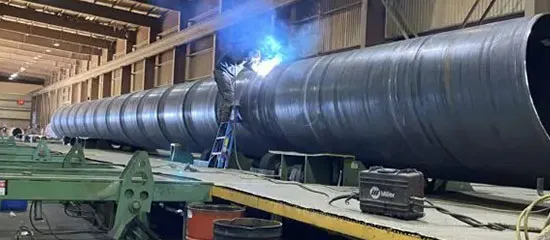
LSAW typically uses internal and external submerged arc welding, with wire, flux, edge preparation and one or more controlled passes. ERW/HFW creates the seam by resistance heating and forge pressure without filler metal. The processes therefore consume different materials and operate at different speeds. The buyer should focus on the required seam properties and evidence rather than treating the visible weld bead as a quality ranking.
Repair rules also affect cost and schedule. An LSAW project may permit qualified local weld repair under controlled limits and post-repair NDT; another project may restrict or prohibit it. ERW seam dispositions follow the product standard and mill procedure and may not use the same repair route. A quotation that assumes permissive repair rules can be cheaper but commercially noncompliant.
One supplier may quote a base product standard while another includes a project ITP, purchaser review, third-party witnessing, raw-material traceability, automatic UT records, radiography at pipe ends, hydrotest charts, impact tests and a compiled manufacturing data book. Those are different deliverables. Normalize the inspection matrix line by line and identify hold, witness, review and surveillance points before comparing price.
Documentation has a real cost because records must be generated, reviewed, corrected, indexed and retained. The appropriate response is not to remove evidence blindly. Classify documents as mandatory release records, purchaser-review records and retained mill records. That keeps the data book proportionate while preserving the evidence needed for a critical line.
Large-diameter LSAW pipe can have different coating-line availability, handling fixtures, nesting efficiency and vessel or truck utilization from medium-diameter ERW pipe. Bevel geometry, end protectors, internal lining, external FBE or 3LPE, cutback and field-joint compatibility should be priced on the same basis. Freight quoted per tonne can hide inefficient volume use, port handling or special lifting requirements.
|
Line item |
Supplier A |
Supplier B |
Buyer action |
|
Base pipe |
LSAW, project grade and PSL2 |
ERW, standard grade and PSL1 |
Not comparable: align grade and PSL |
|
Seam examination |
Full project NDT package |
Product-standard minimum |
Price the same NDT scope |
|
Coating |
External FBE included |
Bare pipe |
Separate coating and cutback price |
|
Documents |
MTC, ITP and indexed data book |
MTC only |
State the required document register |
|
Delivery |
Delivered port with export packing |
Ex-works |
Compare landed cost and schedule |
In this example, the apparent LSAW premium cannot be interpreted until Supplier B prices the same grade, PSL, NDT, coating, documentation and delivery basis. After normalization, the remaining difference can be discussed as material-route efficiency, manufacturing conversion, mill allocation and technical capability. This prevents a procurement team from selecting a lower headline price that later accumulates variations.
· Which order requirement determines the proposed manufacturing route?
· What plate or coil source, delivery condition and mill campaign are assumed?
· Which inspection, testing and document items are included, optional or excluded?
· What quantity, size mix and repeat-order assumptions support the conversion price?
· Which repairs, concessions or alternate routes require purchaser approval?
· What coating, packing, freight and delivery risks remain outside the quoted price?
No. Strength and suitability depend on the specified grade, manufacturing quality, seam properties, heat treatment, inspection and service requirements. The process name alone is not a mechanical-property certificate.
They may use different plate sources, forming routes, expansion, NDT scope, testing frequency, coating, documentation, inspection involvement, schedule assumptions or delivery terms. A deviation schedule should expose those differences.
ERW is often attractive for medium diameters and stable repeat quantities that fit an available coil and mill campaign, provided the product standard and project specification permit the route.
Specify the performance, service and evidence required. Restrict the route when the design basis or owner specification justifies it; otherwise, qualified alternatives can improve cost and delivery without reducing compliance.
Material lead time and production-slot availability can be as important as conversion cost. LSAW may depend on a plate rolling schedule and individual plate allocation; ERW may depend on a coil campaign and tooling slot. Ask for quotation validity, raw-material reservation date, production window, inspection duration and shipping basis. A cheaper offer that misses the project mobilization date can create more cost than the pipe-price saving.
Payment terms also affect apparent price. Advance material payment, milestone billing, retention, warranty security and currency validity shift financing risk between buyer and supplier. Keep technical normalization separate from commercial normalization, then compare both. This prevents a procurement team from treating a financing difference as a manufacturing-process advantage.
Total delivered cost can include base pipe, testing, coating, inspection, documentation, end protection, packing, inland movement, port charges, ocean freight, insurance, customs and site handling. Large-diameter pipe can cube out a vessel or require special lifting before reaching weight limits. Compare the same Incoterm, destination, shipment split and unloading responsibility.
Also price the risk of late technical clarification. If one quotation contains unresolved deviations, the later cost may appear as re-engineering, new tests, coating rework or schedule extension. A transparent quote should distinguish firm scope, options, exclusions and assumptions so the buyer can calculate the cost of closing each gap before award.
· The supplier explains the gap only as “LSAW is better.”
· The two offers use different grades, PSL levels, wall tolerances or NDT scopes.
· One price excludes coating, testing, inspection or documentation.
· Plate/coil surcharges and quantity assumptions are hidden.
· The quoted manufacturing route does not match the project specification or size range.
· API 5L Line Pipe Selection Guide
· LSAW Pipe Documentation Package: Release Checklist
· Weld Seam Inspection for ERW, LSAW and SSAW Pipes
· Steel Pipe Inspection Checklist Before Shipment
The references below are provided for technical context. The purchase order and project specification must identify the controlling edition and acceptance criteria.
· TWI - Submerged Arc Welding - Independent process explanation for SAW.
· American Welding Society - Submerged Arc Welding - Welding-process and fabrication knowledge.
· API - Specification 5L 47th Edition announcement - Current line-pipe manufacturing, inspection, testing, marking and traceability context.
· worldsteel - Steel industry facts - Raw-material and steel-production context.
· TWI - Welding technical knowledge - Independent welding, inspection and manufacturing references.
A lower USD-per-tonne figure may exclude testing, coating, packing or freight items included elsewhere. Rebuild each offer on the same quantity, technical scope, Incoterm and destination basis before selecting a supplier.
| Cost block | Normalize | Evidence |
| Plate and yield | Grade, wall, width, order quantity and expected yield loss | Material basis and mill route |
| Manufacture | Forming, seam welding, repairs and dimensional control | Included production scope |
| Acceptance | NDT, hydrotest, mechanical tests and TPI | ITP and document list |
| Delivery | Coating, end protection, packing, inland haulage and ocean freight | Incoterm and load plan |
Forever Steel can issue an LSAW pipe cost breakdown tied to the same approved technical line item used for production and inspection. This makes commercial changes visible instead of hiding them inside a single tonne rate.