+8615674993216
 sales@forever-steels.com
 English
 العربية




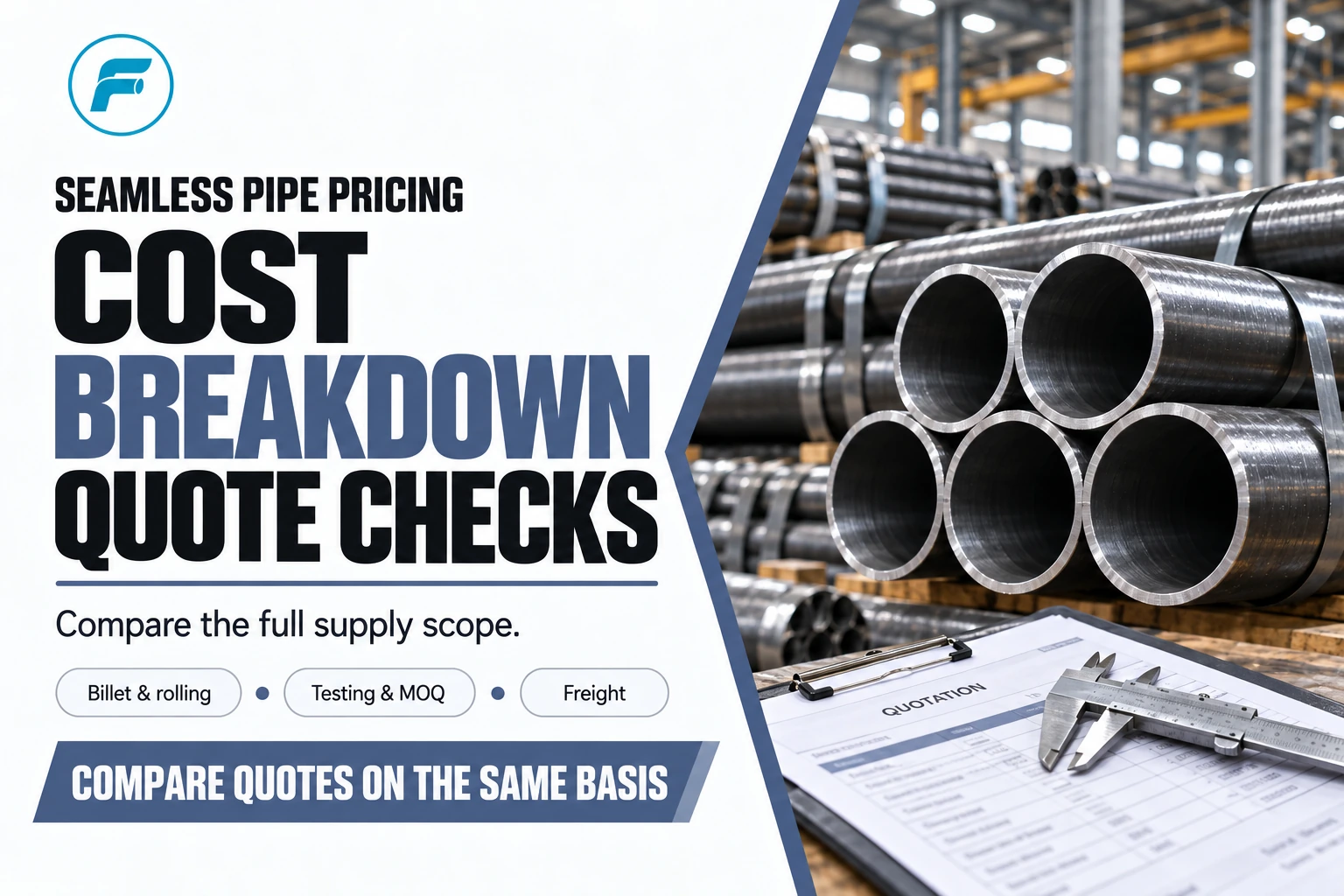

Calculate theoretical round-pipe weight from OD and wall thickness, then separate it from actual tally and shipping gross weight. The formula and density assumption support an estimate; contract weight, tolerances, packing and freight must be stated separately.
Use the reference chart and worked example below for estimates, then confirm actual or theoretical weight settlement and the verified gross weight needed for shipment.
For carbon steel round pipe, the standard theoretical weight formula is:
Weight per meter (kg/m) = 0.02466 × WT × (OD − WT)
Where OD = outside diameter in mm, WT = wall thickness in mm. The constant 0.02466 is derived from carbon steel density (7.85 g/cm³) × π ÷ 1000.
Material density varies by grade and product specification. For stainless or duplex pipe, use the density stated in the approved calculation basis or supplier data instead of a universal multiplier.
Total order weight:
Total weight (kg) = kg/m × length (m) × quantity (pcs)
OD 219.1 mm × WT 8.18 mm (8-inch Sch 40), length 12 m, quantity 150 pieces:
|
Step |
Calculation |
Result |
|
kg/m |
0.02466 × 8.18 × (219.1 − 8.18) |
42.55 kg/m |
|
kg per piece |
42.55 × 12 |
510.6 kg |
|
Total net weight |
510.6 × 150 |
76,590 kg |
|
Metric tons |
76,590 ÷ 1,000 |
76.6 MT |
At inquiry stage, budget roughly 77 MT before coating and packing allowances.
lb/ft = kg/m x 0.671969. For the worked example above, 42.55 kg/m is approximately 28.59 lb/ft. To convert the other way, kg/m = lb/ft x 1.488164.
The lb/ft column converts the displayed theoretical kg/m values and is rounded to two decimal places. It is not a separate API nominal-weight designation or actual scale weight. NIST unit-conversion reference.
Try the calculator: Open the steel pipe weight, package CBM and container planning calculator. The source code and version history are publicly available on GitHub.
The table below uses selected example wall thicknesses and formula outputs; it is not a complete pipe-schedule table. Recalculate with the ordered wall thickness and confirm dimensions against the applicable standard edition. For early comparison, the same calculation logic applies to seamless steel pipes and welded pipe as long as OD, wall thickness and density are defined.
|
NPS |
OD (mm) |
Wall thickness (mm) |
kg/m |
lb/ft |
Common standard / use |
|
1/2" |
21.3 |
2.77 |
1.27 |
0.85 |
Instrument tubing, small fluid line |
|
3/4" |
26.7 |
2.87 |
1.69 |
1.14 |
Water and gas utility |
|
1" |
33.4 |
3.38 |
2.50 |
1.68 |
General piping, low-pressure gas |
|
1-1/2" |
48.3 |
3.68 |
4.05 |
2.72 |
Water, HVAC, process line |
|
2" |
60.3 |
3.91 |
5.44 |
3.66 |
General fluid, ERW and seamless |
|
3" |
88.9 |
5.49 |
11.29 |
7.59 |
Industrial piping, process |
|
4" |
114.3 |
6.02 |
16.07 |
10.80 |
Structural, piling, process line |
|
6" |
168.3 |
7.11 |
28.26 |
18.99 |
Oil, gas, water and piling |
|
8" |
219.1 |
8.18 |
42.55 |
28.59 |
Pipeline, piling, industrial |
|
10" |
273.1 |
9.27 |
60.31 |
40.53 |
Transmission and process |
|
12" |
323.9 |
9.53 |
73.88 |
49.65 |
Large-diameter industrial piping |
|
14" |
355.6 |
9.53 |
81.33 |
54.65 |
Pipeline and water transmission |
|
16" |
406.4 |
9.53 |
93.27 |
62.67 |
Water transmission, oil and gas |
|
18" |
457.0 |
9.53 |
105.16 |
70.66 |
Bulk water transmission, piling |
|
20" |
508.0 |
9.53 |
117.15 |
78.72 |
Large-diameter pipeline |
|
24" |
610.0 |
9.53 |
141.12 |
94.83 |
Long-distance pipeline, piling |
|
30" |
762.0 |
9.53 |
176.84 |
118.83 |
Water and gas transmission |
|
36" |
914.4 |
9.53 |
212.65 |
142.89 |
Major water transmission, SSAW |
Note: For heavy-wall pipe (e.g., Sch 80, Sch 160, XXS), wall thickness increases significantly and the kg/m values above do not apply. Recalculate using the formula with the actual wall thickness.
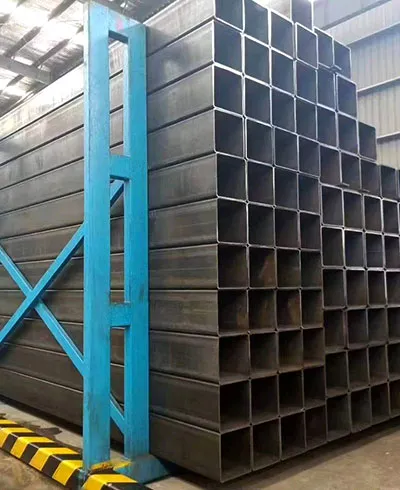
The round pipe formula does not work for SHS or RHS. Use cross-sectional area: For carbon steel hollow sections, supplier weight charts should be checked because corner radius and tolerance affect the actual area.
Weight per meter (kg/m) = steel cross-section area (mm²) × 0.00785
For RHS, the steel area = (B × H) − [(B − 2t) × (H − 2t)], where B = width, H = height, t = wall thickness. This simplified calculation ignores rounded corners. Do not apply a fixed percentage correction; use the manufacturer's section-property or theoretical-weight table for the specified standard and profile. For an exact value, use the manufacturer's theoretical weight tables from their EN 10219, ASTM A500 or AS/NZS 1163 catalog.
Example: RHS 150 × 100 × 6 mm
|
Dimension |
Value |
|
Outer area |
150 × 100 = 15,000 mm² |
|
Inner area (approx.) |
138 × 88 = 12,144 mm² |
|
Steel area (approx.) |
15,000 − 12,144 = 2,856 mm² |
|
Weight per meter |
2,856 × 0.00785 = 22.42 kg/m (before corner radius adjustment) |
The formula gives pipe body net weight only. What actually ships includes coatings, couplings, end protectors, bundling materials and wooden dunnage. These additions matter for freight cost and container payload calculations.
|
Addition |
Weight impact |
Notes |
|
Anti-rust oil (bare pipe) |
Negligible |
Thin surface application only |
|
Galvanizing (hot-dip) |
Calculate from specified coating mass and actual coated surface area |
Confirm the coating standard, specified local or average coating thickness, and supplier calculation |
|
FBE coating |
Calculate from coating density, specified thickness and coated surface area |
Confirm the project coating specification, DFT and cutback areas |
|
3PE coating |
Calculate each layer from the approved coating system, thickness, density and coated area |
Confirm coating build-up, cutbacks and supplier mass calculation |
|
Couplings (threaded pipe) |
Use the actual coupling mass for the specified size, grade and connection |
List coupling weight separately on the packing list |
|
Thread protectors |
Small but countable on large orders |
Steel or plastic; include in gross weight estimate |
|
Bundle straps and separators |
Use the packing list or an approved packing design; do not apply a universal percentage |
Wire, steel strip or PP strap depending on pipe size |
|
Wooden dunnage / end boards |
Use the actual tare mass of dunnage, end boards and securing materials |
Part of gross weight for freight and customs |
Do not apply one percentage allowance to every shipment. Build gross weight from pipe net weight plus the calculated coating mass, coupling and protector mass, and the actual or approved packing tare.
Steel pipe shipments hit container limits in different ways depending on the product. Weight, length and volume are independent constraints — a shipment may be limited by any one of them.
|
Pipe condition |
Limiting constraint |
Notes |
|
Small OD bundled pipe (2–6") |
Usually weight |
Payload may govern, but confirm the container CSC plate, carrier payload, axle and terminal limits, and load distribution for the booked equipment |
|
Large OD pipe (12" and above) |
Usually volume / floor area |
Volume, door opening, stacking method and surface protection may govern; calculate the arrangement for the actual OD and packing method |
|
12 m pipe |
Length |
A nominal 40-ft container has only limited clearance beyond a 12 m pipe, and door opening, end protection and loading access can prevent loading. Confirm the exact equipment drawing and booking; flat rack, open top or breakbulk may be required |
|
6 m pipe in 20-ft container |
Typically weight |
Confirm exact cut length, door clearance, bundle dimensions and payload before booking 20-ft equipment |
|
Coated large-diameter pipe |
Loading method and coating protection |
Cannot nest and stack as freely as bare pipe; handling restrictions reduce effective capacity |
|
Mixed pipe + fittings |
Documentation and blocking |
Fittings add complexity; list separately by HS code and weight; ensure blocking prevents pipe movement |
The article on container loading covers quantity estimation in detail. Weight is only one dimension — understanding the length and OD constraints together is what allows accurate container planning.
Permitted wall-thickness, outside-diameter and mass variation depends on the governing product and dimensional standard, manufacturing route, size and ordered condition. Do not apply a universal tolerance or overweight percentage. State the applicable standard edition and settlement basis in the purchase order, then compare the packing list or weighbridge record with that agreed basis.
Purchase orders should specify one of the following clearly:
|
Settlement basis |
When to use |
Buyer protection |
|
Theoretical weight |
Standard for most export orders quoted per metric ton by formula |
Simple; widely accepted; no weighing disputes but buyer bears overweight risk |
|
Actual weight (scale) |
When buyer wants to pay only for what is shipped |
More accurate but requires verified weighbridge records; may slow shipment |
|
Actual weight within tolerance |
Only when buyer and supplier expressly agree a permitted mass band and verification method |
Balances commercial simplicity with protection against consistent heavy production |
|
Per piece or per meter |
For some hollow section and structural pipe orders |
Removes weight ambiguity; useful when dimensions are tightly controlled |
Silence on weight settlement creates avoidable commercial ambiguity. State theoretical or actual weight, the formula or scale record, included accessories and packing tare, and any agreed mass tolerance in the purchase order.
For round carbon steel pipe, use 0.02466 × WT × (OD − WT), with both dimensions in millimetres. The result is kg/m based on a density of 7.85 g/cm³. Use measured or ordered dimensions consistently and identify which basis the calculation uses.
No. NPS and DN are nominal size designations. Use the corresponding outside diameter and the specified wall thickness in millimetres; a nominal 8-inch size is not an OD of 203.2 mm.
Actual dimensions, manufacturing tolerances, material density and surface condition can change the result. Coating, end protection and packing also affect shipping weight. Agree the invoicing basis in the purchase order and use verified shipment figures for transport documents.
Multiply kg/m by 0.671969 to obtain lb/ft. To convert lb/ft to kg/m, multiply by 1.488164. This unit conversion does not turn theoretical weight into actual scale weight.
Theoretical pipe weight is the starting point, not the final shipping figure. A dependable reconciliation keeps the pipe-body calculation, ordered quantity, coating or coupling allowance, packing weight and carrier limit as separate lines so that a buyer can see where each difference comes from.
The table below shows the minimum data trail needed to check a weight-based quotation or packing list.
| Check | Calculation basis | Evidence to retain |
| Pipe body net weight | Approved OD, wall thickness, density, length and quantity | Formula or applicable standard weight table |
| Order quantity | kg/m × ordered length × number of pieces | Quotation line item and approved quantity schedule |
| Added product weight | Coating, couplings, protectors or other supplied accessories | Supplier allowance or measured component weight |
| Packing weight | Bundles, straps, timber, frames and other packing materials | Packing design and final packing list |
| Transport check | Gross cargo weight by package and loading unit | Final load plan and carrier acceptance |
If the quotation is priced by metric ton, the purchase order should state whether invoicing uses theoretical weight, actual scale weight or an agreed standard table. The same basis should appear in the commercial invoice and packing list; otherwise a small difference per meter can become a material quantity dispute across a full shipment.
When Forever Steel reviews a weight-based inquiry, the useful inputs are the applicable product standard, material density where it differs from carbon steel, OD or section dimensions, wall thickness, length, quantity, coating and packing method. Buyers can use the steel pipe weight and logistics calculator for an initial estimate, then reconcile the result against the approved order data and final packing records.