+8615674993216
 sales@forever-steels.com
 English
 العربية

Sour service is an operating and materials condition, not a product grade. Specify H₂S partial pressure, pressure, temperature, pH, stress and fluid chemistry, then require the governing standard and cracking-control evidence. Correct dimensions, a passing hydrotest and a proper MTC do not by themselves prove sour-service qualification.
The reference standard is NACE MR0175 / ISO 15156. It provides a framework for selecting materials that are resistant to H₂S-related cracking. It does not certify grades as universally "sour service safe" — it requires suitability to be established against the actual environment and the material's metallurgical condition. The distinction matters in procurement because it means "NACE compliant" written on an inquiry or a quotation is not a complete technical specification.
For production-tubing material selection, the L80 and 13Cr comparison distinguishes CO2 corrosion, chloride exposure and H2S-related qualification questions.
H₂S can damage steel through several mechanisms that are distinct from ordinary corrosion. Procurement teams do not need to be corrosion engineers, but understanding the basic mechanisms is necessary to ask the right questions and review documentation properly.
|
Mechanism |
What happens |
Where it appears |
Procurement implication |
|
Sulfide stress cracking (SSC) |
Hydrogen entering the steel causes cracking under tensile stress, especially in hard zones |
Base metal and weld / HAZ at high stress |
Hardness control is critical — base metal, weld metal and HAZ must all be within limits |
|
Hydrogen-induced cracking (HIC) |
Hydrogen accumulates at inclusions and segregation bands, forming internal cracks without external load |
Plate and pipe body — often in the middle-thickness band where segregation is highest |
Requires clean steelmaking, controlled rolling and HIC test when the project specifies it |
|
Stepwise cracking (SWC) |
HIC cracks link through the wall thickness in a stepped pattern |
Longitudinal extent through the pipe wall |
A consequence of HIC — controlled by the same material requirements as HIC |
|
Stress-oriented HIC (SOHIC) |
HIC cracks develop perpendicular to applied stress, most dangerous at weld toes and stress concentrations |
Weld zones, formed pipe, cold-worked areas |
Welding procedure qualification and PWHT requirements become more critical |
The key point is that SSC is a stress-related phenomenon — harder material cracks more readily — while HIC is a cleanliness-related phenomenon that occurs without applied load. A pipe qualified against SSC criteria may still be vulnerable to HIC if the steelmaking quality is not controlled. Both need to be addressed, depending on the service conditions.
Sour service material requirements cannot be defined without knowing the environment. The same pipe grade may be acceptable in one H₂S environment and unacceptable in another. The following parameters need to come from the project's process engineer or corrosion engineer before any meaningful material specification can be written:
|
Parameter |
Why it controls material selection |
|
H₂S partial pressure |
The primary criterion for whether sour service provisions apply (ISO 15156 defines threshold values). Also governs the severity class of the sour environment |
|
pH of water phase |
Low pH accelerates cracking. Combined with H₂S concentration, it defines the severity region in the ISO 15156 environmental limits for carbon steel |
|
Temperature |
SSC risk is generally highest at ambient temperature; HIC risk persists across a wide range. Temperature also affects the threshold H₂S partial pressure |
|
Chloride content |
Relevant primarily for CRAs and stainless steel, but high chloride combined with H₂S can accelerate damage on carbon steel as well |
|
Total system pressure |
Governs the H₂S partial pressure calculation — pH2S = (mol fraction H₂S) × (total pressure) |
|
CO₂ and water chemistry |
CO₂ corrosion and H₂S cracking can occur together; produced water chemistry affects internal corrosion rate and pH |
Without these parameters, a supplier quoting "NACE compliant" pipe has no basis for that claim beyond a general statement. Once the environment is defined, material selection can be tied to specific ISO 15156 compliance criteria.
For carbon and low-alloy steel pipe in sour service, ISO 15156-2 defines material requirements in terms of hardness limits, yield strength limits, heat treatment condition, and (for HIC-exposed service) specific testing. The main requirements buyers need to track:
|
Requirement |
Typical limit / specification |
Notes |
|
Maximum hardness — base metal |
HRC 22 (HB 237) maximum for carbon and low-alloy steel |
Applies to the pipe body; lower limits may apply for specific alloy systems |
|
Maximum hardness — weld metal and HAZ |
HRC 22 maximum, confirmed by hardness traverse |
Often the critical constraint — welds can be harder than base metal if not properly controlled |
|
Minimum yield strength |
Often ≤ 690 MPa (100 ksi) for standard carbon steel grades |
Higher strength grades require individual qualification; P110 casing, for example, is not automatically acceptable |
|
Heat treatment condition |
Normalized, normalized-and-tempered, or Q+T depending on grade and thickness |
As-rolled condition generally not acceptable for sour service |
|
Carbon equivalent (CE) |
Project-specific — lower CE generally indicates lower SSC risk and better weldability |
CE value should be stated on the MTC; verify against welding procedure requirements |
|
Sulfur content |
Low-sulfur steel (≤0.003% S) typically required for HIC-resistant grades |
Reduces inclusion density and HIC initiation sites |
|
HIC test |
NACE TM0284 — CLR, CTR, CSR acceptance criteria per project specification |
Required when pipe may be exposed to wet H₂S without sustained stress (line pipe body, plates) |
|
SSC test |
NACE TM0177 Method A or equivalent — when required by project |
More relevant for components under stress: fittings, wellhead parts, OCTG |
API 5L PSL2 includes sour service provisions in Annex H (46th edition). These cover chemistry controls, hardness limits, HIC testing and additional NDT requirements above the baseline PSL2 specification. The grade itself — X52, X60, X65 — does not determine sour service acceptability; the production method, steel cleanliness, heat treatment and test results do. This is why sour-service inquiries for API 5L seamless line pipe should state the environment and testing scope before price comparison.
A practical procurement note: higher API 5L grades do not automatically perform better in sour service. X70 and X80 achieve their strength through higher CE values and microalloying, which can increase SSC susceptibility if hardness is not carefully controlled. For severe sour environments, many projects prefer X52 or X60 with strict chemistry and HIC testing over X70 with standard chemistry.
The purchase order for sour service API 5L line pipe should explicitly state: PSL2 with Annex H sour service requirements, the required HIC test standard and acceptance criteria, hardness limits for base metal and weld/HAZ, impact test temperature and minimum energy, and NDT scope for weld seam and pipe body.
Casing and tubing face a different set of sour service challenges compared to transmission line pipe. The primary concern in OCTG is SSC, because tubulars operate under significant tensile and compressive loads in a produced fluid environment that may contain H₂S. For procurement, this belongs to broader OCTG products selection rather than ordinary line-pipe sourcing.
Common OCTG grades and their sour service status under ISO 15156-2:
|
Grade |
General sour service status |
Notes |
|
J55 / K55 |
Generally acceptable with hardness verification |
Low strength; SSC risk is lower but hardness still needs to be confirmed |
|
N80 Type 1 |
Acceptable in many sour environments with hardness limits |
Normalized condition required; check hardness on MTC |
|
N80Q |
Better controlled hardness than N80 Type 1 |
Q+T condition — more consistent hardness across the pipe body |
|
L80 |
Specifically designed for mildly sour service in API 5CT |
Maximum hardness HRC 23; yield strength ceiling of 655 MPa (95 ksi) — these limits exist for SSC control |
|
C90 / T95 |
Acceptable in defined sour conditions with additional requirements |
Requires individual qualification; hardness and yield limits are critical |
|
P110 |
Not acceptable for sour service under standard ISO 15156 conditions |
High yield strength and hardness increase SSC risk; requires individual qualification or material substitution |
|
Q125 |
Not acceptable for standard sour service |
For ultra-deep and high-pressure wells; sour service requires specific qualification |
The connection type also matters. Thread compounds and premium connection geometries can affect hydrogen entry and stress concentration at the coupling, particularly under high cyclic loads.
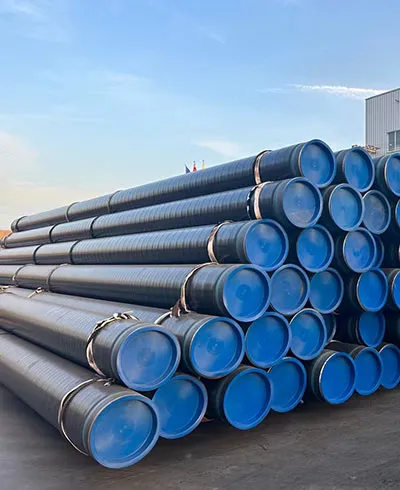
External coatings — 3PE, FBE, epoxy — protect the pipe exterior from soil corrosion, cathodic disbondment and mechanical damage during installation. They do not affect the pipe's resistance to internal H₂S cracking. A 3PE-coated X65 line pipe with no sour service qualification is still vulnerable to internal SSC or HIC if the service conditions require material qualification. For buried pipeline sections, 3PE coated steel pipe may be specified for external corrosion control, but this does not replace sour-service material qualification.
Both requirements apply independently. For a buried sour service pipeline, the typical approach is: sour-service-qualified base material (defined by chemistry, hardness, heat treatment and HIC testing), plus external coating system (3PE or FBE to ISO 21809), plus cathodic protection design. These are three separate specifications, not alternatives to each other.
Documentation for sour service pipe is more extensive than for standard line pipe. The following should be specified in the purchase order and checked before accepting the shipment:
|
Document |
What to check |
|
Mill test certificate (MTC) |
Actual chemical analysis values (especially S, P, CE), mechanical test results, hardness values, heat treatment condition — not just conformance statements |
|
Hardness test report |
Individual test values for base metal, weld metal and HAZ; method (Rockwell, Brinell or Vickers); sample location and traverse pattern |
|
HIC test report (NACE TM0284) |
Actual CLR, CTR and CSR values; test solution (Solution A or B per project specification); acceptance criteria applied |
|
SSC test report (NACE TM0177) |
When specified by project — test method, stress level, duration and result |
|
NDT report |
Scope, method, acceptance criteria and result for pipe body and weld seam |
|
Welding procedure qualification (welded pipe) |
Hardness survey of weld and HAZ; PWHT record if required; weld procedure approval for sour service |
|
Heat treatment record |
Furnace chart or time-temperature records; confirms actual Q+T or normalize condition was applied |
|
Hydrostatic test record |
Test pressure, duration, leakage result |
A vague inquiry produces a vague quotation. The following format gets a technically specific response:
|
Field |
Example |
|
Product and standard |
API 5L PSL2 seamless line pipe, Annex H sour service requirements, 46th edition |
|
Grade and size |
X52, OD 219.1 mm, WT 12.7 mm, length 11.8–12.5 m, bevel ends |
|
Environment (if available) |
H₂S partial pressure ≤0.3 kPa, pH 4.5–5.5, operating temperature 40–60°C |
|
Testing |
HIC test per NACE TM0284, CLR ≤0.15 / CTR ≥0.03 / CSR ≤0.01; CVN impact test at −20°C; UT for weld seam |
|
Hardness |
Max HRC 22 for base metal and weld/HAZ; hardness traverse report required |
|
Heat treatment |
Normalized or Q+T — confirm per order |
|
Coating |
3PE to ISO 21809-1, thickness class per project, holiday test at 10 kV; bare bevel ends |
|
Inspection |
Third-party inspection required before shipment; witnessing of HIC and hardness testing |
|
Documentation |
MTC to EN 10204 3.2, HIC test report, hardness report, NDT report, coating inspection report |
· ISO 15156-2:2020 — Cracking-Resistant Carbon and Low-Alloy Steels for H2S-Containing Environments — International Organization for Standardization.
· ANSI/NACE MR0175/ISO 15156 — Materials for Use in H2S-Containing Environments — Association for Materials Protection and Performance.
· NACE TM0177 — Laboratory Testing of Metals for Resistance to Sulfide Stress Cracking — Association for Materials Protection and Performance.
· NACE TM0284 — Evaluation of Pipeline and Pressure Vessel Steels for Resistance to Hydrogen-Induced Cracking — Association for Materials Protection and Performance.
· API Specification 5L, Line Pipe — 47th Edition — American Petroleum Institute.