+8615674993216
 sales@forever-steels.com
 English
 العربية


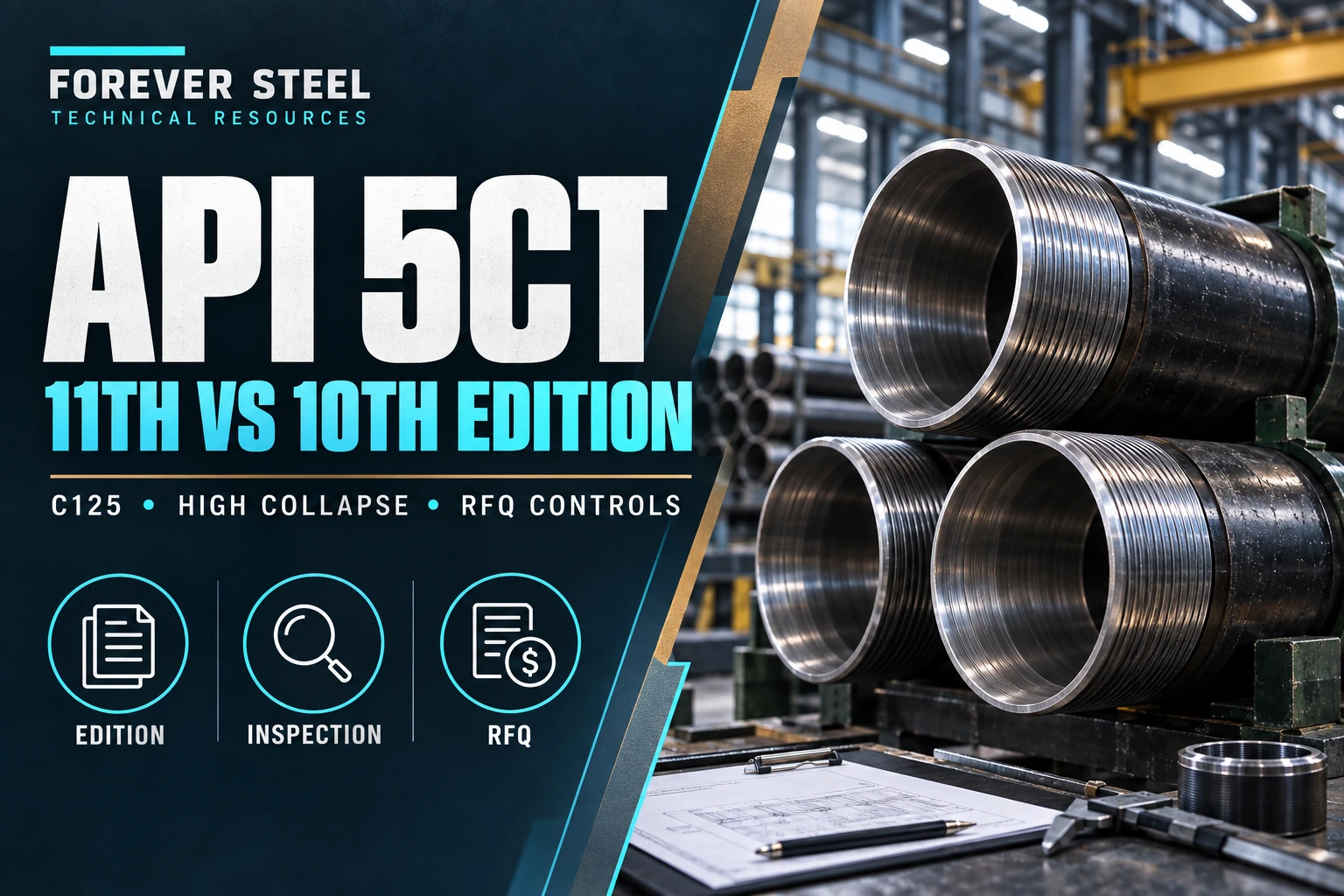
API Spec 5CT 11th Edition (December 2023) removed the Product Specification Level (PSL) system and added grade L80 3Cr. It has since been amended by Addendum 1 and three errata. An order that says only “latest API 5CT” or “PSL 2” no longer defines the requirements. This guide lists what changed from the 10th Edition and what an RFQ must state.
Quick answer.The 11th Edition was published in December 2023, and Errata 1 corrected its Monogram effective date to January 1, 2025.[5] Addendum 1 took effect on June 1, 2026.[4] Errata 3 was published on June 24, 2026 with immediate effect.[7] Name the edition, the addendum and the errata on every RFQ and purchase order.
The version determines what applies to manufacturing, marking, certification and acceptance.
|
Document |
Issue or effective date |
What it means for buyers |
|
10th Edition |
Published 2018; Monogram effective July 1, 2019[1] |
Legacy baseline. Do not copy its PSL structure into an 11th Edition order without a requirement-by-requirement review. |
|
11th Edition |
Published December 2023; Monogram effective January 1, 2025[2][5] |
Current basis for products manufactured and Monogrammed after the transition date. |
|
Errata 1 |
May 2024[5] |
Corrected the Monogram effective date; revised purchaser-information, testing, marking and certification references. |
|
Errata 2 |
August 2024[6] |
Corrected purchasing information, straightening provisions, dimensional tables and marking tables. |
|
Addendum 1 |
Issued May 2025; effective June 1, 2026[4] |
Adds C125, high-collapse requirements, end-sizing and thermal-recovery controls, end drifting and other technical changes. |
|
Errata 3 |
June 24, 2026; effective immediately[7] |
Corrects C110/C125 SSC test durations and further table, marking and test-lot errors. |
Buyer action:record the exact edition, addendum and errata status in the RFQ, quotation, purchase order, inspection plan and certificate-review checklist. Stock made to an earlier edition is a documented deviation that needs purchaser approval. An older Monogrammed product does not automatically satisfy a current order.
|
Topic |
10th Edition practice |
11th Edition and current updates |
Buyer check |
|
PSL |
PSL references and Annex H communicated additional controls. |
No PSL references. Former requirements moved into the body, became SRs or were deleted.[3] |
Translate each intended requirement. Do not replace PSL 2 or PSL 3 with one generic SR. |
|
Grade family |
No L80 3Cr in the original 10th Edition. |
State the exact grade and type, not only “L80” or a strength number. |
|
|
Inspection |
NDE, hydrotest, dimensional and mechanical testing requirements. |
Advanced automated inspection and updated straightness-measurement controls.[2] |
Define method, coverage, acceptance basis, qualification and report content. |
|
Impact testing |
Depended on grade, product and applicable PSL provisions. |
Selected Charpy provisions for thick-wall products simplified and redistributed.[2] |
Check grade, wall, orientation, specimen size and SR. Do not rely on a blanket energy value. |
|
Pipe ends |
End-finish requirements, but no full validation framework. |
Addendum 1 adds end-sizing and thermal-recovery validation and production controls.[4] |
Request validation evidence when the product and process trigger it. |
|
Collapse |
Assessed against the applicable design basis. |
Addendum 1 adds normative high-collapse (UC) requirements.[4] |
Require the claimed rating, qualification route, test evidence and certificate entry. |
|
Thread protectors |
Part of delivery control. |
Enhanced protector quality and testing.[2] |
Confirm protector class, fit, condition and packing before shipment. |
The 11th Edition did not rename PSL 1, PSL 2 and PSL 3. According to API’s transition notice, PSL-related provisions were handled in three ways: incorporated into the main clauses, converted into selectable Supplementary Requirements (SRs), or removed.[3] The result differs by grade and topic, so each legacy requirement must be stated explicitly.
|
Legacy intent |
What the buyer must define now |
Typical evidence |
|
Extra heat-treatment or straightening control |
Grade/type, route, body clause and any relevant SR |
Process route; heat-treatment, straightening or stress-relief record |
|
Higher impact-testing expectation |
Test temperature, orientation, specimen size, absorbed energy and applicable SR |
Impact-test report linked to heat/lot and product |
|
Extra body or end NDE |
Method, orientation, coverage, reference standard, acceptance level and SR |
NDE procedure, personnel qualification, calibration, traceable results |
|
Full wall-thickness coverage |
Whether 100 percent automated coverage and piece-level reporting are required |
Calibration record and minimum measured wall record, when specified |
|
Extra hardness or SSC control |
Grade-specific hardness, SSC method, solution, specimen plan and acceptance criteria |
Hardness map, SSC report, validation record |
A quotation that says only “API 5CT 11th Edition, equivalent to the old PSL 2” is uncontrolled. Ask the supplier to state which requirements are in the base offer and which need purchaser selection, added testing, a separate process route or a price adjustment.
L80 3Cr is new in the 11th Edition.[2] In the current text, “L80” can refer to L80 Type 1, L80 3Cr, L80 9Cr or L80 13Cr, which differ in metallurgy and service envelope. Name the full type in the RFQ and give the actual fluids, H2S, CO2, chlorides and temperature. A grade name is not a sour-service approval.
API lists advanced automated inspection and updated automated straightness measurement as major changes.[2] Specify the result you need (method, orientation, coverage, reference standard, calibration or validation, acceptance basis and reporting) rather than the supplier’s equipment brand.
The 11th Edition reorganizes and simplifies selected Charpy absorbed-energy provisions for thick-wall products.[2] Before comparing test values, confirm product form, grade, wall thickness, specimen orientation, full-size or sub-size specimen, test temperature, averaging rule and any purchaser-selected SR. An energy value copied from a mill summary is not enough.
Enhanced protector quality is meant to reduce thread and seal-area damage in storage, handling and export transport.[2] Add protector class or project requirement, fit, visual condition and packing verification to the pre-shipment inspection plan. Protectors do not replace thread gauging or connection-specific inspection.
A January 2025 API licensing notice removed “Pipe Threader” from the API 5CT licensing form and moved casing and tubing threading to API 5B. Affected licensees were transitioned to an API 5B license.[8] When a threader is a separate facility, verify its API 5B scope, not only the mill’s API 5CT license.
Addendum 1 took effect on June 1, 2026.[4] It changes material selection, performance claims, pipe-end processing, testing and certification.
|
Topic |
What changed |
Procurement consequence |
|
Grade C125 |
Adds C125 with chemical, mechanical, heat-treatment, hardness, SSC, NDE, marking and certification requirements. |
Confirm size, wall, connection, service qualification, test route and current mill capability. |
|
High-collapse UC |
Adds normative Annex H for products with a collapse rating above the API 5C3 value. |
Require rating, units, qualified procedure, production controls, testing and certificate entry. “High collapse” alone is not enough. |
|
End sizing |
Defines swaging, expansion or rounding of pipe ends for threading or special end finishes. |
Ask whether the process changes wall, ovality or properties and whether validation is triggered. |
|
Thermal recovery |
Adds validation and production controls for heating end-sized pipe ends to recover properties or relieve stress. |
Request validation, controlled parameters, temperature/time records and test results. |
|
End drifting |
Clarifies end-drift testing after coupling power-tight make-up or end sizing, with specified exceptions. |
Define the drift basis and get a result that covers the processed end, not only the pipe body. |
|
Welded-product flattening retest |
Clarifies the retest route after a failed flattening specimen (adjacent lengths or lot disposition, depending on sample location). |
Treat the original failure, retest sampling, accepted lengths and any re-heat-treatment as controlled records. |
|
Transition-error corrections |
Corrects technical errors introduced between the 10th and 11th Editions. |
Revalidate cached size, mass, drift, marking and grade tables against the current publication. |
|
Property |
Addendum 1 value |
Buyer interpretation |
|
Minimum yield strength |
125 ksi / 862 MPa |
The grade number is minimum yield strength, not minimum tensile strength. |
|
Maximum yield strength |
135 ksi / 931 MPa |
The upper yield limit is controlled. Higher is not automatically better. |
|
Minimum tensile strength |
130 ksi / 896 MPa |
C125 does not have a 125 ksi minimum tensile strength. |
|
Maximum mean hardness |
34.0 HRC / 319 HBW |
Hardness and variation controls remain part of qualification and acceptance. |
|
Manufacture and heat treatment |
Seamless; quenched and tempered; minimum tempering temperature 630 °C / 1166 °F |
Confirm the current qualified route and heat-treatment records for the ordered product. |
API 5CT assigns C125 no universal well depth or pressure rating. Burst, collapse, tension, connection performance, combined loads, temperature and corrosion qualification depend on the full product geometry and project design.
Addendum 1 defines a high-collapse tubular as a product made under Annex H with a collapse rating above the value determined using API 5C3. It sets no universal 150 ksi threshold. The manufacturer’s procedure must cover the parameters behind the claimed rating, with process control, inspection and testing, and collapse test results are reported in the certificate.[4] Ask these questions before accepting a “high-collapse” offer:
|
Review item |
Question for the supplier |
|
Rating basis |
What collapse rating is claimed, in which units, for which exact OD, wall and grade? |
|
Qualified procedure |
Which manufacturing parameters are controlled, and how were they validated? |
|
Production measurements |
How are wall thickness, ovality, tensile properties and other relevant variables measured and recorded? |
|
Testing |
Which production or qualification collapse tests apply to this order? |
|
Certification |
Will the UC designation, rating and test results appear in the material certificate? |
|
Design approval |
Has the operator or responsible engineer accepted the rating and design basis for the actual load case? |
Errata correct the published standard, including purchasing tables, dimensions, marking, test durations and acceptance records.
|
Errata |
Selected confirmed corrections |
Buyer or supplier action |
|
Errata 1, May 2024[5] |
Corrected the Monogram effective date to January 1, 2025. Revised purchaser-information tables, SR references, SSC, NDE, marking, hydrotest and certification provisions. |
Update controlled copies, training and purchase templates. Do not reuse the superseded effective date. |
|
Errata 2, August 2024[6] |
Corrected Table 4, gag-straightening/stress-relief language, martensite wording, casing/tubing dimension and mass tables, drift headers and marking tables. |
Recheck internal databases and quotation tables, especially values transcribed before August 2024. |
|
Errata 3, June 2026[7] |
Clarified C110 and C125 Method D SSC minimum test durations, expanded a manufacturer section title, and corrected tensile, marking and test-lot tables. |
Confirm SSC procedures and certificates show 14 days for C110 and 17 days for C125 where the corrected Method D requirement applies. |
An erratum does not change every order in the same way. A J55 casing order, a C125 sour-service qualification and a high-collapse P110 order touch different clauses. Identify the controlled publication first, then run an item-specific impact review.
Two quotations cannot be compared on OD, weight, grade and price alone if one includes purchaser-selected SRs, end-processing validation or extra inspection and the other does not. Complete every field below before requesting prices.
|
RFQ or PO field |
What to state |
Mistake to avoid |
|
Standard basis |
API Spec 5CT 11th Edition, Addendum 1, and applicable Errata 1–3 |
Writing only “latest API 5CT” |
|
Product |
Casing, tubing, pup joint, coupling, coupling stock or accessory material, and its role in the well |
Using “OCTG” as the full description |
|
Size and weight |
OD, nominal weight, wall or ID reference, drift, length range, quantity and units |
Selecting from an uncontrolled legacy chart |
|
Grade and type |
Full grade/type, such as N80Q, L80 3Cr or C125 |
Writing only “L80” or “125 ksi” |
|
Manufacturing route |
Seamless or permitted welded route; heat-treatment condition |
Assuming the grade fixes the route |
|
Connection |
STC, LTC, BTC, NUE, EUE or the exact licensed proprietary designation |
Treating different connections as equivalent |
|
Service data |
Pressure, temperature, fluids, H2S, CO2, chlorides, design loads and completion duty |
Inferring sour-service suitability from the grade name |
|
SR matrix |
Each required SR and purchaser agreement |
Carrying PSL 2 or PSL 3 forward as shorthand |
|
Inspection |
NDE, hydrotest, drift, dimensions, thread inspection, hold and witness points, defined before production |
Requesting extra evidence after packing |
|
Documentation |
MTC, coupling certification, test reports, tally, release note and traceability package |
Accepting a certificate not matched to the shipped joints |
|
Delivery |
Marking, protectors, bundling, shipping marks, destination, and any edition-related stock restriction |
Treating thread protection as cosmetic packing |
Example controlled RFQ line:API Spec 5CT, 11th Edition, including Addendum 1 and applicable Errata 1–3; [casing/tubing], [OD] x [nominal weight], [grade and exact type], [manufacturing route], [connection], Range [ ], [standard or special drift], quantity [ ], with attached SR matrix, inspection plan, certification and packing requirements.
For size and weight lookup, use the API 5CT casing dimensions database or the API 5CT tubing dimensions and drift database. Then validate the selected row against the controlled standard, current errata, mill data and project design.
|
Claim |
Why it is incomplete |
What to confirm |
|
“The 11th Edition equals the old PSL 2.” |
PSL provisions were moved, converted to SRs or removed, depending on the topic. |
The intended heat treatment, impact, NDE, wall, hardness, SSC and reporting requirements, each converted to a clause or SR. |
|
“C125 suits every ultra-deep well.” |
Grade strength is one input to well design. |
Geometry, connection, burst/collapse/tension, combined loads, temperature and corrosion qualification. |
|
“High collapse means a fixed minimum rating.” |
Addendum 1 sets no universal threshold. |
Exact UC rating, units, Annex H qualification, test and certificate. |
|
“L80 13Cr is sour-service qualified.” |
13Cr content does not establish suitability for every H2S environment. |
Actual environment, ISO 15156/NACE basis, hardness, heat treatment and project qualification. |
|
“Monogrammed 10th Edition stock meets an 11th Edition PO.” |
Edition compliance and contractual acceptance are separate questions. |
Manufacture date, marking, MTC, deviations and purchaser approval. |
|
“API 5CT compliance proves the premium connection.” |
Product specification and connection qualification are separate scopes. |
Licensed connection source, performance envelope, qualification and running procedure. |
|
“A size-table row proves availability.” |
A dimensional combination is not a production commitment. |
Mill capability, grade/type, route, connection, quantity and delivery schedule. |
|
Area |
Required review |
Release evidence |
|
Document control and training |
Current 11th Edition, Addendum 1 and Errata 1–3; training for production, laboratory, inspection, certification and sales staff |
Revision register, affected-document list, training records completed before the effective date |
|
Contract review |
Legacy PSL clauses, SR selections, purchaser agreements and deviations |
Signed technical review and deviation schedule |
|
Capability and licensing |
Grade/type, product, route and API license scope; API 5B for threading |
Current license scope and approved manufacturing source |
|
Process validation |
Automated inspection, straightness measurement, high-collapse, end sizing and thermal recovery, as applicable |
Validated procedures, qualification reports, change-control records |
|
Inspection, certification and marking |
Calibration, personnel competence, test frequency, acceptance criteria; edition, grade/type, SR, UC data, coupling certification and markings |
ITP, calibration certificates, NDE/hydro/drift/thread reports, MTC checked against tally and shipped product |
|
Supplier control |
Coupling, protector, processor and testing-subcontractor requirements |
Approved supplier scope, incoming evidence, nonconformance control |
Implement by requirement, not by equipment brand. API 5CT calls for a result, a process validation or a calibrated measurement. It does not require every mill to buy a laser gauge, a phased-array unit or a furnace with one universal temperature-uniformity figure. The facility must show that its chosen method meets the applicable requirement.
No. The 11th Edition no longer references PSLs. Former PSL requirements were moved into the main body, converted into SRs or removed, so the purchaser must specify each control individually.[3]
January 1, 2025, as corrected by Errata 1. Products manufactured on or after that date can be Monogrammed only under the 11th Edition.[5]
Yes. Addendum 1 was issued in May 2025, and its Monogram Program effective date was June 1, 2026.[4]
No. Under Addendum 1, C125 has a 125 ksi minimum yield strength and a 130 ksi minimum tensile strength.[4]
No. Annex H controls UC products, but the rating is specific to the product, manufacturing route and qualification. Request the exact value and the supporting evidence.[4]
It signals legacy intent but does not create a complete current requirement. Convert it into explicit clauses, SRs, testing, inspection and reporting requirements before accepting the order.
As of 2026-09-20, API has published Errata 1, 2 and 3 for the 11th Edition.[5][6][7] List all three and update the reference if API issues a later one.
Where the Addendum 1 provisions apply: the process-validation basis, grade/size/connection scope, deformation level, temperature and time controls, mechanical or SSC tests, production records and the end-drift result.[4]
No. Casing and tubing threading moved to API 5B. API 7-2 covers only rotary shouldered connection threading transferred from API 7-1.[8]
Replacing “10th Edition” with “11th Edition” on a purchase order is not enough. Remove legacy PSL shorthand, select the applicable SRs, cite Addendum 1 and Errata 1–3, and define the inspection and certification evidence for each product. Suppliers need controlled publications, validated processes, a current license scope and traceable release records. The safest order fixes edition, grade/type, geometry, connection, service conditions, inspection and documents before production starts.
To have an RFQ checked against the 11th Edition, send your size, grade/type, connection and service data with a request for API 5CT casing pipe or API 5CT tubing pipe.
API 5CT Casing and Tubing Complete Guide
API 5CT Pre-Shipment Inspection: Thread Gauging, Drift Test, Hydrotest, NDT and Tally Check
Standard API Threads vs Premium Connections: When STC, LTC, BTC, NUE or EUE Is Not Enough
[1] API Specification 5CT 10th Edition announcement
[2] API Specification 5CT 11th Edition announcement
[4] API Spec 5CT 11th Edition, Addendum 1 (May 2025)
[5] API Spec 5CT 11th Edition, Errata 1 (May 2024)
[6] API Spec 5CT 11th Edition, Errata 2 (August 2024)
[7] API Spec 5CT 11th Edition, Errata 3 (June 2026)
[8] API threading licensing information forms update (January 2025)