+8615674993216
 sales@forever-steels.com

 English
 العربية



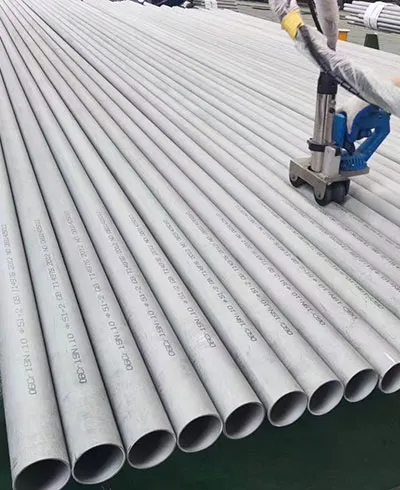
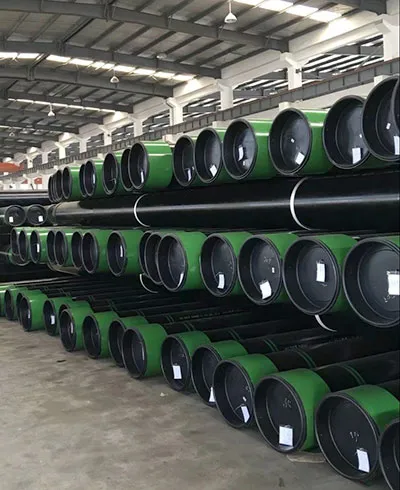
Welded steel pipe is a proven choice for large-diameter potable water transmission mains, but the purchase is never just “pipe”. Select the pipe body (SSAW, LSAW or ERW), internal lining (cement mortar, liquid epoxy, FBE or polyurethane), external coating and field joints as one coordinated package, then confirm drinking-water approval for the lining system that will actually be supplied. A pipe standard alone settles neither decision.
This guide covers bulk mains between treatment plants, pumping stations and reservoirs, including connection spools. It does not select domestic plumbing. Start with the owner’s specification and the hydraulic and structural design; use the tables below to turn those requirements into a comparable steel-pipe inquiry.
For raw water, reclaimed water or another conveyed medium, start with the Steel water pipe selection by service to identify the matching service guide and required inputs.
|
Decision |
Options to evaluate |
What settles it |
|
Pipe body |
SSAW, LSAW or ERW to AWWA C200, API 5L / ISO 3183 or EN 10224, as the project specifies |
OD, wall, design and surge pressure, external loads, owner approval |
|
Internal lining |
Cement mortar (AWWA C205), liquid epoxy (C210), fusion-bonded epoxy (C213), polyurethane (C222) |
Delivered-water chemistry, velocity, approval scheme, joint access |
|
External protection |
3LPE/3PE, FBE, polyolefin, tape, polyurethane or mortar coating, with cathodic protection where specified |
Soil, groundwater, buried vs exposed sections, installation method |
|
Field joints |
Welded, flanged, gasketed or coupled, with internal and external reinstatement |
Diameter and man-entry access, repair procedure, inspection and release |
|
Drinking-water approval |
NSF/ANSI/CAN 61, WRAS or another scheme accepted at the destination |
Exact product, production site and use conditions covered by the listing |
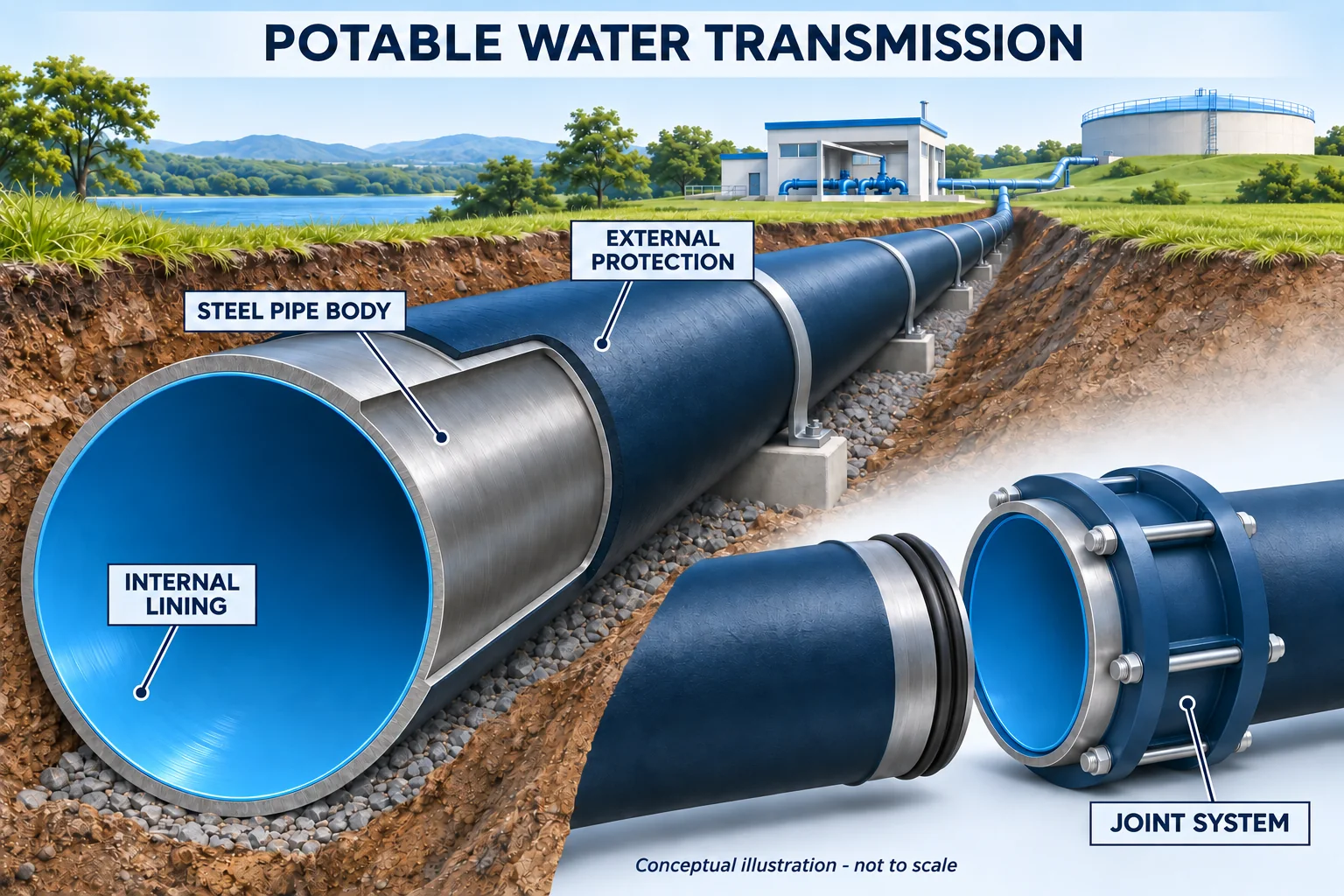
Bulk-water transmission concept showing the pipe body and protection as separate parts of the purchase. Illustrative only; not a project record.
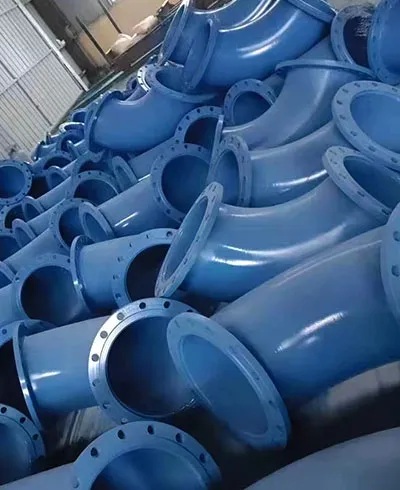
Welded steel is a candidate for large-diameter bulk mains, and fabricated bends, reducers and fittings can follow the route geometry. The trade-off is that carbon steel needs a lining and a coating that stay continuous through every joint, and buried lines usually need an external corrosion-control design.
Use the table to screen steel against other water-main materials under the same design inputs. It is a starting point, not a ranking.
|
Material |
Typically strong on |
Check before choosing |
|
Welded steel (lined and coated) |
Large diameter; high pressure; surge tolerance; welded restrained joints; fabricated fittings |
Lining and coating continuity at joints; cathodic protection; skilled field welding and reinstatement |
|
Ductile iron |
Gasketed joints and fast laying in small to medium sizes; wide availability |
Joint restraint for thrust; weight and cost at large diameter; aggressive soils need protection |
|
GRP (fibre-reinforced plastic) |
Corrosion-immune pipe body; light handling |
Stiffness, bedding and deflection control; pressure and surge limits; fittings and joint supply |
|
Prestressed concrete cylinder |
Established large-diameter option |
Heavy handling; prestressing-wire corrosion is a recognised concern in aggressive soils |
When comparing SSAW steel pipe and LSAW steel pipe, first confirm that both routes satisfy the project, then compare them on the same grade, outside diameter, wall thickness, tolerances, inspection and joint details. A spiral seam or a straight seam is not, by itself, a complete acceptance or rejection rule.
|
Pipeline location |
Candidate pipe route (where the design permits) |
Approval inputs |
|
Bulk transmission main |
SSAW or LSAW, as the approved specification permits |
Approved OD and wall envelope; seam inspection and NDT; coil or plate traceability; end geometry and bevel |
|
High-load or crossing section |
LSAW or SSAW, as the design and owner approve |
Grade and wall for the load case; seam inspection; ovality and delivered length |
|
Connection line |
ERW where the product envelope and specification fit |
Available size and grade; seam inspection; lining access; mating connections |
|
Fabricated spool (pump station, valve chamber, tie-in) |
Fabricated steel pipe and fittings to approved drawings |
Pressure basis; supports and restraint; flange interfaces; lining continuity |
Review ERW steel pipe only where it fits the required product envelope. Do not specify seamless pipe merely because it sounds stronger, or switch to a thinner wall because a higher grade is available; the designer must approve the complete load and installation basis. For the seam-inspection side, see the guide to weld seam inspection for ERW, LSAW and SSAW pipes.
The pipe body, the drinking-water-contact materials and the connections each have their own basis, and a complete water-pipe order names more than one document. AWWA C200 covers steel water pipe 6 in. (150 mm) and larger; API 5L / ISO 3183 and EN 10224 are other pipe-product references a project may specify, and none of them makes the lining or joint materials drinking-water compliant. The AWWA steel water pipe standards map shows how the AWWA documents fit together, and the AWWA C200 versus API 5L comparison covers the pipe-product choice in detail.
Always cite the contractual edition and amendments. AWWA Standards List.
Obtain the delivered-water analysis, operating temperature, disinfectant regime, expected residence conditions and owner acceptance criteria before choosing a lining. Northwest Pipe notes that cement mortar adds stiffness, that its high-pH environment passivates the steel and that the lining can self-heal in the presence of water, and that it performs best at flow velocities of 20 ft/s (about 6 m/s) or less. It describes liquid epoxy and polyurethane as options for higher velocities and demanding conditions, with epoxy performance depending on surface preparation and curing. Steel Mains also identifies water chemistry and residence time as selection considerations. These are manufacturer descriptions: useful starting points, not approvals for another supplier’s formulation. Northwest Pipe Linings; Steel Mains Introduction to Cement Mortar Lining.
For a main carrying desalinated product water, review final water chemistry and commissioning conditions before transferring an existing potable-water lining specification.
|
Lining |
AWWA |
Drinking-water acceptance to establish |
Internal joint repair and change conditions |
|
Cement mortar |
C205 |
Approval of the lining materials where the destination requires it; compatibility with the delivered water |
Mortar reinstatement at site joints; curing and handling; any substitution is an engineered review |
|
Liquid epoxy |
C210 |
Exact product and use conditions covered by the listing |
Field-applied repair product and its listing; surface preparation, cure and inspection; substitution review |
|
Fusion-bonded epoxy |
C213 |
Exact powder and production site covered by the listing |
Repair route where the factory coating is interrupted at joints; continuity records; substitution review |
|
Polyurethane |
C222 |
Exact formulation and water-contact evidence |
Repair product and procedure; application controls; substitution review |
•Water chemistry:pH, alkalinity, hardness or saturation index, chlorine or chloramine, temperature.
•Flow regime:design velocity, and low-flow or stagnant periods during start-up or seasonal demand.
•Diameter and joint access:can a crew enter the pipe to reinstate the internal joint, or must the joint design avoid it?
•Approval scheme:which drinking-water listing the owner accepts, and which exact product it covers.
•Repair and maintenance:how a damaged lining will be repaired in the field and who releases it.
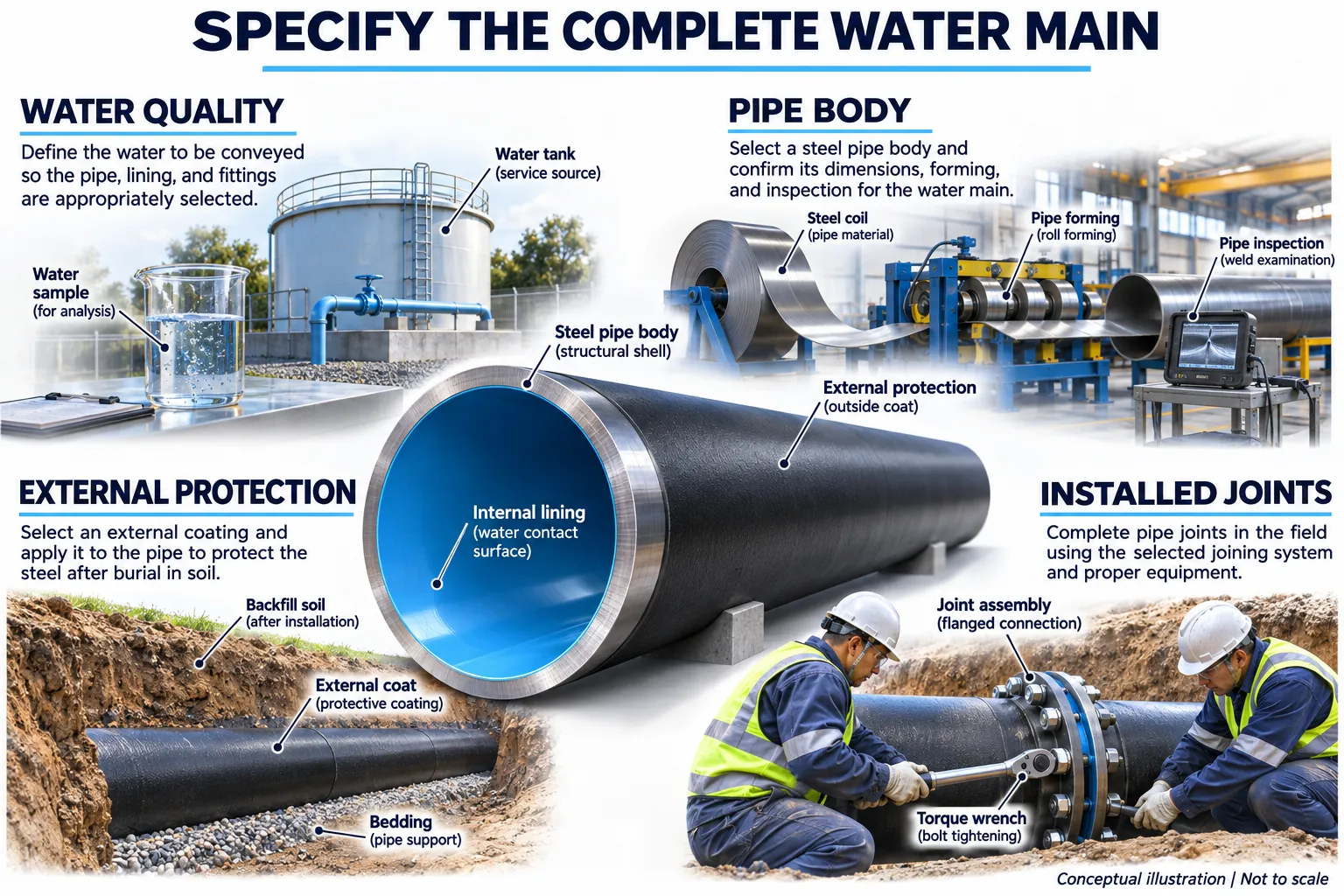
Four coordinated decisions for a potable-water main. Review water, pipe body, external protection and installed joints as connected purchase items.
Where the project specifies NSF/ANSI/CAN 61, check the applicable certification listing and its use conditions for the proposed materials and components. NSF describes the standard as a health-effects evaluation for materials in contact with drinking water. It is not a wall-thickness calculation, a pressure rating or a coating-durability guarantee. Other destinations accept other schemes, for example WRAS in the UK or the national schemes of France and Germany. NSF ANSI CAN 61 Testing and Certification.
Ask the supplier for a document set that answers these points:
• Which exact product name or formulation, and which production location, the certificate covers.
• The water-contact application, size or temperature limits and any restrictions on the listing.
• Whether the joint repair materials, fittings and any lubricants or sealants are covered as well as the shop lining.
• That the listing is current and issued by a body the owner accepts.
A coating brochure or an unrelated certification logo does not establish acceptance of the delivered water-contact system.
External protection addresses the surrounding exposure and installation method; the internal lining addresses the conveyed water. An external 3PE coating does not replace an internal lining. If liquid epoxy lined pipe or FBE coated steel pipe is proposed, identify the surface being protected and its own specification.
|
Exposure |
Coating families to evaluate |
Design note |
|
Buried, general soil |
3LPE/3PE, FBE, extruded polyolefin or tape systems |
Usually paired with a cathodic protection design |
|
Aggressive or saline ground |
Heavier-build polymer systems, polyurethane or a multilayer system |
Soil resistivity, chlorides, sulfates and groundwater drive the choice |
|
Exposed or above-ground |
Liquid-applied coating systems with UV-stable topcoat |
Separate atmospheric exposure from buried sections |
|
Cement mortar coating |
Mortar coating where specified |
Handling and impact allowances; joint reinstatement |
Issue a coating and lining schedule by pipe section instead of one note for the whole route, check each coating against the requirements the project actually adopts, and send the cathodic protection requirements (for example AMPP/NACE SP0169) with the inquiry where the design includes them.
Agree how each installed joint will regain internal and external protection after assembly. A continuous shop lining can still have an unresolved site joint, so settle three decisions before award:
•Internal access:can a crew enter the pipe to reinstate the internal joint at this diameter, or must the joint design avoid it?
•Drinking-water-contact repair material:the exact mortar, epoxy or polyurethane used on site, and the approval that covers it.
•Completion and release:who applies, inspects and accepts the joint before the line is filled.
Where diameters are too small for internal access, the joint design itself must provide continuity; this is a design decision, not a site fix. Cutback, surface preparation, cure and inspection steps follow the field joint coating guide for steel water pipe.
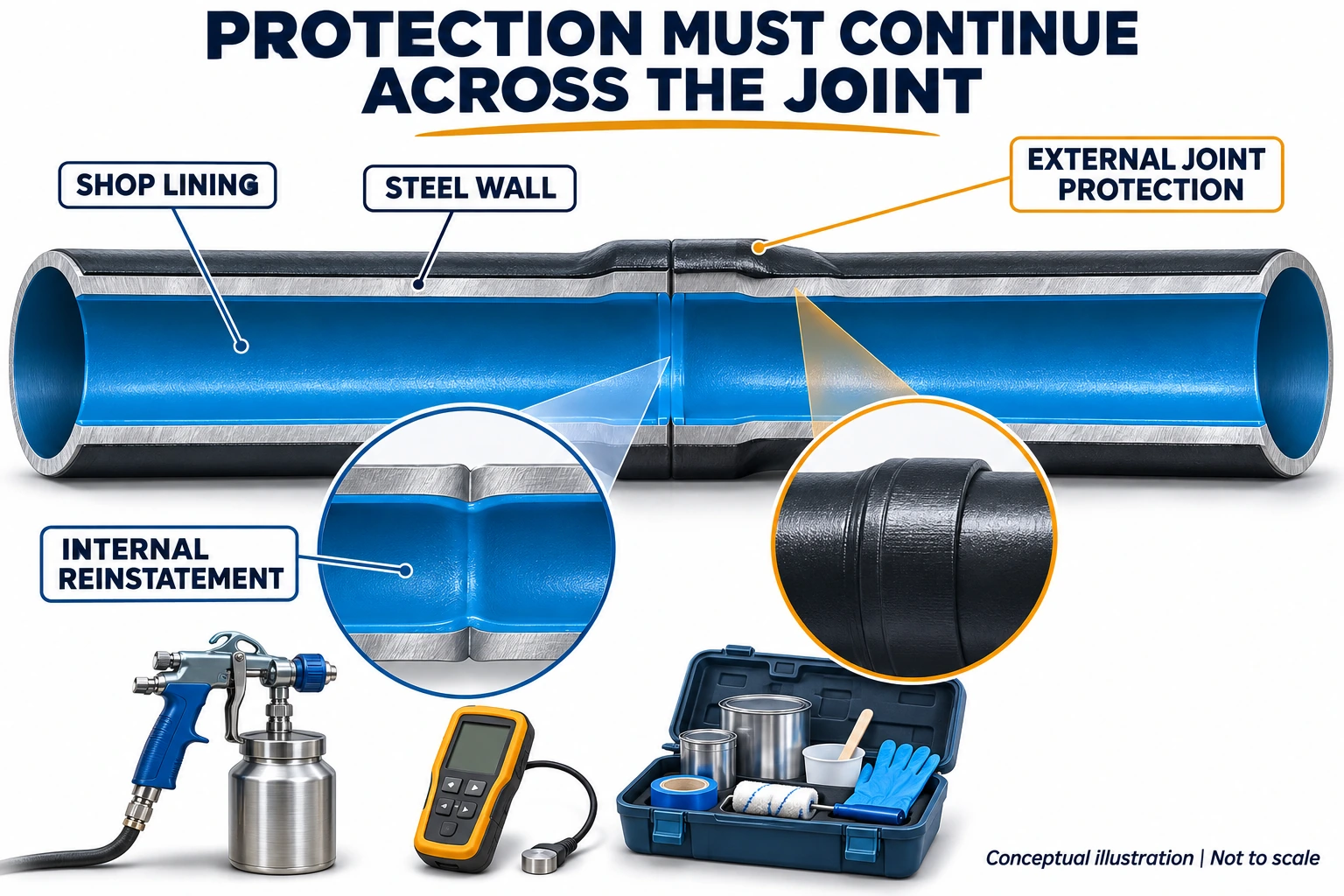
Illustrative joint checklist. The diagram separates factory lining from site reinstatement; it does not prescribe a joint geometry or repair dimension.
|
Mistake |
Why it changes the order |
Correction |
|
API 5L automatically makes a drinking-water pipe |
Pipe manufacture and water-contact acceptance are different questions |
Name both the pipe specification and the water-contact system |
|
A lining certificate approves the complete assembly |
Fittings and joint products may have different scopes |
Review every water-contact component and the applicable approval |
|
The cheaper pipe price is the cheaper installed system |
Field lining, joints, inspection and repair can be excluded |
Compare equal installed supply and responsibility boundaries |
|
One protection system fits the whole route |
Buried and exposed sections have different conditions |
Issue a coating and lining schedule by pipe section |
Send these items with the inquiry so every bidder prices the same scope. State whether factory lining, site reinstatement and installation are included or excluded.
|
Item |
What to include |
|
Project documents |
Specification and revision; adopted standards and editions |
|
Pipe schedule |
OD, wall, grade, lengths and quantities by section |
|
Design envelope |
Operating and design pressure, approved transient and external-load requirements |
|
Water and disinfection |
Final water analysis; disinfectant regime; operating temperature; soil and atmospheric exposure by section |
|
Protection |
Proposed internal lining and external coating, with the factory and site responsibility boundary |
|
Water-contact approval |
Scheme required at the destination; exact products and production sites covered; joint-repair materials included |
|
Joints and fittings |
Joint and fittings drawings; internal repair material and who applies and releases it |
|
Inspection and records |
Inspection plan, test and release documents,MTC and traceabilityrequirements |
|
Supply |
Shipment protection, destination, delivery sequence and supply boundary |
For FBE, use the AWWA C213 RFQ and inspection guide to define the system and records. Request a line-by-line proposal against this schedule so pipe manufacture, lining, fittings and delivery can be reviewed on the same basis.
Neither route wins from its name alone. Check the permitted route, dimensions, loads, inspection and installed joint system against the same approved specification.
It addresses health effects of materials in contact with drinking water. It does not certify wall thickness, pressure rating or long-term coating durability.
Northwest Pipe states that cement mortar lining performs best at 20 ft/s (about 6 m/s) or less. Confirm the limit with the lining supplier and the project specification.
Review them against the same destination approval. A shop-lining certificate does not automatically cover repair materials, fittings, lubricants or sealants, so ask which exact products and use conditions each listing covers.
Treat the change as an engineered substitution. Review water compatibility, approvals, bore, field joints, handling and acceptance before obtaining written approval.
Steel water pipe selection by service
Desalinated water pipeline lining guide
Steel pipe for sewage force mains guide
Slurry pipeline steel pipe and lining guide
AWWA C200 versus API 5L for water pipe
Field joints for steel water pipe
Pipe coating inspection before shipment