+8615674993216
 sales@forever-steels.com
 English
 العربية

AWWA C200 and API 5L solve different procurement problems. AWWA C200 is a waterworks product standard for steel water pipe 6 in. (150 mm) and larger. API 5L is a line-pipe specification for pipeline transportation systems. A water project can specify SSAW pipe under AWWA C200, API 5L or a project combination, but the purchase order must state which document governs base pipe manufacture and which documents control design, joints, fittings, lining, coating, installation and field testing. Do not write ‘AWWA C200/API 5L’ as an unexplained dual label. Build a requirements hierarchy and obtain engineering approval for every conflict. [1]-[3]
Large-diameter water-line inquiries frequently begin with OD, wall thickness and a request for spiral welded pipe. That information is not enough. A waterworks package also needs a pressure/design basis, joint system, fittings, internal lining, external corrosion protection, field-welding rules, installation requirements and acceptance documents. AWWA addresses these subjects through a family of coordinated standards rather than through C200 alone. [1]
API 5L is strongest when the owner wants a line-pipe manufacturing framework with a defined grade, PSL, inspection and traceability package. It does not automatically supply the waterworks decisions found in AWWA C205, C206, C207, C208, C210, C213 or C604. Conversely, specifying C200 does not remove the engineer's responsibility to define design pressure, surge, external loads, corrosion allowance and project details.
|
Scope question |
AWWA C200 route |
API 5L route |
Buyer action |
|
Primary service |
Steel water pipe |
Pipeline transportation line pipe |
Name the actual conveyed medium and design basis |
|
Grade language |
Project selects suitable steel and properties |
Grade B or X grades; PSL 1/2 |
Do not translate grades without engineering review |
|
Joints and fittings |
Use the applicable AWWA companion standards |
Not a complete waterworks joint package |
Specify field welds, flanges, couplings and fittings separately |
|
Lining/coating |
C205/C210/C213 and other AWWA systems may apply |
Normally project coating specification |
State internal and external systems independently |
|
Documents |
Waterworks product and project records |
Line-pipe MTC, inspection and traceability |
Create one master document register |
A combined specification can work when the hierarchy is explicit. For example, the owner may require API 5L PSL 2 manufacturing and MTC controls while using AWWA standards for fabricated fittings, field welding, flanges, lining and installation. The purchase specification should state which document wins when chemistry, dimensions, tolerances, testing or repair rules conflict.
1. Owner and design specification, including pressure, surge, temperature, route and external loads.
2. Base pipe manufacturing standard and edition: AWWA C200, API 5L or an approved combination.
3. Pipe grade, dimensions, wall calculation basis and corrosion allowance.
4. Joint, fitting, lining, coating, installation and field-test standards.
5. Inspection and test plan, document register and deviation process.
· Is the water potable, raw, treated, industrial, irrigation or wastewater, and are health-effect approvals required?
· What are operating pressure, transient/surge pressure, vacuum condition and test pressure?
· What buried loads, traffic loads, groundwater, soil and installation conditions govern the wall design?
· Which joint types are permitted, and who owns field-welding procedure qualification and coating restoration?
· What internal lining and external coating systems apply to pipe, fittings, joints and repair areas?
· Which records are required for release: MTC, NDT, hydrotest, dimensions, lining/coating, repairs and packing?
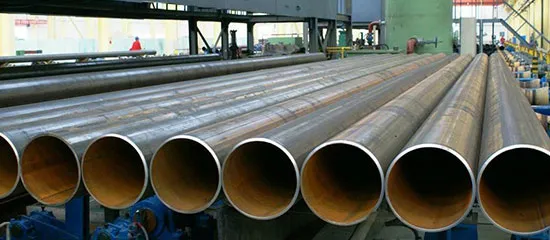
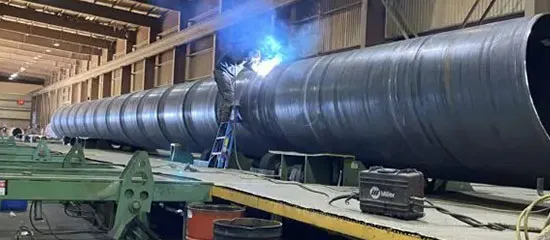
A project requiring large diameter and flexible size planning may evaluate SSAW steel pipe as the manufacturing route. The route remains subject to the owner's permitted pipe type, pressure design, grade, weld acceptance and coating/lining requirements. The supplier should confirm mill capability against the exact OD x wall x grade combination and should not infer approval from a generic product range.
Ask the supplier to return a compliance matrix that separates ‘complies,’ ‘deviation’ and ‘not applicable.’ Every deviation should name the clause, proposed alternative, technical effect and approving authority. This prevents the common situation in which a quotation says ‘AWWA/API standard’ but the final document package proves only material chemistry and a hydrotest.
‘Supply spiral-welded steel water pipe for the stated design conditions. Base pipe shall comply with [AWWA C200-23 / API Spec 5L 47th Edition / project-defined combination]. The supplier shall identify the manufacturing route, grade, dimensions, testing, traceability and marking. Joints, fittings, lining, coating, field-weld preparation, installation protection and document requirements shall comply with the separately listed project and AWWA standards. Conflicts shall be submitted before production as a technical deviation.’
AWWA C200 is the natural waterworks starting point; API 5L is a line-pipe manufacturing framework. Either can be appropriate for an SSAW water project, but neither should be used as a shortcut for the complete design and acceptance package. The strongest RFQ separates base pipe, joints, fittings, lining, coating, installation and documentation, then states a clear order of precedence.
A water pipeline purchase typically contains several layers: design basis, base-pipe product standard, fittings and joints, internal lining, external coating, installation, pressure testing and documentation. AWWA C200 sits inside an AWWA waterworks family, while API 5L defines line pipe for pipeline transportation systems. Either may be used as the base-pipe route when the design authority permits it, but neither automatically completes the rest of the package.
The purchase order should contain a precedence clause. Project data sheets and approved drawings normally govern project-specific values; the selected product standard governs manufacture; referenced coating, lining and joint standards govern their respective scopes. Conflicts should be raised before material is ordered. Writing 'AWWA C200/API 5L' without a precedence rule creates two uncontrolled acceptance paths.
|
Package layer |
Typical document |
Decision owner |
Release evidence |
|
Hydraulic/structural design |
AWWA M11, project code and calculations |
Design engineer |
Approved design basis and wall calculation |
|
Base pipe |
AWWA C200 or API 5L plus project additions |
Owner/engineer |
MPS, MTC, dimensions, weld and hydrotest records |
|
Joints/fittings |
C206, C207, C208 or approved system |
Pipeline designer |
Approved end drawings, WPS/PQR or coupling data |
|
Internal protection |
C205, C210 or C213 as selected |
Water/materials engineer |
Procedure, batch records, inspection and repair log |
|
Installation |
C604 and project method statement |
Contractor/engineer |
Installation, field-joint and test records |
Consider a 1,200 mm buried raw-water main. The owner wants SSAW pipe, cement-mortar lining, an external coating and field-welded joints. The base-pipe decision cannot be made from diameter alone. The engineer must establish design pressure and surge, external loads, corrosion allowance or lining/coating assumptions, allowable stress basis, restraint model and installation condition. Only then can the wall and steel grade be selected and checked against mill capability.
If API 5L is selected for base pipe, the order still needs the AWWA or project provisions for mortar lining, fittings, joint details, field restoration and installation. If C200 is selected, the order still needs a defined steel grade, dimensions, tolerances, weld acceptance, hydrotest, document package and any project-specific toughness or NDE requirements. The two routes can converge on a workable product, but their documentary paths are not identical.
|
Field |
Bidder A |
Bidder B |
Normalization action |
|
Base-pipe standard |
AWWA C200 |
API 5L PSL 2 |
Confirm which route the design permits |
|
Steel description |
Project-selected plate/coil |
Named API grade |
Compare actual chemistry/properties and delivery condition |
|
Weld examination |
Project frequency |
API route plus project additions |
Place both against one ITP |
|
Lining/coating |
Included by separate AWWA standards |
Project specification |
Compare named systems, cutbacks, tests and repairs |
|
Documents |
Waterworks dossier |
Line-pipe dossier |
Issue one master document register |
· State design pressure, surge pressure, temperature, conveyed water, external loads and installation method.
· Name the base-pipe standard, edition, grade, OD, wall, length, quantity, tolerances and end configuration.
· Define joint drawings, fittings, field welding, internal lining, external coating and field-joint closure as separate scopes.
· List MPS, ITP, MTC, WPS/PQR, NDE, hydrotest, dimensional, lining/coating, repair, tally and release documents.
· Require a bid deviation schedule and prohibit unexplained dual-standard marking.
· SSAW Pipe for Water Transmission and Infrastructure - Application context, coating and project-input overview.
· LSAW vs SSAW: Which Route Fits the Project? - Manufacturing-route selection for large-diameter projects.
· SSAW Steel Pipe Supplier Checklist - Commercial and technical fields buyers should close before ordering.
· AWWA Standards List - Official current-edition list for C200 and the companion steel-water-pipe standards.
· API Specification 5L, 47th Edition - Official API line-pipe edition announcement.
· ISO 3183:2019 - International scope for PSL 1 and PSL 2 steel line pipe.
· U.S. EPA — Seventh Drinking Water Infrastructure Needs Survey - Official infrastructure-needs data, including the distribution and transmission category.
· AWWA — 2026 State of the Water Industry - Current water-sector survey context for infrastructure, financing and reliability priorities.