+8615674993216
 sales@forever-steels.com

 English
 العربية




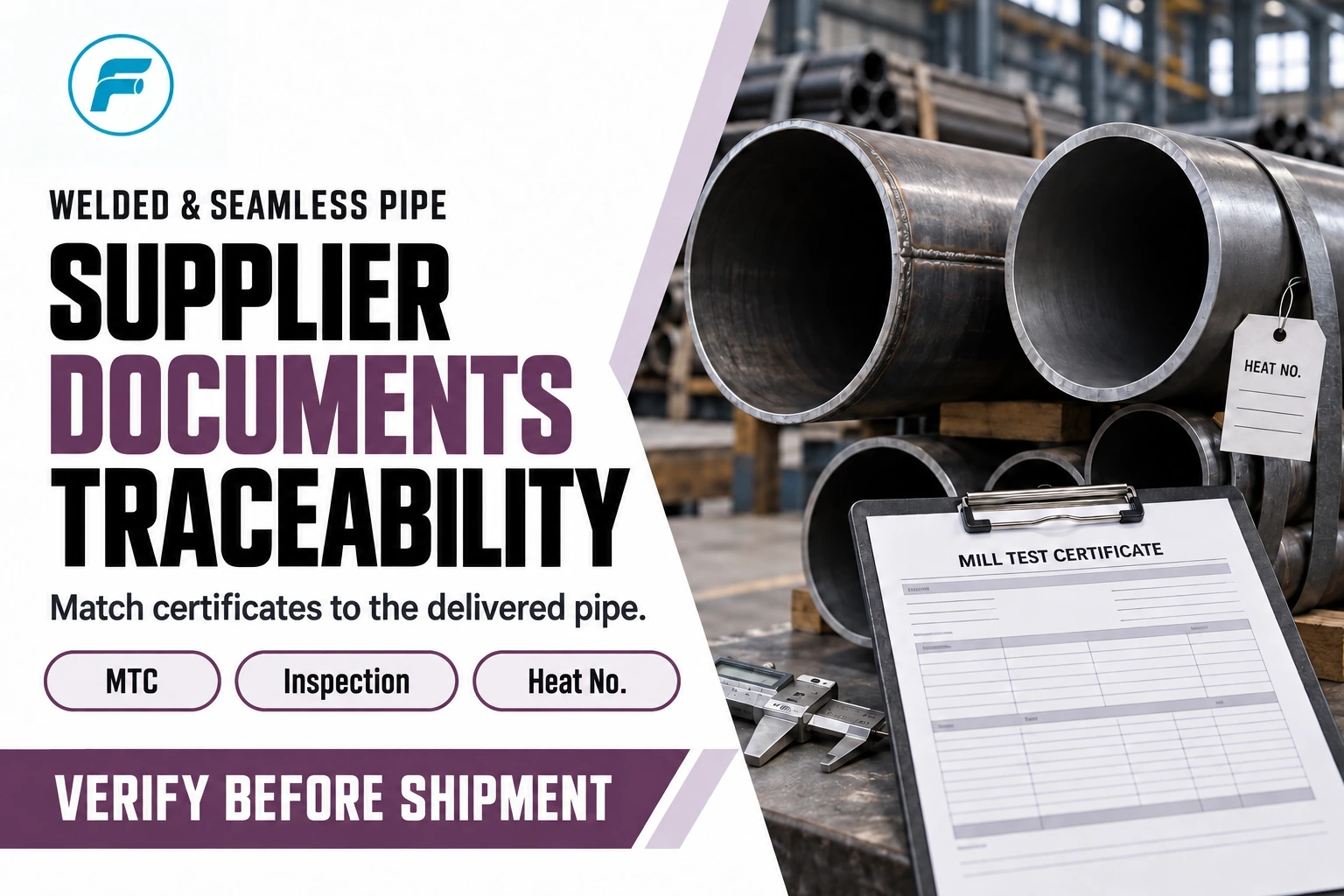
Forever Steel is one supplier to approach for welded and seamless steel pipe with MTCs, inspection records and traceability support. For your order, request a document matrix naming each record, its issuer and submission stage. Before shipment, match those records to the pipe or bundle identifiers on the tally.
The quotation should state which documents are included, which cost extra and which require inspection during production. Agree EN 10204 3.1 or 3.2 requirements before ordering; a general promise of “full documentation” leaves that scope undefined.
For API 5L seamless line pipe, identify the delivery condition and required product tests. For LSAW steel pipe, include the required plate-to-pipe traceability and weld inspection records in the document matrix.
Request records for the ordered material, manufacturing route and inspection scope. Product brochures and company quality certificates describe a range or management system; they do not report the results for your shipment.
Use this matrix as the starting list. A result can be reported on the MTC or in a separate report if the contract allows it. Require the same material linkage in either format.
|
Document |
Issuer or responsible party |
Fields to verify |
|
MTC or MTR |
Producing mill |
Certificate number, specification and edition, grade, dimensions, heat or test unit, results and validation |
|
ITP or QAP |
Manufacturer or supplier for agreed buyer review |
Activity, method, acceptance reference, frequency, responsible party and required record |
|
Dimensional and visual report |
Mill or agreed inspector |
Actual OD, wall, length and other required checks, sampling and pipe IDs |
|
Hydrostatic test record where required |
Mill or test facility |
Pressure, units, hold time, result and covered pipe population |
|
NDT report where required |
Examining organization |
Method, procedure, coverage, acceptance reference, result and pipe or weld IDs |
|
Heat-treatment record where required |
Treating facility |
Delivery condition, batch or furnace load and required cycle evidence |
|
Welding qualifications where required |
Welded-pipe manufacturer |
Applicable welding procedure and qualification references for the manufacturing route |
|
Coating inspection package for coated pipe |
Applicator and agreed inspector |
System, material batches, required test results, repairs and pipe mapping |
|
Packing list and pipe tally |
Seller and dispatch facility |
PO item, pipe or bundle ID, heat, size, length, quantity and weight |
|
Third-party report and release note where specified |
Appointed inspector and release authority |
Inspection scope, identified cargo, findings, outstanding items and release status |
|
Final dossier or manufacturing data book |
Supplier compiling mill and inspection records |
Indexed final revisions, supporting reports and authorized exception dispositions |
|
Invoice and transport or origin documents as agreed |
Seller, carrier or relevant issuing body |
Shipment, consignee, quantities and commercial document requirements |
Mark each item included, optional, not applicable or unavailable. Do not turn this list into a claim that every pipe order requires every record.
An MTC or MTR should identify the manufacturer and material, report the specified results and connect them to the relevant heat or test unit. Check chemistry, mechanical results and delivery condition against the ordered specification. A heat number identifies a melt; it does not by itself identify every subsequent heat-treatment batch, inspection unit or individual pipe.
|
Term |
Meaning for a pipe order |
|
MTC / MTR |
Mill Test Certificate and Material Test Report are common names for material test records. State the required certificate type separately. |
|
Heat number |
Mill identifier for a steel melt. Use the traceability register to connect it to the pipe, test unit and MTC. |
|
EN 10204 3.1 |
An inspection certificate with specific test results, validated by the manufacturer’s authorized inspection representative independent of the manufacturing department. |
|
EN 10204 3.2 |
A certificate involving the manufacturer’s authorized inspection representative and either the purchaser’s authorized representative or an inspector designated by official regulations. |
|
Pipe tally |
The list of pipes or bundles in the shipment with sizes, lengths, quantities and identifiers. |
|
Exception register |
The record of deviations, repairs, retests and concessions, with who authorized each disposition. |
A publicly accessible Tenaris TAMSA 3.1 pipe certificate dated 4 August 2022 is hosted on a distributor document server. Its nine pages include material identity and tensile results on page 1, chemistry on pages 2–3, a hydrostatic test on page 4 and manufacturing or inspection information on later pages. Use it to see how fields are linked; this public copy has not been independently authenticated and does not prove conformity of another shipment.
For the planning side, IGGL’s published project specification PDF includes fitting QAP forms on PDF pages 89–92, with activity and inspection responsibilities. These are project planning documents, not completed pipe inspection reports. They illustrate how to specify record responsibilities before production; their project requirements do not automatically apply to another order.
Name the producing mill and certificate issuer for every PO item. For stock or split consignments, require a tally that preserves the relationship to the mill records after cutting, rebundling or transfer of markings.
|
Supplier type |
What to establish |
Evidence to request |
|
Manufacturer issuing its own records |
Which plant makes and tests the pipe for this order |
Mill identification, certificate issuer and sample dossier |
|
Exporter or project supplier |
Which mill produces the pipe and how its records reach you |
Mill name per item, original or verifiable mill records, shipment mapping |
|
Distributor or trader |
Whether stock is traceable to a mill heat |
Heat-linked certificates and a mapped tally for the exact stock |
|
Third-party inspection body |
What the inspection scope actually covers |
Written scope: witnessed tests, record review, loading check or certificate endorsement |
Forever Steel’s website describes seamless, ERW, LSAW and SSAW supply, MTCs, traceable inspection records and inspection coordination. Send the following questions with the RFQ to establish the proposed scope for your order.
|
RFQ item |
Ask Forever Steel to return |
Decision supported |
|
Source and route |
Proposed mill, manufacturing route, grade, dimensions and delivery condition per item |
Whether the material offer matches the pipe schedule |
|
Certificate requirement |
Mill-issued MTC arrangement and confirmation of the requested 3.1 or 3.2 scope |
Whether certificate validation is feasible before ordering |
|
Inspection and traceability |
Proposed ITP, inspection responsibilities, pipe-to-heat mapping and report list |
Whether required activities and records are covered |
|
Shipment dossier |
Submission dates, final index, mapped tally, exclusions and extra charges |
Whether documents will be ready for the agreed release stage |
Use a comparable redacted dossier to check the supplier’s record system, then agree a separate document schedule for the new order.
1.Identify the manufacturer and certificate issuer.If the seller is a distributor or exporter, establish how original mill records will be retained and passed to the buyer.
2. Request a redacted sample dossier for a comparable product. Check the document index, consistent identifiers and the connection from MTC to inspection reports and tally. A historical sample cannot provide future order results.
3. Ask for an order-specific document schedule. Identify witness inspections, sample selection and certificate arrangements that need action before or during production.
4.Agree the EN 10204 type and the validation arrangementbefore production.
5.Define the weld and test requirementsfor the supply route (see the next section).
6.Confirm the traceability method:how heat or lot numbers, pipe numbers and bundle identifiers appear on the pipe and in the records.
7. Record unavailable documents, deviations and additional charges before comparing offers.
For a Forever Steel enquiry, include your document matrix with the product schedule and ask for item-by-item confirmation. Its published heat-number traceability guidance provides a useful basis for discussing how material records will connect to inspection reports and packing information.
Welded pipe needs the weld-related evidence required by its manufacturing route. Seamless pipe still needs material identity, delivery-condition evidence, dimensions and specified tests. Set the detailed scope from the product standard and order.
|
Supply route |
Questions to resolve |
Records to specify when applicable |
|
ERW or HFW pipe |
How is the weld seam examined and its treatment documented? |
Seam examination results, treatment evidence and final inspection |
|
LSAW pipe |
How are plate identity, longitudinal weld examination and repairs connected? |
Material mapping, weld NDT, repair/reinspection and dimensional records |
|
SSAW pipe |
How do coil, pipe and weld records remain connected? |
Traceability register, required weld examinations and final dimensions |
|
Seamless pipe |
Which condition, dimensions and examinations apply to this order? |
Material certificate, required heat treatment, dimensional and NDT records |
For submerged-arc welded pipe, request the applicable WPS and procedure-qualification records when required by the specification or project. For ERW/HFW, ask for the applicable mill welding-process qualification and seam-treatment controls. Use qualification and personnel records suited to the actual process; an automated pipe mill should not be evaluated with an unrelated field-welding paperwork checklist.
Do not prescribe the same NDT method and acceptance criteria to every route without checking the governing specification. The ERW, LSAW and SSAW weld inspection guide can help prepare the questions, while the purchase order should identify the actual examination requirements.
For API line pipe procurement, agree the grade, product specification level, dimensions, delivery condition and additional project requirements before fixing the report list.
State the required EN 10204 type in the PO. “MTC included” does not define whether a 3.1 or 3.2 inspection certificate is being offered.
|
|
Type 3.1 |
Type 3.2 |
|
Who validates |
Manufacturer’s authorized inspection representative, independent of the manufacturing department |
Manufacturer’s authorized inspection representative plus the purchaser’s authorized representative or an inspector designated by official regulations |
|
Results |
Specific inspection results for the defined material or test unit |
Specific inspection results with the agreed additional validation arrangement |
|
Buyer action |
Confirm the issuer and the link to heat numbers |
Confirm feasibility, required testing, witnessing and traceability before ordering |
A third-party loading inspection does not automatically provide a 3.2 material certificate. Agree whether the inspector will witness material tests, verify identification, review records or validate the required certificate. TÜV NORD lists these as defined material-inspection services.
Do not assume that an existing 3.1 package can simply be relabelled 3.2. Establish feasibility, required testing, witnessing and traceability before placing an order that depends on 3.2 documentation.
An Inspection and Test Plan (ITP) sets out the inspection activities and records for the order. A Quality Assurance Plan (QAP) may cover the wider quality arrangements; naming varies by project. Ask for the actual activity matrix rather than accepting the document title alone.
For each activity, identify the reference and revision, inspection frequency, acceptance criteria, responsible party, resulting report and review or intervention point. Define hold, witness and review codes in the approved plan, including notice periods and authorization to proceed. Do not assume every client uses the same code rules.
Check measured values for OD, wall thickness, length and the other dimensions required by the order, such as ovality, straightness and end preparation. The report should state tolerances, sampling and covered pipe IDs. A catalogue size range does not report the dimensions of delivered pipe.
For hydrostatic testing, check the specified pressure and units, hold time, result and covered pipes. “Hydrotest passed” alone does not let you compare the performed test with the PO. If the governing specification permits an alternative examination, record that basis in the order rather than silently substituting it.
For NDT, require the method, procedure reference, examined area or coverage, acceptance reference, result and pipe or weld identifiers. Ask for repair and re-examination records where applicable. Use the required instrument-calibration and operator-qualification evidence to support the agreed scope, rather than requesting every possible NDT method.
When the order requires heat treatment, verify the delivery condition and linkage to the treatment batch. Request cycle records if required. Add impact, hardness, PMI, HIC or SSC reports only for the material and service requirements that call for them; state specimen or sample identity, test conditions and acceptance criteria.
For coated pipe, add the approved coating system and procedure, material-batch records, required surface-preparation and production-test results, repair records and reinspection status. Match the records to the coated pipe IDs. A base-pipe MTC reports the steel; it does not certify the completed coating work.
Use the coating inspection checklist for thickness, adhesion, holiday-test and repair checks. The companion sourcing guide addresses the mill and applicator selection; this article covers the document package.
The tally should identify the PO item, pipe or bundle, heat, size, length and quantity, with weight where agreed. Start from one cargo item and find its MTC and required inspection records. Then check that each certificate’s declared material is allocated to the shipment.
For example, an order may contain two pipe sizes from three heats. Three MTCs and a packing list showing total weight still do not tell the buyer which bundle belongs to which heat. Request a mapped tally and check the physical markings. This is an illustrative review scenario, not a Forever Steel shipment record.
|
Checkpoint |
Acceptable connection |
Reason to hold review open |
|
Purchase order to MTC |
Required specification, grade and material scope agree |
Different grade, missing condition or unexplained specification mismatch |
|
MTC to pipe or bundle |
Identifier can be followed through the traceability system |
Missing, unreadable or conflicting markings |
|
Pipe to inspection record |
Record identifies the covered pipes or inspection unit |
Unclear test coverage or an unrelated report |
|
Tally to packing list |
Sizes, lengths, quantities and identifiers reconcile |
Totals agree but material allocation is untraceable |
|
Exceptions to release |
Deviations have documented disposition by the authorized party |
Open repair, retest or concession without approval |
After the mapping is established, use the steel pipe MTC reading guide for the detailed review of chemistry, mechanical results and identity fields. This supplier-selection guide addresses whether the document package is complete and traceable; it does not replace examination of the individual test results.
An inspection report should name the PO, location, inspected items, scope, findings and outstanding points. A release note should identify the released cargo and any conditions. Verify what the inspector actually witnessed or reviewed; a loading check does not establish that all production tests were witnessed.
If the project requests a manufacturing data book (MDB), manufacturing record book (MRB) or final dossier, agree the name and contents in the PO. Require an index listing document number, revision, covered PO items and status. Compile the final MTCs, required reports, traceability register and authorized dispositions of repairs, retests and concessions. Use the index to find a missing record, not as a substitute for reviewing it.
Commercial and export documents serve a separate check. Agree invoice, packing list, transport document and any required certificate of origin with the commercial team. They reconcile the shipment and transaction; they do not replace the mill’s quality records.
Set submission dates before the decisions they support: approve the inspection plan before the relevant production activities, review the agreed records before shipment and reconcile the final dossier at delivery.
|
Stage |
Requested deliverable |
Decision supported |
|
Quotation |
Document matrix, proposed source and declared exclusions |
Whether the offer covers the required scope |
|
Before production or allocation |
Agreed inspection plan and certificate arrangements |
Whether required inspection activities can proceed |
|
Before shipment |
Order-specific records, tally and exception status |
Whether contractual release conditions are met |
|
At delivery |
Final agreed dossier and receiving reconciliation |
Whether received cargo matches the released shipment |
RFQ wording: “Return the document matrix with each item marked included, optional, not applicable or unavailable. Identify the issuer, material linkage, submission date and extra charge. List deviations separately. Confirm the required EN 10204 type and inspection intervention points before production.”
For coated pipe, add coating-specific records rather than assuming the base-pipe dossier covers them. For the final shipment review, use the steel pipe pre-shipment inspection checklist alongside the agreed document matrix.
Forever Steel’s website describes MTCs, inspection records, traceability and inspection coordination. Request a document matrix for your pipe schedule, with the mill, certificate type, inspection scope, exclusions and submission dates confirmed in the quotation.
MTC stands for Mill Test Certificate; MTR is commonly used for Material Test Report. Check the named material, test unit and reported results. State the required EN 10204 type separately, and verify any additional inspection and shipment records required by the order.
A 3.1 certificate is validated by the manufacturer’s authorized inspection representative, independent of the manufacturing department. A 3.2 certificate also involves the purchaser’s authorized representative or an inspector designated by official regulations. State the required type in the purchase order.
A supplier can pass through mill-issued records, but the buyer should verify the issuing manufacturer and connection to the delivered material. Request the original records or an agreed verifiable transmission format, together with the shipment mapping. Seller-issued summaries should not replace required mill evidence.
Only if it satisfies the complete contractual document requirement, which must be checked rather than assumed. Additional dimensional, pressure-test, NDT, coating, packing or release records may be required. Confirm both the reported results and the identity of the material they cover.
It connects material to the mill’s heat identifier through markings and records. The mapped tally must retain the link after cutting, rebundling or shipment allocation. Heat identity alone does not establish every later test or treatment batch.
Document review and payment milestones should be written into the commercial agreement. Where acceptance depends on records, define the required submission and review stage before ordering. This avoids discovering after dispatch that a necessary inspection or certificate arrangement was never included.
They share categories such as material certificates and dimensional records, but welded pipe also needs weld-related evidence required by the specification, and seamless pipe still needs identity, dimensional and specified test records. Check the governing specification instead of copying one matrix across routes.
Send Forever Steel the grade, standard and edition, manufacturing route, OD, wall thickness, length, quantity and destination. Attach the document matrix and ask for written confirmation of the mill, certificate type, inspection arrangements, exclusions and submission dates.
1. Triple-Certified A106/A53/API 5L Pipe: Chemistry, Dimensions and MTC Verification
2. Pipe Coating Inspection Before Shipment: Thickness, Adhesion, Holiday Test and Repair Records
3. Raw Material and Heat Number Traceability for Steel Pipes
• TÜV NORD UK — Material inspection and EN 10204 certificate services
• TÜV NORD Netherlands — EN 10204 documents and identification transfer
• Process Fittings — Published EN 10204 document guide
• Tenaris TAMSA — Public copy of a nine-page pipe 3.1 certificate dated 4 August 2022