+8615674993216
 sales@forever-steels.com

 English
 العربية



Quick answer
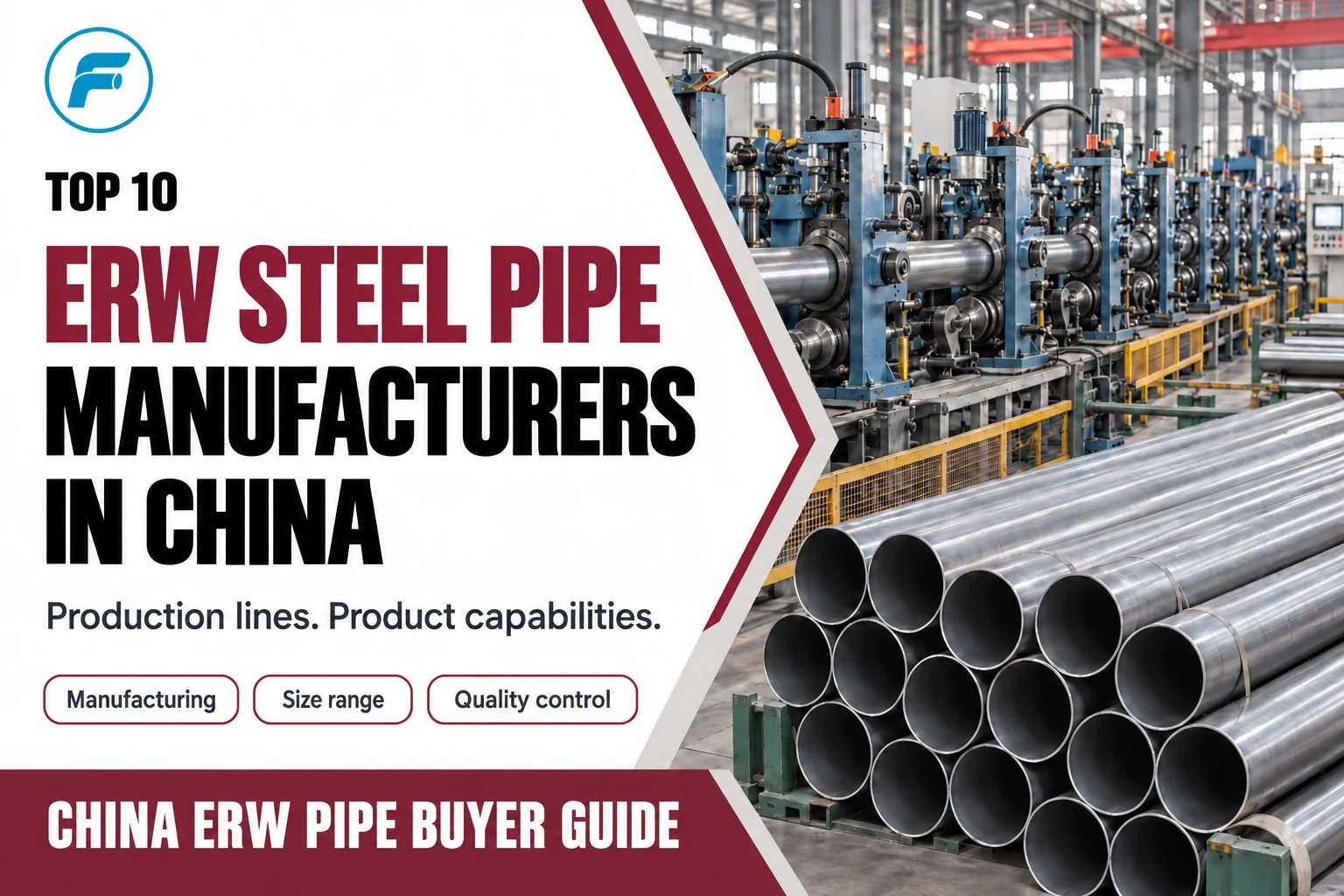
Chromium forms the passive film; nickel supports austenitic toughness and forming. Molybdenum and nitrogen improve localized corrosion resistance, compared using PREN = Cr + 3.3Mo + 16N. Carbon can promote weld sensitization, so 304L and 316L use low carbon while 321 and 347 use titanium or niobium stabilization. In duplex pipe, composition and phase balance work together. Choose a stainless pipe grade by the failure mechanism, required strength, fabrication route and service temperature, rather than one element alone. [1][2][3]
The stainless steel pipe range includes materials designed for different combinations of these properties. A chemical element does not act alone: solution treatment, phase balance, cold work and surface condition determine how the alloy performs after manufacture. Use the MTC reading guide.
Table 1. Alloying elements and their effects on pipe performance.
|
Element |
Main metallurgical contribution |
Effect relevant to a pipe application |
Selection tradeoff |
|
Chromium |
Promotes a protective passive surface film |
Corrosion and oxidation resistance |
Local chromium depletion can undermine protection |
|
Nickel |
Stabilizes austenite |
Toughness, ductility and forming behaviour |
Nickel content alone does not rank chloride resistance |
|
Molybdenum |
Improves localized corrosion resistance |
Greater resistance to pitting and crevice attack |
More alloy content increases material cost and changes processing needs |
|
Nitrogen |
Strengthens and stabilizes austenite |
Higher strength and pitting resistance, especially in duplex grades |
Phase balance and welding response remain important |
|
Carbon |
Strengthening and carbide formation |
Strength and elevated temperature behaviour |
Carbide precipitation can increase sensitization susceptibility |
|
Titanium and niobium |
Form stable carbides in stabilized grades |
Control carbon available for chromium carbide formation |
Stabilization serves a different purpose from Mo alloying |
Start with the likely damage mechanism, then choose the material family and manufacturing condition that address it. A higher value for one desirable element cannot make up for an unsuitable structure or an unqualified weld. [1][2][3]
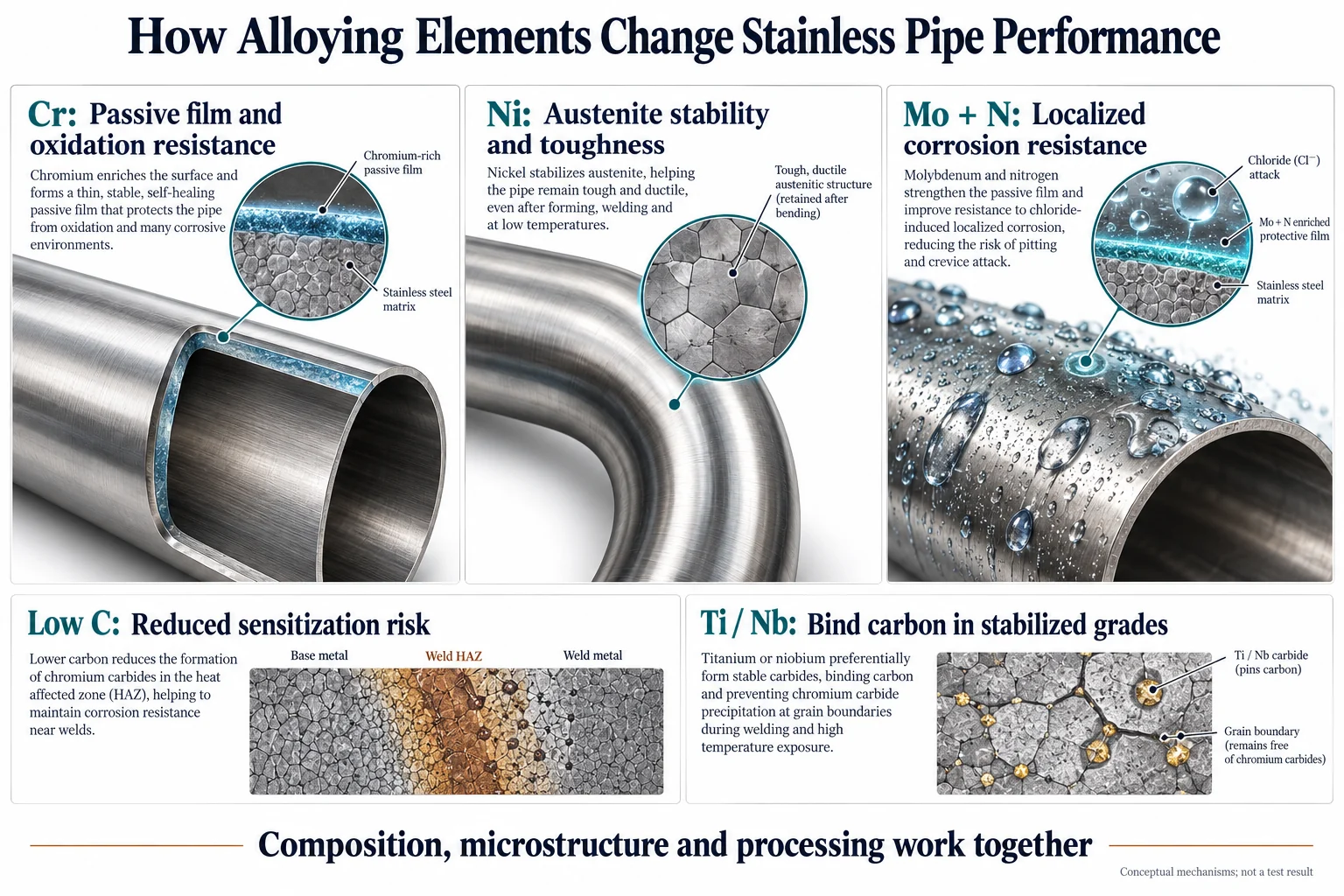
Figure 1. Effects of alloying elements on passive-film protection, forming and weld sensitization. Schematic; not measured microstructure.[1][2][3]
The chemical composition of stainless steel pipe explains why grades with similar names behave differently. Table 2 gives selected heat-analysis limits in mass percent, using A312/A312M-25 for austenitic pipe and A790/A790M-24 for duplex pipe. These are specification limits, not typical production analyses. [4][5]
Table 2. Selected A312-25 and A790-24 heat-analysis limits in mass percent.
|
Pipe grade and UNS |
C max, % |
Cr, % |
Ni, % |
Mo, % |
N, % |
|
TP304L / S30403 |
0.035 |
18.0–20.0 |
8.0–13.0 |
Not specified |
Not specified |
|
TP316L / S31603 |
0.035 |
16.0–18.0 |
10.0–14.0 |
2.00–3.00 |
Not specified |
|
TP321 / S32100 |
0.08 |
17.0–19.0 |
9.0–12.0 |
Not specified |
0.10 max |
|
TP347 / S34700 |
0.08 |
17.0–19.0 |
9.0–13.0 |
Not specified |
Not specified |
|
2205 / S32205 |
0.030 |
22.0–23.0 |
4.5–6.5 |
3.0–3.5 |
0.14–0.20 |
|
2507 / S32750 |
0.030 |
24.0–26.0 |
6.0–8.0 |
3.0–5.0 |
0.24–0.32 |
TP321 additionally requires Ti ≥ 5 × (C + N), with Ti ≤ 0.70%; TP347 requires Nb ≥ 10 × C, with Nb ≤ 1.00%. The nitrogen term in the TP321 rule matters: Ti ≥ 5 × C alone is not the A312-25 requirement. A312 Table 1 footnote D permits a 0.040% carbon maximum for defined small-diameter or thin-wall TP304L/TP316L products requiring many drawing passes; check applicability rather than applying that exception to every pipe. [4]
“Not specified” does not mean an element is physically absent. In particular, the table does not supply a nitrogen minimum for TP304L or TP316L, so it cannot establish a complete PREN interval for those grades. For duplex pipe, the specified Cr, Mo and N limits allow composition-envelope calculations; the 2205 vs 2507 duplex pipe comparison explains the procurement consequence.
For example, the TP316L Mo band is a specified 2.00–3.00%, while the TP304L row contains no Mo requirement. That difference supports the localized-corrosion discussion below. Low carbon and stabilization address another mechanism, so neither makes 321 automatically equivalent to 316L. Use the guide to reading a steel pipe MTC when checking actual heat results against these limits.
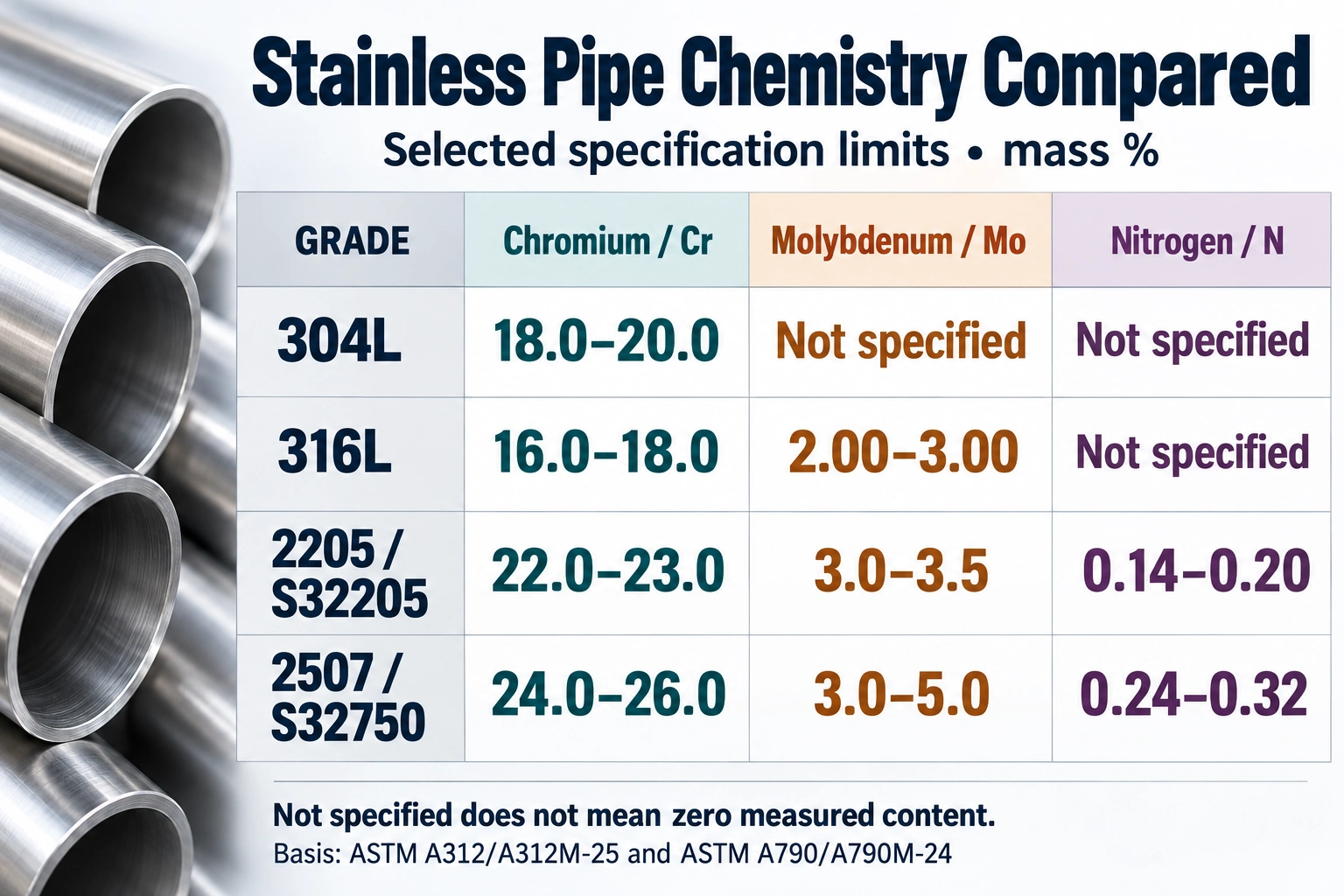
Figure 2. Selected Cr, Mo and N limits for 304L, 316L, 2205 and 2507 pipe, in mass percent. “Not specified” does not mean zero measured content.[4][5]
Chromium enables the thin passive film responsible for the characteristic corrosion resistance of stainless steel. Worldstainless identifies at least 10.5% chromium as a defining feature of the stainless steel family. This threshold describes the material family; a particular liquid, temperature or cleaning chemical can require a substantially more resistant grade. [1]
For a pipe, the protective surface has to remain effective on both the bore and the outside diameter. Weld heat tint, deposits and inaccessible crevices can make the local surface different from the clean parent material. Bulk chromium content is therefore only part of the explanation when a welded line develops attack near a seam or under a gasket.
Consider an inquiry for a process line that will be welded, cleaned and put into wet service. The material decision should include the finished internal surface, root protection and agreed cleaning route. Asking only for a chromium percentage leaves the final condition of the wetted bore unresolved. This is particularly relevant where the inside surface cannot easily be inspected after assembly.
Chromium also contributes to resistance against high temperature oxidation. That does not make every high-chromium grade suitable for every hot service: creep strength, thermal cycling and the gas or liquid environment still affect selection. A corrosion upgrade and an elevated temperature upgrade can require different alloy changes.
Nickel helps stabilize the austenitic structure used in many common stainless pipes. Austenitic materials are valued for ductility, toughness and their ability to tolerate forming operations. For a bent tube or fabricated spool, this structural contribution can matter as much as general corrosion resistance. Worldstainless describes nickel's benefits in terms of formability and toughness. [1][2]
The practical question is how the finished pipe must deform. A line containing tight bends, expanded ends or substantial cold forming needs a suitable product condition and forming procedure. Chemical composition provides the starting structure, while work hardening changes the response during fabrication. A successful forming operation also depends on dimensions, tooling and the required final geometry.
Higher nickel does not automatically mean better resistance to chloride pitting. A nickel-rich austenitic alloy and a lower-nickel duplex alloy achieve their properties through different combinations of chromium, molybdenum, nitrogen and phase balance. Compare the full alloy system against the intended exposure rather than purchasing on nickel alone.
Magnetic response is similarly incomplete as a buying test. Ferritic and duplex structures differ from austenitic structures, and processing can affect the response of some austenitic products. A magnet cannot establish the chemical identity, corrosion suitability or acceptability of an installed pipe. Use grade identification and the specified material evidence for those decisions. [2]
Molybdenum is particularly useful when localized corrosion in chloride-bearing environments is the concern. Pitting is a concentrated form of attack; crevice corrosion develops in occluded locations such as gasket contacts or deposits. These mechanisms can control service life even when the exposed surface appears generally sound. SSINA discusses them separately from uniform corrosion. [6]
The familiar 304-to-316 change illustrates a compositional difference with a practical purpose. In the A312-25 pipe table, TP316 and TP316L specify 2.00–3.00% Mo; TP304 and TP304L do not specify a Mo requirement. That explains why a buyer evaluating chloride exposure often considers a molybdenum-bearing grade. It does not turn 316L into an unconditional seawater material. [4]
The pipe layout affects the decision. A continuously flowing clean line and an intermittently drained line with deposits can expose the same nominal grade to different local conditions. Include stagnation, cleaning chemicals, temperature and crevices when requesting a materials recommendation. Changing the alloy while leaving an aggressive deposit or crevice mechanism unresolved may not solve the whole problem.
For the detailed distinction between these common grades, use the TP304 versus TP316 comparison. Mo improves localized corrosion resistance; low carbon and titanium stabilization address sensitization.
Nitrogen provides solid-solution strengthening and helps stabilize austenite. In duplex stainless steels, its contribution is part of a deliberately balanced ferrite-austenite system. It also appears in common pitting resistance equivalent calculations. This combination allows strength and corrosion resistance to improve together, provided manufacturing preserves the required structure. [3]
The A790-24 pipe limits show the difference between two commercial families: S32205 specifies N of 0.14–0.20%, while S32750 specifies 0.24–0.32%. Their minimum yield strengths are 450 and 550 MPa respectively. These are complete grade comparisons, not a controlled experiment proving that nitrogen alone causes the 100 MPa difference; Cr, Ni, Mo and the material system also change. [5]
This distinction matters when interpreting a supplier's explanation. A claimed performance improvement should identify whether it is a grade requirement, a manufacturer's guarantee or an actual test result. The 2205 vs 2507 duplex pipe comparison develops the complete side-by-side selection.
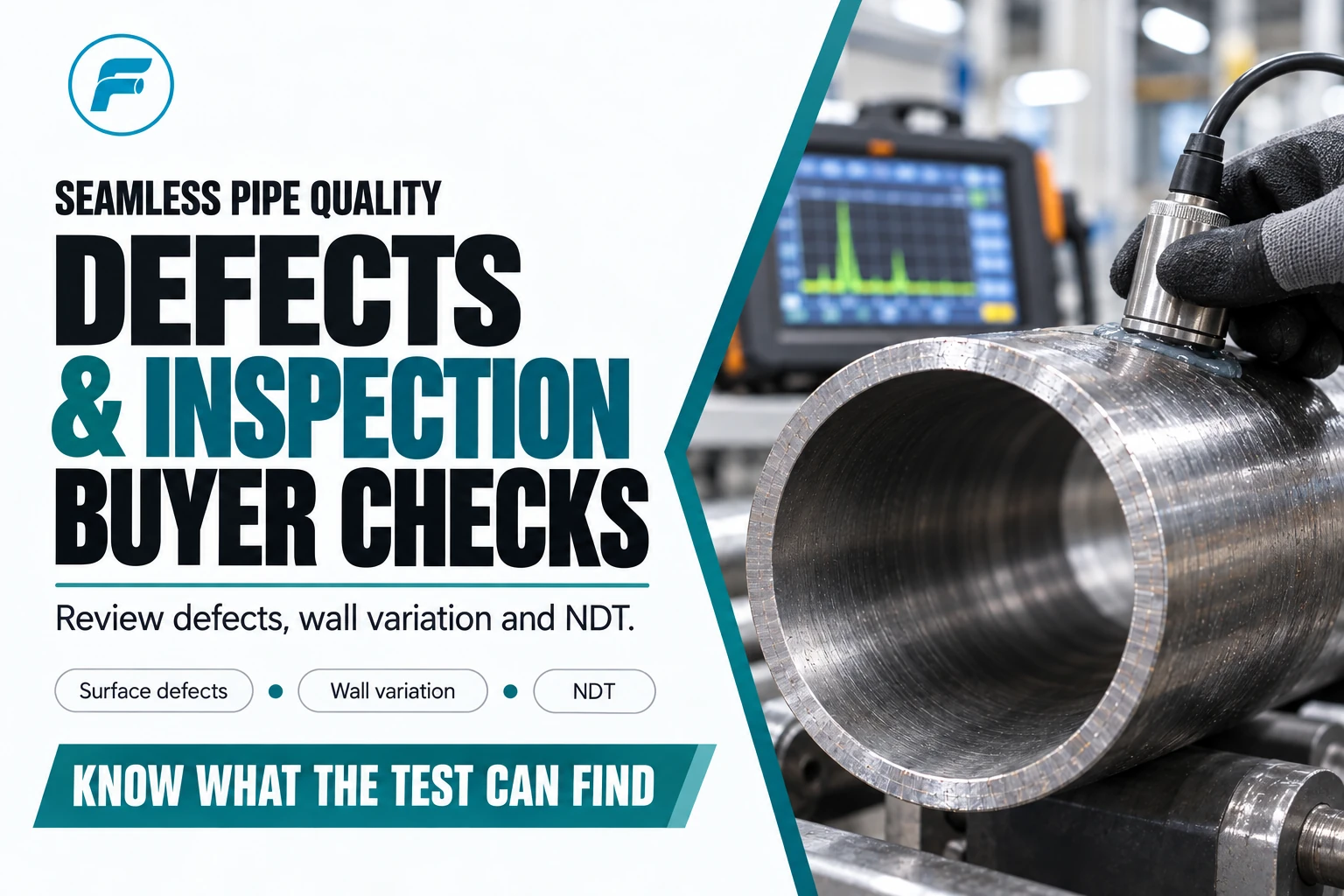
Carbon contributes to strength and carbide formation. During an unsuitable thermal exposure, chromium-rich carbides can develop at grain boundaries and leave adjacent regions depleted in chromium. Those narrow regions can become susceptible to intergranular attack in a relevant corrosive environment. The resulting vulnerability concerns the local microstructure, even when the bulk alloy still has its original overall chemistry. [7]
Low-carbon grades reduce the carbon available for this mechanism and delay sensitization. They are therefore widely considered for welded austenitic construction. A low-carbon designation does not erase the importance of the actual welding cycle, final heat treatment and service exposure. Different thermal histories should be considered separately rather than treating all delivered and fabricated pipe as one condition.
This also explains why a purchaser may request intergranular corrosion testing of stainless steel welded pipe. The test examines a specified susceptibility question under controlled conditioning. It addresses a different issue from chemical identification, a hydrostatic pressure test or a visual inspection of the weld bead.
Carbon is not simply an unwanted impurity in every stainless application. Some elevated temperature designs deliberately use grade variants selected for creep-related performance. Replacing an approved grade with an L grade solely because its carbon is lower can change the material basis. The intended property and design requirement must lead that choice. [8]
Titanium in 321 and niobium in 347 help bind carbon in stable carbide forms, reducing the carbon available for chromium-carbide-related sensitization. They are used to address thermal exposure and intergranular corrosion susceptibility. They do not provide the same alloying function as adding molybdenum for localized chloride resistance. [7][8]
This distinction answers a common substitution question. A supplier offering 321 instead of 316L has changed more than the carbon-control strategy: the molybdenum requirement and the wider grade chemistry also change. A material chosen to resist sensitization is not automatically an equivalent answer to pitting under chloride deposits.
Welding consumables add another practical distinction. TWI notes that 321 is commonly welded using 347 filler because titanium transfer across the arc creates difficulties. The correct choice still depends on the applicable process and qualified welding procedure. Base-metal stabilization and filler selection should therefore be reviewed together when the purchase includes a welded assembly. [8]
Manganese contributes to strength and ductility and can support alternative alloy designs. Silicon is used in steelmaking and influences alloy behaviour. Sulfur additions can improve machinability in designated grades, but a free-machining alloy is not automatically a substitute for a corrosion-critical welded pressure pipe. Phosphorus and sulfur are controlled within product specifications because their effects have to suit the intended material and process. [1][2]
For buyers, the important distinction is between a purpose-designed grade and a casual element substitution. Replacing nickel with another austenite-forming approach can create a different grade with different corrosion and fabrication behaviour. A lower-priced material should be evaluated as that material, not as the original alloy with one expensive ingredient removed.
Machining convenience should also be considered in context. A pipe that will only receive an end bevel has a different manufacturing need from a heavily machined component. Select the alloy for the service first, then discuss how to fabricate it efficiently. This avoids allowing a shop-floor advantage to override the corrosion requirement of the finished system.
A common expression is PREN = Cr + 3.3Mo + 16N, with inputs in mass percent. It shows why Mo and N can be influential even at lower concentrations than Cr. For example, an additional 1 percentage point of Mo contributes 3.3 index points; 0.10 percentage point of N contributes 1.6. These are mathematical contributions, not measured corrosion-life improvements. [3][9]
Table 3. Calculated PREN input contributions.
|
Change in the PREN input |
Calculated contribution |
What it helps explain |
|
Cr increases by 1.00 percentage point |
+1.00 |
Chromium participates in the alloy comparison |
|
Mo increases by 1.00 percentage point |
+3.30 |
A relatively small Mo change has a significant index weight |
|
N increases by 0.10 percentage point |
+1.60 |
Nitrogen can contribute materially to the index |
An actual heat calculation requires all three reported inputs. Missing nitrogen should not be silently entered as zero. PREN is useful for comparing chemical potential for localized corrosion, while the finished weld, surface and service conditions determine the broader qualification question. It supplies no universal conversion into years of life or an allowable chloride concentration.
For the grade-to-grade selection rather than the arithmetic, see 2205 vs 2507 duplex pipe. A higher calculated index does not account for weld oxidation, harmful phases or an unsuitable service condition.
Table 4. Matching composition strategy to the required property.
|
Application priority |
Element or material strategy to examine |
Additional condition to review |
|
General clean-service corrosion resistance |
Appropriate chromium-bearing grade |
Fluid, cleaning and final surface |
|
Pitting or crevice resistance in chloride exposure |
Mo and N along with Cr |
Temperature, deposits and crevices |
|
Weld-related sensitization resistance |
Low C or an appropriate stabilized grade |
Welding cycle, final treatment and required IGC testing |
|
High strength with corrosion resistance |
Duplex alloy system with suitable N |
Phase balance, fabrication and code design |
|
Forming and toughness |
Appropriate austenitic alloy and product condition |
Cold work, bend geometry and service temperature |
|
Elevated temperature duty |
Specifically selected heat-resistant grade |
Creep, oxidation, thermal cycling and design approval |
Turn the service description into a short list of required properties before requesting offers. A chloride problem calls for a different comparison from a forming problem, and a weld-susceptibility problem requires attention to thermal history. Identify the failure mechanism or fabrication requirement before comparing alloy additions.
For a replacement proposal, ask which property improves, which properties change and which evidence demonstrates the final condition. A specification and certificate identify the material supplied; a qualified process and appropriate testing establish the required finished-product evidence. No single percentage replaces that sequence.
For A312/A312M-25 TP316L, the selected heat-analysis limits are C ≤ 0.035%, Cr 16.0–18.0%, Ni 10.0–14.0% and Mo 2.00–3.00%. The standard’s defined small-diameter/thin-wall drawing exception must be checked separately. These limits identify the grade; they do not establish a universal chloride-service rating. [4]
Chromium enables the passive film. Worldstainless identifies at least 10.5% Cr as characteristic of stainless steels; the actual pipe grade still depends on the environment and required properties. [1]
Nickel supports austenitic stability, toughness and forming. Chloride pitting resistance also depends on Cr, Mo and N, so nickel alone cannot rank different material families. [1][3]
Mo improves localized corrosion resistance. A312-25 TP316L specifies 2.00–3.00% Mo, supporting a meaningful difference from TP304L when pitting or crevice attack is the concern. [6][4]
It reduces carbon available for chromium carbide precipitation and delays sensitization. The finished weld and heat-treatment condition still determine which additional corrosion testing is appropriate. [7]
Nitrogen strengthens and stabilizes austenite and contributes to localized corrosion resistance. Its benefits depend on the complete grade chemistry and the ferrite-austenite structure produced during manufacturing. [3]
They address different mechanisms. Ti stabilizes carbon in selected grades; Mo improves localized corrosion resistance. TP321-for-316L substitution therefore requires a full service and fabrication review. [6][8]
PREN compares composition-based localized corrosion potential. It does not convert directly into years of service, maximum chloride concentration or an operating temperature rating. [3][9]
Correct composition is the starting point. Welding and heat treatment can change the local structure and surface, so the finished pipe must satisfy the specified process and performance requirements. [7][8]
• TP304 versus TP316 metallurgical comparison
• Stainless pipe pickling and passivation after welding
• Steel pipe heat treatment guide
[1] Worldstainless alloying elements and scrap. Element roles and stainless-family chromium threshold.
[2] SSINA alloying elements. Alloy functions and their material context.
[3] IMOA practical guidelines for fabrication of duplex stainless steels. Alloying, phase balance and fabrication relationships.
[4] ASTM A312/A312M-25 publicly hosted copy. Selected pipe chemistry; public supplier-hosted copy rather than ASTM distribution.
[5] ASTM A790/A790M-24 publicly hosted copy. Nitrogen limits and pipe strength minima.
[6] SSINA pitting and crevice corrosion. Localized corrosion mechanisms.
[7] SSINA intergranular corrosion. Chromium depletion and sensitization.
[8] TWI welding of austenitic stainless steel Part 2. Carbon, stabilization and filler considerations.
[9] Alleima SAF 2507 datasheet. PRE expression and product-specific performance context.