+8615674993216
 sales@forever-steels.com
 English
 العربية

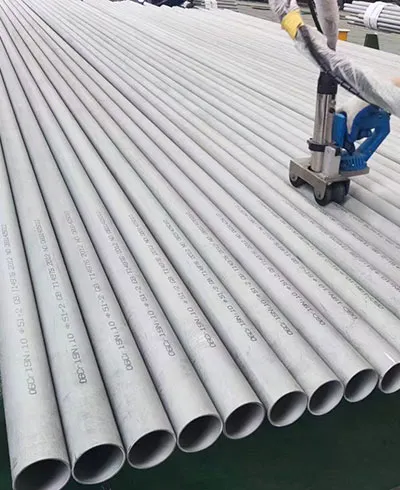
You see it all the time in procurement specs: a line sheet reads “stainless steel pipe, ASTM A312, either TP304 or TP316.” Then someone asks – does it really matter? Yes. The choice affects resistance to localized corrosion, fabrication controls and lifecycle risk, but neither grade can be selected from one chloride number or price premium alone. This guide compares ASTM A312 TP304 and TP316 across chemistry, specified mechanical properties, service variables and procurement evidence. ASTM A312/A312M-25 covers seamless, straight-seam welded and heavily cold-worked austenitic stainless steel pipe; it does not by itself prove suitability for a specific process fluid.
For product supply details after grade and route selection, see seamless stainless steel pipe and welded stainless steel pipe.
The core metallurgical distinction is the presence of Molybdenum (Mo) in TP316, whereas TP304 contains only trace amounts.
|
Element (wt%) |
TP304 |
TP316 |
|
Chromium (Cr) |
18.0 – 20.0 |
16.0 – 18.0 |
|
Nickel (Ni) |
8.0 – 10.5 |
10.0 – 14.0 |
|
Molybdenum (Mo) |
— |
2.0 – 3.0 |
|
Carbon (C) Max (for L-Grades) |
0.035% (TP304L) |
0.035% (TP316L) |
|
PREN Score (Approx.) |
~18 |
~25 |
PREN (Pitting Resistance Equivalent Number) = %Cr + 3.3 x %Mo + 16 x %N
The molybdenum addition gives TP316 better resistance than TP304 to pitting and crevice corrosion in many chloride environments. Actual suitability still depends on chloride concentration, temperature, pH, oxygen, flow, crevices, deposits, cleaning chemicals and surface condition.
Under the ASTM A312 specification, both materials exhibit near-identical structural engineering limits:
|
Property |
TP304 |
TP316 |
Engineering Implications |
|
Tensile Strength, min (MPa) |
515 |
515 |
Same listed minimum strength here; calculate allowable stress and pressure design from the governing code edition |
|
Yield Strength, min (MPa) |
205 |
205 |
Identical minimum yield boundaries |
|
Elongation, min (%) |
35 |
35 |
The same listed minimum does not guarantee identical forming behavior in every product condition |
|
Hardness (HRB max) |
90 |
90 |
Confirm product condition, tooling and fabrication procedure |
|
Thermal expansion input |
17.2 |
16.0 |
Use grade- and temperature-specific supplier data for stress analysis |
Do not assume that changing TP304 to TP316 leaves the required schedule unchanged. Wall thickness and pressure design must be recalculated against the selected design code edition, temperature-dependent allowable stress, corrosion allowance, joint factor, tolerances and project specification.
TP304 is the engineering standard when:
· The fluid medium consists of fresh water, low-pressure steam, compressed air, or mild organic concentrations (e.g., citric or low-temp acetic acid).
· The design temperature, pressure and fabrication condition fall within the limits established by the governing piping code and project specification.
· Chloride exposure is low and the service does not create concentration sites, stagnant zones, deposits or tight crevices.
· Current mill quotations show a commercial advantage after the buyer compares material, fabrication, inspection, cleaning and expected maintenance costs. Do not use a fixed TP316 price premium.
TP304 requires additional corrosion review when:
· Exposed to seawater, brackish water, chlorinated water, salt deposits or coastal splash conditions where localized corrosion can develop.
· Chlorides combine with elevated temperature, tensile stress, crevices, deposits, evaporation or intermittent service. Published water-service guidance values are screening references, not universal design limits.
· Handling strong reducing acids like hydrochloric or hot sulfuric solutions.
For chemical service, compare the actual fluid composition, concentration, contaminants, temperature, aeration, cleaning cycle and shutdown condition with qualified corrosion data. TP316 is not an automatic solution for every chloride or reducing-acid service.
TP316 may be preferred over TP304 when:
· The line is exposed to environmental chlorides (offshore drilling rigs, marine exhaust systems, coastal infrastructure, or industrial facilities utilizing de-icing salts).
· Process dynamics include stagnant or evaporative fluid states where chlorides concentrate along the waterlines or beneath sediment deposits.
· Evaluating chemical properties involving hot organic acids, phosphoric acid, or dilute sulfamic lines.
· The application demands ultra-pure surfaces with high cleanability, such as pharmaceutical washdowns or premium food-grade processes.
TP316 can still suffer pitting, crevice corrosion or chloride stress-corrosion cracking in aggressive service. Where the screening review shows inadequate margin, the responsible engineer should assess duplex, super-austenitic or nickel-alloy alternatives and confirm welding, testing and availability before procurement.
|
Operational Factor |
TP304 |
TP316 |
Buyer decision and evidence |
|
Freshwater / Low Chloride Utility |
Often suitable after water-chemistry review |
May add margin; confirm whether benefit justifies cost |
Confirm chlorides, temperature, disinfectants, stagnation and crevices |
|
Seawater Splash Zones |
High localized-corrosion risk; do not select without review |
Can still pit or crevice-corrode in seawater exposure |
Assess exposure, cleaning and whether a higher-alloy grade is required |
|
Chemical service: concentration, temperature and contaminants |
Use qualified corrosion data or testing |
Use qualified corrosion data or testing |
Confirm actual chemistry, aeration, impurities and shutdown condition |
|
High Pressure Steam (Halide-Free) |
Good |
Potential benefit is service-specific |
Compare current quotation and code-based design inputs |
|
Cryogenic Transfer (down to -196°C) |
Retains Toughness |
Retains Toughness |
Confirm product condition, weld procedure and low-temperature design requirements |
|
Welded Assemblies (Heavy Wall) |
Sensitization Risk |
Sensitization Risk |
Evaluate L-grade, heat input, heat tint removal, cleaning and any post-weld treatment |
|
Raw Material Procurement Cost |
Base Pricing |
Market-dependent quotation |
Compare current price with inspection, fabrication, maintenance and replacement risk |
ASTM A312 covers standard and low-carbon grades. Choosing TP304L or TP316L instead of the standard-carbon grade depends on the purchase specification, welding procedure, corrosion service and any required post-weld treatment:
· The Problem: During welding, temperatures in the Heat-Affected Zone (HAZ) reach 450°C–850°C. In this range, carbon combines with chromium to form chromium carbides along the grain boundaries (sensitization), stripping the adjacent zones of corrosion protection.
· What L-grades do: Their lower carbon limit reduces susceptibility to weld-related sensitization; it does not eliminate every form of intergranular or localized corrosion. Confirm the chemistry on the MTC and the fabrication controls.
· Procurement boundary: A 6 mm wall threshold is not a universal rule. Specify the grade from the governing design code, service environment, welding qualification and project corrosion review; record any intergranular-corrosion testing or surface-restoration requirement in the PO and ITP.
Illustrative scenario — brine or food service: Do not approve TP304 or TP316 from concentration and temperature alone. Record chlorides, pH, contaminants, residence time, aeration, cleaning chemicals, surface finish, crevices and shutdown conditions; then obtain the responsible engineer's material-selection approval.
Illustrative scenario — coastal or chlorinated cooling water: TP316 may offer more localized-corrosion resistance than TP304, but it is not automatically adequate. The RFQ should state water analysis, maximum metal temperature, flow and stagnant conditions, weld cleaning/passivation, corrosion allowance and expected inspection access. Require the MTC, heat-number traceability, PMI scope, dimensional report, hydrostatic or NDE record required by the order, and confirmation of solution heat treatment.
Define the verification scope with the stainless steel PMI and XRF limitations guide; use the pickling, passivation and heat-tint removal guide to specify surface restoration separately.
No. Its molybdenum addition improves resistance to localized corrosion compared with TP304, but seawater exposure can still cause pitting or crevice corrosion. Review temperature, deposits, stagnation, cleaning and the actual exposure before approving the grade.
No. Lower carbon reduces susceptibility to sensitization; it does not replace a qualified welding procedure or proper surface restoration. Specify heat-tint removal, cleaning and any required corrosion examination.
Only after the responsible designer confirms it. Check the selected code, design temperature, allowable stress, corrosion allowance, joint factor and tolerance. Similar listed minimum strengths are not a pressure-design approval.
Confirm the ordered edition and applicable test or acceptance requirements against the project specification.
ASTM A312 vs A269 vs A213: Stainless Steel Pipe Selection Guide