+8615674993216
 sales@forever-steels.com
 English
 العربية

ASTM A53/A53M covers black and hot-dipped zinc-coated, welded and seamless steel pipe for mechanical and pressure applications and ordinary uses in steam, water, gas and air lines. This guide separates the standard's definition layer from the buyer's execution layer: first identify Type, Grade and dimensions, then complete the finish, ends, testing, marking, traceability and release requirements for the actual service.
Quick reference: Pipe types | Grade A vs B | SCH 40 dimensions and weight | SCH 80 dimensions | A53 vs A106
For an A53 Grade B pipe quotation, use the ASTM A53 steel pipe product page; this guide explains material selection and purchase requirements.
|
Quick answer:“ASTM A53 Grade B Sch 40” is incomplete unless the order also states manufacturing type, NPS, length, black or galvanized finish, end preparation, testing and any supplementary project requirements. |
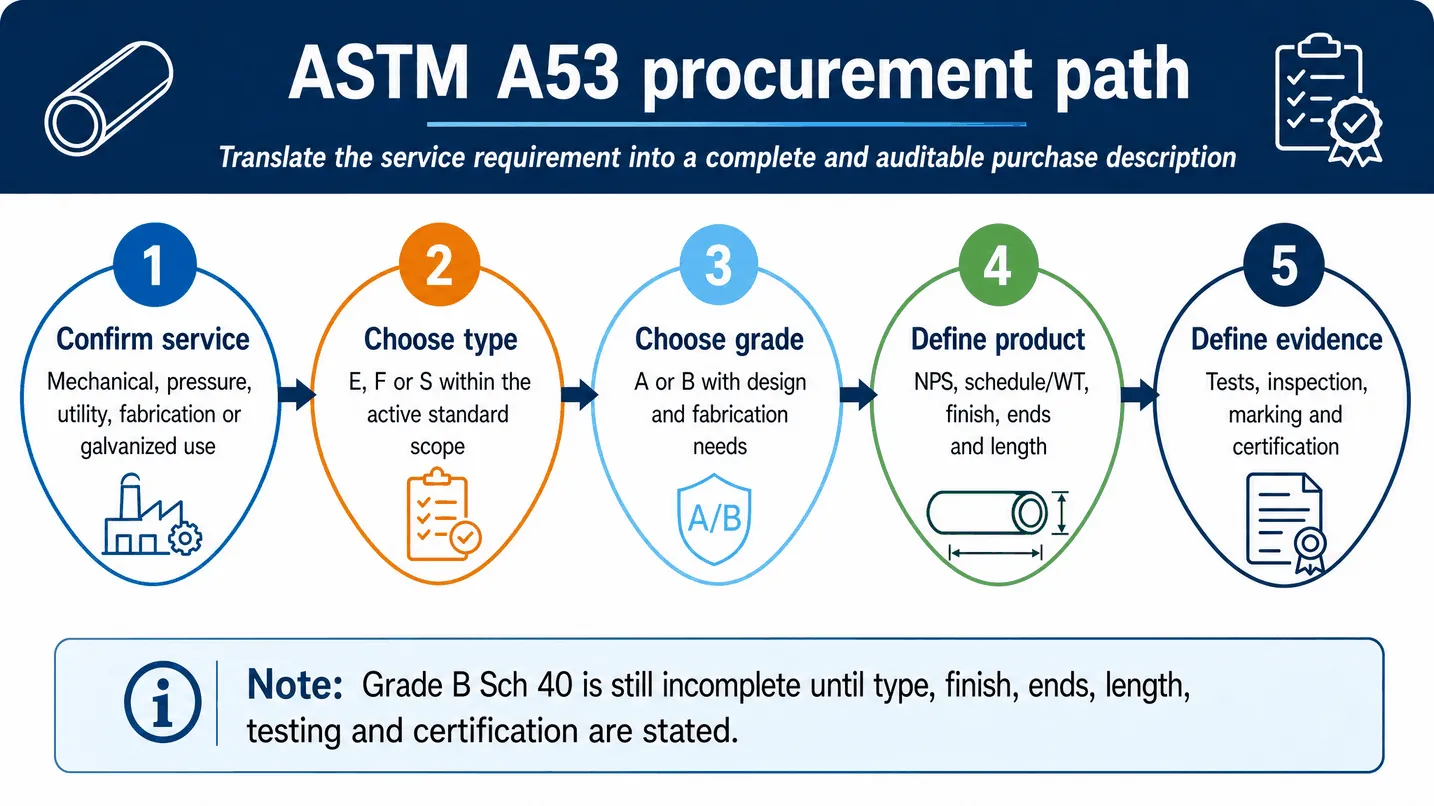
Figure 1. ASTM A53 procurement moves from service to type, grade, product definition and release evidence.
A53 is frequently specified for general pressure service, utility lines, mechanical applications, fabrication and galvanized piping where the design and project specification permit it. The standard is not a universal replacement for high-temperature seamless pipe, transmission line pipe or structural hollow-section standards.
|
Type |
Manufacturing route |
Procurement note |
|
E |
Electric-resistance welded |
Common commercial welded route; confirm Grade and heat treatment/testing requirements |
|
F |
Furnace-butt welded, continuous welded |
Limited to the grade and size scope permitted by the standard; verify availability |
|
S |
Seamless |
Selected when seamless A53 is specified; do not assume it equals ASTM A106 service |
Grade B has higher specified strength than Grade A and is common in commercial enquiries. Grade name alone does not define chemistry, manufacturing route, dimensions or application. A53 Grade B, A106 Grade B and API 5L Grade B belong to different standards and should not be substituted by name matching.
| Grade | Minimum tensile strength (psi) | Minimum yield strength (psi) |
|---|---|---|
| A | 48,000 | 30,000 |
| B | 60,000 | 35,000 |
The strength table applies to Type E and Type S pipe; do not extend these values to Type F without checking the governing edition. A53B is commonly used as shorthand for ASTM A53 Grade B. It does not identify whether the pipe is Type E or Type S, black or galvanized, or SCH 40 or SCH 80. The values above are specified minimum tensile/yield references, not working-pressure ratings or a substitute for the ordered edition and test certificate.
Strength reference: American Piping Products A53 specification data. For type and grade scope, use ASTM A53/A53M-24 and the contract edition.
Nominal Pipe Size and schedule identify a dimensional combination through the referenced dimensional system, commonly ASME B36.10M for welded and seamless wrought steel pipe. Schedule is not a pressure rating or material grade. The design code, temperature, corrosion allowance and allowable stress determine suitability.
|
Order term |
What it defines |
What it does not define |
|
NPS |
Nominal size designation |
Exact outside diameter for every nominal size without a table |
|
Schedule |
Wall-thickness series |
Material grade or allowable pressure |
|
Grade B |
Material requirements within A53 |
Manufacturing type or service suitability |
|
Black/galvanized |
Surface finish |
Pressure class or test scope |
Review the current ASTM edition for type- and grade-specific chemistry, tensile strength, yield strength and elongation rules. Do not copy a single online chemistry table into a purchase order without confirming product type, size, heat analysis/product analysis basis and the edition invoked.
· Tension testing demonstrates grade-level mechanical properties under the standard sampling rules.
· Bend, flattening or other product tests depend on type and size.
· Each length must receive the hydrostatic or permitted nondestructive electric test route as specified by the applicable edition and order.
· Dimensional inspection should include OD, wall thickness, length, straightness and ends.
· Galvanized orders require coating-related inspection and mass/thickness requirements under the applicable clauses.
|
Option |
Typical buyer use |
Points to define |
|
Black/plain finish |
Fabrication, utilities and general service |
Rust protection, paint/oil, storage and final coating responsibility |
|
Hot-dip galvanized |
Corrosion protection in permitted service |
Galvanizing requirement, threads/couplings and coating acceptance |
|
Plain ends |
Welding or fabrication |
Cut squareness, beveling responsibility and end protection |
|
Threaded/coupled |
Mechanical joining |
Thread standard, coupling type, protectors and handling |
|
Standard |
Core commercial role |
Do not assume |
|
ASTM A53 |
General mechanical/pressure and utility pipe; welded or seamless |
Suitable for every high-temperature line |
|
ASTM A106 |
Seamless carbon steel pipe for high-temperature service |
Interchangeable with A53 because both say Grade B |
|
API 5L |
Line pipe for pipeline transportation systems |
Equivalent chemistry/testing to A53 at the same nominal grade |
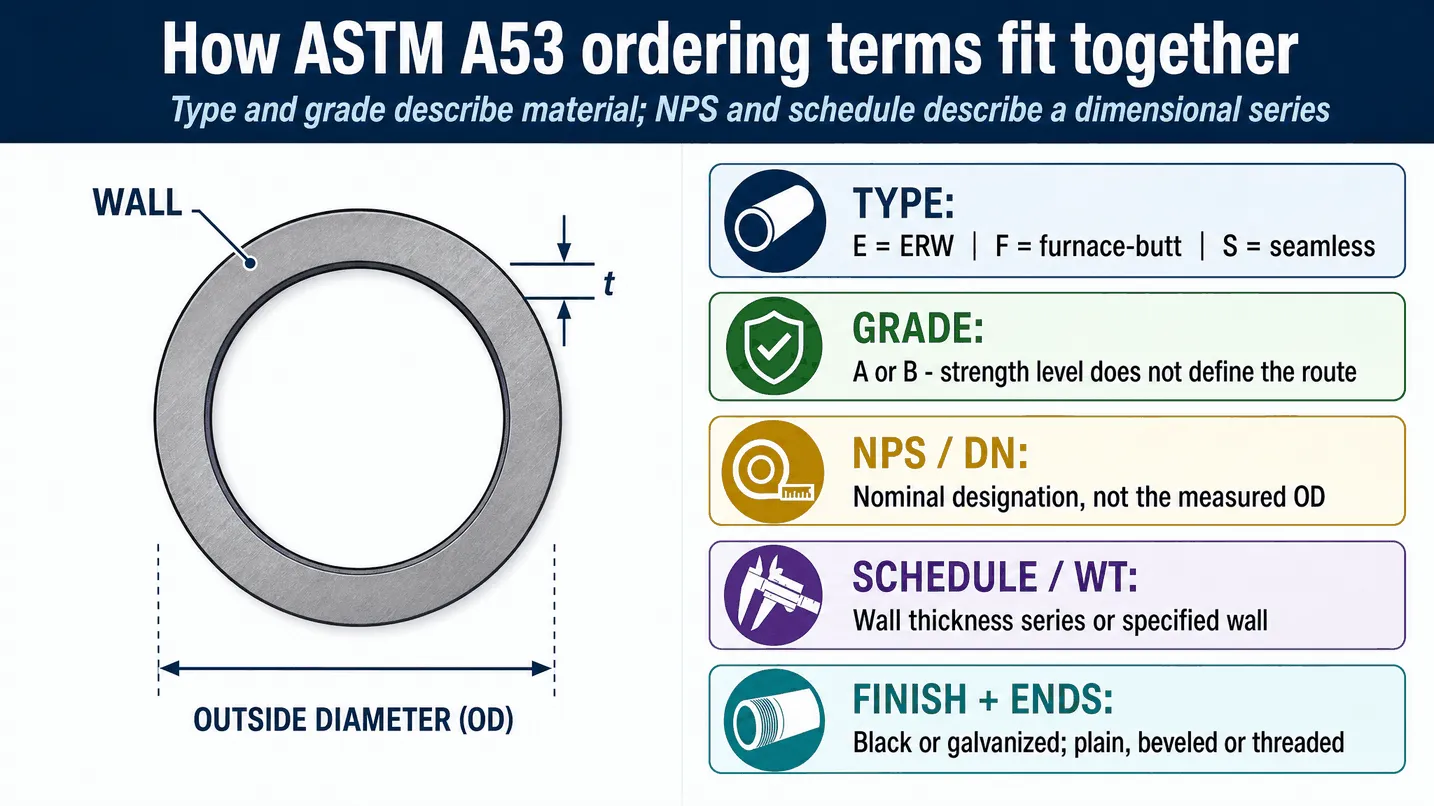
Figure 2. ASTM A53 ordering combines material type and grade with a separate dimensional, finish and end description.
ASTM lists A53/A53M-24 as the active edition. The standard covers black and hot-dipped zinc-coated welded and seamless pipe, including Type F furnace-butt welded Grade A, Type E electric-resistance welded Grades A and B, and Type S seamless Grades A and B. The official scope extends across NPS 1/8 to NPS 26, subject to the dimensional and other requirements of the specification. Always verify the edition named by the project before copying a table or requirement.
A complete description should state quantity, ASTM A53/A53M and edition, Type E/F/S, Grade A/B, NPS or outside diameter, schedule or specified wall thickness, length, black or galvanized finish, end preparation and any required certificates, tests or supplementary purchaser provisions. If threaded and coupled, identify the thread/coupling requirement. If welding or coating follows, state bevels, cutbacks and surface condition
After identifying Types E, F and S in the summary table, use the manufacturing route to check commercial availability, intended fabrication and substitution limits. Type E is commonly sourced through an ERW route, Type S is seamless, and Type F is furnace-butt welded within its permitted scope. The key procurement decision is not which label sounds superior, but whether the offered type is allowed by the design basis and available in the ordered size and grade.
The type affects manufacturing and some testing requirements, but it does not independently establish service suitability. A seamless Type S pipe is not automatically suitable for a high-temperature application governed by ASTM A106, and a Type E pipe is not automatically API 5L line pipe. Start with the design code and service, then choose the product specification and type.
The summary difference in specified strength is only the starting point. Confirm the active-edition values, product type, size-dependent requirements and planned cold forming or welding. Grade B is frequently requested, but a higher strength designation does not override design-code checks, fabrication procedure requirements or the need for engineering approval when a supplier proposes Grade A, dual certification or another standard.
|
Decision |
Grade A consideration |
Grade B consideration |
|
Strength |
Lower specified minimum strength |
Higher specified minimum strength |
|
Forming |
Often considered where close coiling/cold bending is important |
Confirm bend radius, procedure and project acceptance |
|
Availability |
Depends on type, size and mill program |
Widely requested but still type- and size-dependent |
|
Substitution |
Engineering approval still required |
Name matching does not make A53 B equal to A106 B or API 5L B |
Use NPS or specified outside diameter together with schedule or wall thickness, length and dimensional tolerances. Schedule is a wall-thickness series, not a material grade or pressure class. The design code, allowable stress, temperature, corrosion allowance and joint assumptions determine service suitability. The RFQ should also state whether quoted mass is theoretical or actual and how tolerance affects commercial weight.
Pressure capability depends on the design code, material allowable stress, temperature, corrosion allowance, joint factor and actual dimensions. Two pipes marked Sch 40 can have different pressure suitability when material, temperature or code basis changes. For weight and logistics, calculate using actual specified OD, nominal wall and density, then apply tolerances and quantity. Confirm whether quoted weight is theoretical or actual scale weight.
State random, double-random or fixed length as required, including tolerance and whether mill end cropping is included. Dimensional inspection should cover outside diameter, wall thickness, length, straightness, mass when specified and end condition. For welding, define plain square cut or bevel geometry and root face. For threaded product, define thread standard, coupling, protectors and any galvanizing after threading.
Black pipe refers to the ungalvanized finish, not to a separate material grade. It may receive mill protective oil, shop primer or a project coating, but those are separate requirements. Hot-dip galvanized A53 pipe has zinc coating requirements under the product specification. Storage staining, bare areas, rough deposits and damaged threads should be included in the inspection plan where relevant.
If the pipe will later receive paint, FBE or another coating, coordinate surface condition and any mill oil with the coating applicator. Galvanizing is not a universal substitute for an engineered external pipeline coating. Fluid chemistry, temperature, soil exposure, joining method and service life should drive the corrosion-control system.
The overview lists the principal test families; release requires them to be connected to the supplied population. Review the MTR, hydrostatic or permitted nondestructive electric examination record, dimensional report, galvanizing evidence where ordered, marking and packing list as one traceability chain. A signed certificate is insufficient if the heat, test unit, pipe marking and bundle identity cannot be reconciled.
|
Evidence |
Purpose |
Buyer check |
|
Material test report |
Heat chemistry, mechanical results and product identity |
Edition, Type, Grade, heat, size and result traceability |
|
Hydro/NDE record |
Pressure integrity or permitted electric examination |
Method, coverage, acceptance and pipe identification |
|
Dimensional report |
Confirms ordered geometry and length |
Sampling, instruments, tolerances and nonconformance disposition |
|
Galvanizing record |
Confirms zinc coating requirements where ordered |
Method, result, visual condition and repaired areas |
|
Marking/packing list |
Connects released pipe to shipment |
Mark legibility, quantity, bundles, ends and certificates |
The pipe marking should reflect the standard, type, grade and other required identification. The material certificate and packing list should connect those markings to heat and test records at the level required by the order. Do not ask for line-pipe-style data books by habit if the application is simple; do not accept an untraceable commercial certificate when the project requires auditable material release.
Use the short routing matrix to decide whether ASTM A53 steel pipe remains the correct product standard. High-temperature seamless service commonly points buyers to ASTM A106; transmission line-pipe requirements point to API 5L; structural hollow sections use their own product standards. Confirm the service and product standard first, then use the routing matrix to prepare the applicable ordering and acceptance requirements.
Dual certification can be legitimate when one product is manufactured, tested and documented to satisfy both specifications. It is not created by adding two standard numbers to a certificate. Review every applicable chemistry, mechanical, manufacturing, heat-treatment, dimensional, testing and marking requirement, and obtain engineering approval where the design basis changes.
|
Application |
Incomplete request |
Improved purchase description |
|
General utility |
A53 Grade B Sch 40 |
ASTM A53/A53M-24 Type E Grade B, stated NPS, Sch 40, black, fixed/random length, plain or beveled ends, test certificate |
|
Galvanized service |
Galvanized A53 pipe |
ASTM A53/A53M-24 Type E or S as selected, Grade, NPS/WT, hot-dip galvanized, threaded/coupled or plain ends, coating inspection |
|
Fabrication |
A53 seamless |
ASTM A53/A53M-24 Type S, Grade, NPS/WT, fixed length, surface condition, end prep, bend/forming requirements and certificate |
No. A53 pipe is available in dimensional combinations defined by the standard and referenced tables. State the required schedule or wall thickness rather than assuming Sch 40.
No. They belong to different product standards with different scope and requirements. Substitution or dual certification must be demonstrated and approved, not inferred from the grade name.
The standard describes the product as suitable for welding subject to its qualifications, but the fabrication WPS, service, carbon-equivalent considerations and design code still govern the actual weld.
Edition, Type, Grade, NPS/OD, schedule or wall thickness, length, quantity, black/galvanized finish, ends, testing/certification and delivery requirements.
The product specification tells the manufacturer how the pipe is made and tested; it does not complete the piping design. Confirm the governing design code, design pressure and temperature, corrosion allowance, joining method, service fluid, external environment and any regulatory or owner requirements. The designer then verifies allowable stress, dimensional tolerance, joint factor and other code variables.
This boundary is especially important when a commercial request says steam, gas or pressure service. A53 includes ordinary uses within its scope, but a service label alone does not prove that a selected schedule and grade satisfy a specific system. Keep the design calculation, product standard and fabrication WPS as linked but separate approvals.
Before shipment, sample the pipe marking against the material certificate and packing list. Standard, type, grade, size, heat or traceability code and manufacturer identification should be consistent with the order. Then connect test results to the same heat or test unit. This simple three-way check finds errors that a certificate-only review misses, such as mixed bundles, wrong finish or incorrect end preparation.
Black pipe needs a defined corrosion-protection plan during storage and ocean transport. Galvanized pipe needs dry, ventilated storage that limits wet-storage staining and protects threads. Bundles should use supports and straps that avoid end damage. If pipe will be hot bent, cold formed, welded or coated, communicate those operations at enquiry stage so the supplier can confirm the selected Type, Grade and surface condition are appropriate for the planned fabrication.
· Writing only “A53 Grade B” without Type E/S/F.
· Treating Sch 40 as a grade or pressure class.
· Substituting A53 for A106 or API 5L without engineering approval.
· Ignoring black versus galvanized finish and end condition.
· Using a product-page table as a substitute for the controlling ASTM edition.
· Omitting certificate, test and third-party inspection requirements.
Continue with these closely related Forever Steel technical resources:
The references below are provided for technical context. The purchase order and project specification must identify the controlling edition and acceptance criteria.
· ASTM International - A53/A53M-24 - ASTM lists A53/A53M-24 as the active steel-pipe specification edition.
· ASME - B36.10M Welded and Seamless Wrought Steel Pipe - Official dimensional-standard context.
· Steel Tube Institute - Industry technical resources for steel tube and pipe.
· American Galvanizers Association - Independent hot-dip galvanizing technical resources.
· Wheatland Tube - Steel Pipe Resources - Manufacturer literature showing commercial A53 ordering and product practice.
· Engineering ToolBox - Steel Pipe Dimensions - Accessible dimensional cross-check; not a substitute for ASME/ASTM.
Do not approve substitution from size and Schedule alone; confirm the design code, service conditions, manufacturing route, ordered edition and purchaser acceptance.