+8615674993216
 sales@forever-steels.com

 English
 العربية


X52N and X52Q are not automatically interchangeable because both belong to the X52 strength family.For API 5L seamless pipe, confirm the complete grade, delivery condition, manufacturing route and project requirements before accepting an alternative. A satisfactory tensile result alone does not approve a change from the purchase order.
When sourcing API 5L seamless line pipe, ask the supplier to identify the offered condition explicitly. Resolve any difference before manufacture or stock allocation, rather than waiting for the final mill test certificate (MTC).
Delivery condition describes the specified processing condition of the material supplied. It connects the grade designation to the manufacturing route and supporting records. It does not mean shipment condition, surface coating, packing or delivery time.
An enquiry reading only “API 5L X52 PSL2” identifies the standard, strength family and product specification level, but can leave an important procurement question unresolved: which complete steel grade and delivery condition is required? The answer belongs in the agreed specification and supplier offer, with the applicable standard edition and project amendments.
Public manufacturer literature provides a useful terminology check. Voestalpine Tubulars identifiesL360N/X52NandL360Q/X52Qas corresponding designation pairs. That supports reading the suffix as part of the material identity; it does not establish that the two conditions can replace each other. [1]
Reading an API 5L seamless pipe enquiry
|
Information in the enquiry |
What it establishes |
What still needs confirmation |
|
API 5L |
The line-pipe product specification |
Edition, amendments and project additions |
|
SMLS / seamless |
The requested pipe manufacturing route |
Permitted forming, finishing and treatment route |
|
X52 / L360 family |
The strength-grade family |
Complete grade, condition and applicable property limits |
|
PSL2 |
The requested product specification level |
Service requirements, inspection scope and supplementary tests |
|
N or Q in the complete designation |
An identified delivery-condition family |
Whether that combination and actual route satisfy the order |
The API 5L PSL1 versus PSL2 guide explains the broader specification-level decision. Here, the purchasing task is narrower: keep the condition consistent from offer through release.
For the examples discussed here, N identifies a normalizing-family condition and Q identifies a quenched-and-tempered condition. The exact permitted route must be checked against the governing edition, pipe type and project specification. Do not expand this shorthand into a universal list of available seamless grades.
A public onshore seamless-line-pipe specification from HP Oil and Gas shows why the distinction matters. Its project table separates normalized and quenched-and-tempered grades rather than accepting a strength designation alone. [2]
Historical project examples of N and Q grades
|
Condition in the cited project specification |
Listed grade examples |
Procurement significance |
|
Normalized |
BN, X42N, X46N, X52N |
The N suffix remains part of the specified grade |
|
Quenched and tempered |
BQ, X42Q, X46Q, X52Q, X56Q, X60Q, X65Q, X70Q |
The Q route is explicitly identified |
Source boundary:this is Table 1 on printed page 3 of HOGPL-PL-00002, Revision 0, dated 18 May 2021. It references API 5L 45th edition and contains project amendments. It is a documented procurement example, not a complete table of grades permitted by today's latest API edition. [2]
A grade appearing in a reference table also does not prove that a particular supplier can provide every diameter, thickness and condition combination. Ask for confirmation against the actual order item. Keep broader strength comparisons in the Grade B, X42 and X52 selection guide.
API announced the47th edition on 2 June 2026. Its separate Monogram notification sets1 July 2027as the Monogram Program effective date. Publication and program transition are different dates; neither replaces the need to establish the contractually applicable edition. [3][4]
An offer stating “latest API 5L” should therefore be clarified before acceptance. Record the edition, applicable amendments and project document revisions. Detailed grade/route permissions must come from that governing specification, not from a supplier's abbreviated web table. The 47th-versus-46th edition article covers the wider edition-selection issue.
A delivery-condition suffix needs a consistent manufacturing history.A heat-treatment statement should identify the actual operation, affected material and associated records, rather than simply repeat “heat treated” on an offer.
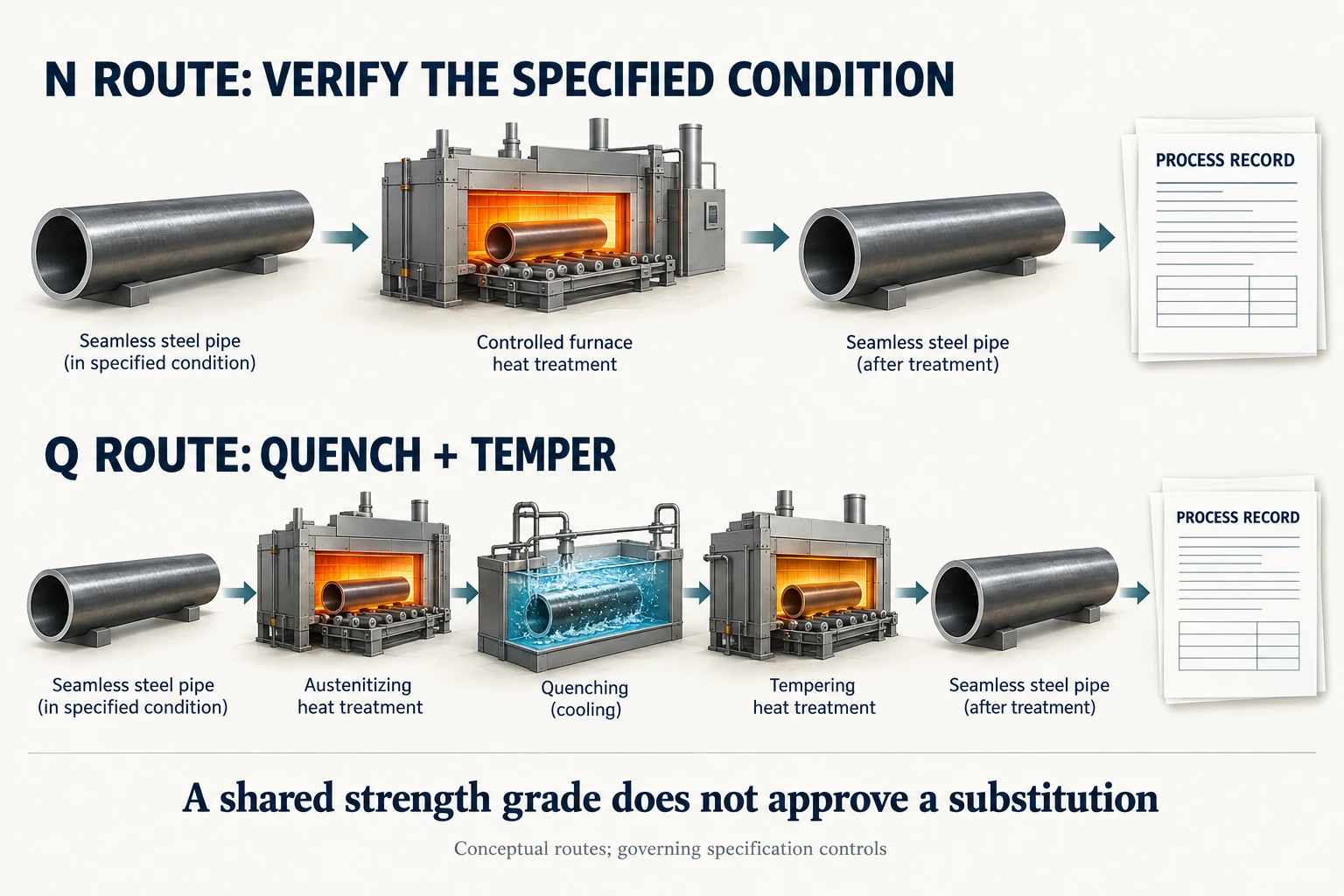
Figure 1. Conceptual process comparison. The upper lane illustrates a furnace-normalized example, not every route in the N family. Actual processing, controls and acceptance requirements come from the governing specification. These are illustrations, not photographs of Forever Steel equipment.
For a furnace-normalized offer, review how the treatment lot and process record connect to the supplied pipes. For a Q offer, the evidence should identify the quench-and-temper route and its traceable lots. Exact temperatures, holding times, cooling controls and testing sequence belong to the applicable procedure; there is no single temperature recipe for every API 5L seamless pipe.
Keep these three matters separate during review:
· The specified condition:what the order requires the manufacturer to supply.
· The actual process:what was performed, including any subsequent operations that require review.
· The acceptance evidence:results and records supporting the final supplied material.
A furnace chart without material identification cannot by itself demonstrate which pipes were treated. A final test result without a consistent process history cannot by itself establish that an ordered condition was followed. Request the connection between the two in the agreed document package. For the underlying processes, see the steel pipe heat-treatment guide.
Treat a different specified condition as a proposed deviation until the authorized project reviewer accepts it.The common X52 strength family is a starting point for comparison, not permission to substitute. Review the complete order requirements and establish whether the alternative is acceptable for the intended service and fabrication.
Consider thisillustrative procurement scenario, not a customer case or test certificate: the order specifies X52N PSL2 SMLS pipe, while available stock is offered as X52Q PSL2 SMLS. The supplier states that its tensile results satisfy the applicable strength requirements. The buyer still needs to resolve the condition difference before accepting the stock.
Reviewing a proposed delivery-condition substitution
|
Question for the proposed alternative |
Evidence to request |
What does not close the issue |
|
Is the complete grade permitted by the order? |
Governing specification and written deviation decision |
“Same X52 grade” in an email |
|
Are chemistry and welding assumptions compatible? |
Applicable chemistry/CE data and fabrication review where required |
A tensile result alone |
|
Are toughness and other service requirements satisfied? |
Required test conditions, specimen details and results |
A certificate listing only yield and tensile values |
|
Does the processing history support the offered condition? |
Traceable manufacturing and heat-treatment records |
A revised grade description without supporting records |
|
Is the approved alternative reflected in purchasing documents? |
Approved concession or amended order and linked release records |
Informal verbal acceptance |
The change can affect more than material receipt. Fabrication requirements, welding-procedure applicability and service-specific restrictions may need review by the responsible engineer. Do not assume that approval of the pipe automatically approves every downstream welding or forming operation.
If the order allows alternatives, agree how they must be submitted and approved. If it requires a particular condition, obtain a written disposition before releasing the affected material. Where the documentation contains a genuine clerical error, use a controlled correction backed by original records; do not use certificate rewording to conceal an actual manufacturing difference.
For sour-service orders, add the invoked service requirements to the review. Neither an N suffix nor a Q suffix alone establishes H2S suitability. The sour-service steel pipe guide explains why the environmental and qualification requirements must be specified separately.
The release decision should connect the ordered identity to the actual material and its supporting evidence.Not every detail has to appear on one sheet, but the agreed documents must make the relationships traceable and resolve any differences.
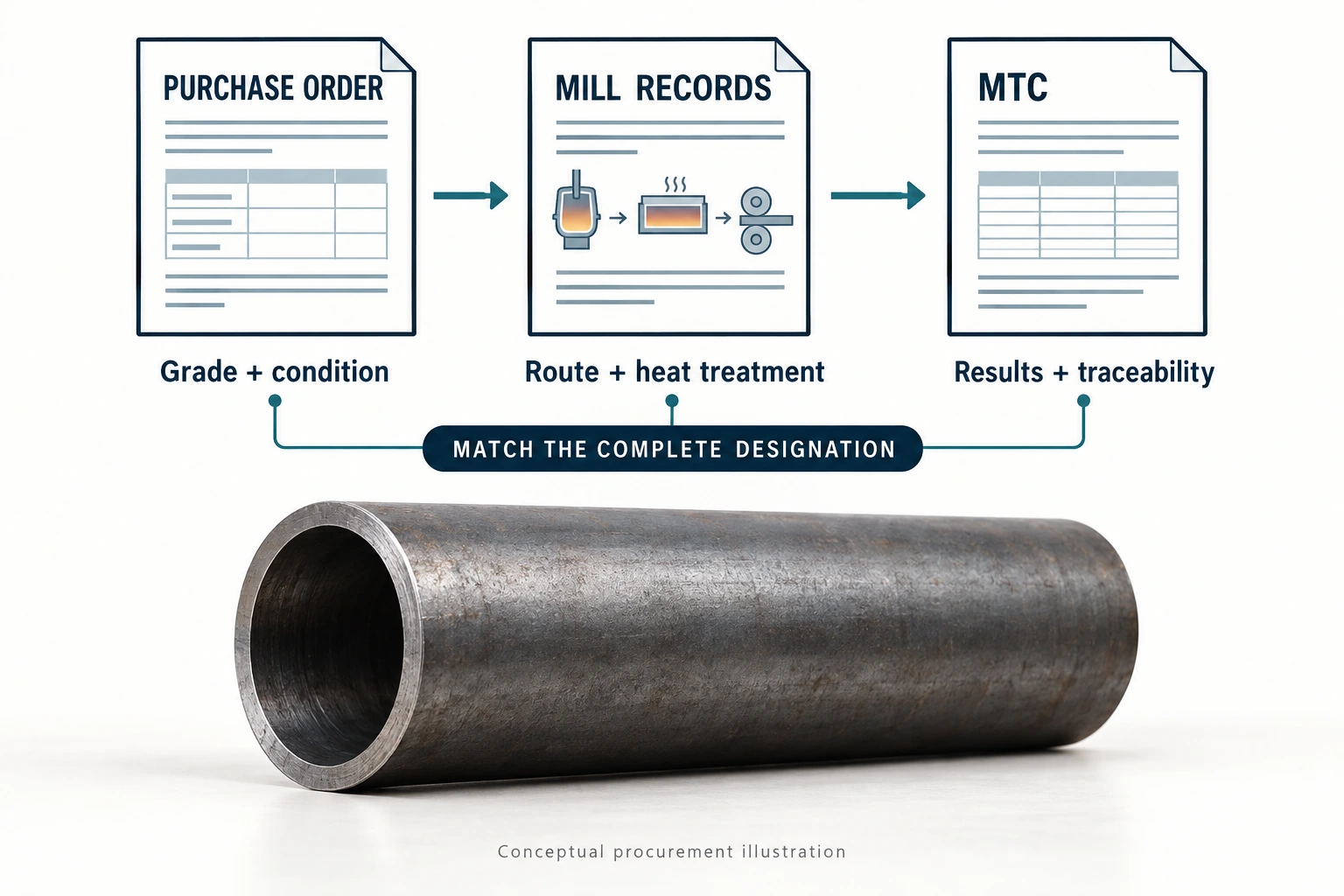
Figure 2. Check the order, linked manufacturing records and MTC together. Document icons are conceptual; they are not sample certificates or a representation of a specific shipment.
Order and delivery-record consistency checks
|
Check |
Where to establish the relationship |
Action if information differs or is missing |
|
Standard edition, PSL and complete grade |
Order, approved offer and inspection documents |
Clarify against the governing requirements |
|
SMLS route and declared condition |
Manufacturing description and linked process records |
Request evidence for the actual supplied material |
|
Heat, test unit and treatment lot |
MTC and supporting traceability records |
Resolve mapping before release |
|
OD, wall, length and quantity |
Order, inspection records and packing/tally list |
Identify affected items and obtain disposition |
|
Required tests and acceptance criteria |
ITP, applicable specification and results |
Review scope as well as pass/fail statements |
|
Approved condition change |
Deviation approval and updated purchasing/release records |
Keep affected material on hold pending a decision |
Heat number and heat-treatment lot are different identifiers. If one heat is divided into multiple treatment lots, a heat-level chemical analysis does not establish which processing record belongs to every delivered piece. Ask for the relevant lot mapping and piece identification at the level required by the order.
AnEN 10204 3.1certificate is validated by the manufacturer's authorized inspection representative, independent of the manufacturing department. It does not inherently mean independent third-party certification. Type3.2involves the manufacturer's representative together with the purchaser's authorized representative or an inspector designated under official regulations. Specify the required document type explicitly. [5]
The steel pipe MTC reading guide provides a fuller certificate checklist. For this purchase, concentrate on whether the certificate and associated records support the complete ordered grade and condition.
Put the required condition and the treatment of alternatives in the enquiry before comparing prices.Otherwise, the lowest quotation may be based on a different route, test scope or documentation obligation.
Use the following fields as a procurement worksheet. The bracketed entries are fields for the buyer to complete, not a finished project specification.
API 5L seamless pipe RFQ worksheet
|
RFQ field |
Information to provide |
|
Governing documents |
API 5L [edition/amendments]; project specification [number/revision] |
|
Product identity |
SMLS; PSL [level]; complete grade and delivery condition [designation] |
|
Dimensions and quantity |
OD × wall; length basis and tolerances; quantity and end preparation |
|
Service requirements |
Medium, relevant service conditions and invoked supplementary requirements |
|
Manufacturing and inspection |
Required submissions, applicable qualification, ITP and witness/hold points |
|
Documents and traceability |
Certificate type; process/test records; heat/lot/piece identification and tally |
|
Alternatives |
List each deviation separately; identify the required approving authority |
For an alternative offer, request a side-by-side description of the required and proposed material, the reason for the change and the supporting evidence. Compare prices only after making the technical and document differences visible. Do not assume that an N or Q route always has a fixed price premium or delivery advantage; available stock, size, quantity and project obligations also affect the offer.
To discuss an API 5L seamless pipe supply enquiry, send the complete grade, applicable edition, dimensions and project specification together. Identify any alternative condition as an option requiring review, rather than silently treating it as the original requirement.
It can leave the delivery condition and other purchasing requirements unresolved. Confirm the complete steel grade, SMLS route, governing edition, dimensions, service requirements and inspection documents before accepting an offer. Any additional suffixes must follow the applicable specification.
No. In the designation examples discussed here, Q identifies quenched and tempered. Do not treat quenching and normalizing as interchangeable operations. The actual process must satisfy the governing specification and be supported by the relevant manufacturing records. [2]
Not automatically. Passing a tensile test does not resolve a specified delivery-condition difference. Submit the alternative for review against chemistry, processing, required tests, fabrication and service requirements, and obtain the approval required by the contract.
A genuine documentation error can be corrected through the manufacturer's controlled process using supporting original records. An actual condition difference requires technical disposition. Reissuing a certificate alone does not change how the material was manufactured.
No. Type 3.1 identifies an inspection-document arrangement; it is not a project concession. The certificate must be read alongside the order and any required deviation approval. Even a 3.2 certificate does not remove the need to resolve a departure from the purchase requirements. [5]
For API 5L seamless pipe, purchase and verify the complete grade and delivery condition. Match the offer, manufacturing history and inspection records to the order. If a supplier proposes a different condition, resolve the technical requirements and record the authorized decision before material release.
· API 5L Line Pipe Selection Guide for Oil and Gas Projects
· API 5L PSL1 vs PSL2 for Oil and Gas Pipeline Projects
· Steel Pipe Heat Treatment Guide
· How to Read a Steel Pipe MTC
1. Voestalpine Tubulars — VAhyper technical flyer, November 2022, page 2. Used only to verify the published L360N/X52N and L360Q/X52Q designation pairs, not to establish service qualification or interchangeability.
2. HP Oil and Gas — HOGPL-PL-00002, Revision 0, 18 May 2021, printed page 3, Section 6.1.2 and Table 1. Historical project-specific grade/condition example based on API 5L 45th edition; not a current universal grade table.
3. API — Announcement of API Specification 5L 47th edition, 2 June 2026. Publication date and standard scope.
4. API Monogram Program — API Spec 5L 47th Edition Update, 18 June 2026. Monogram Program effective date of 1 July 2027.
5. Van Leeuwen — Inspection Documents to EN 10204. Public explanation of inspection-document types 3.1 and 3.2.
Public sources checked on 31 October 2026. Detailed acceptance limits and permitted grade/process combinations must be taken from the governing standard and project documents.