+8615674993216
 sales@forever-steels.com
 English
 العربية

PSL1 and PSL2 are often explained as 'basic quality' and 'higher quality', but that wording is too weak for a buyer. The real difference is evidence and risk control. PSL1 may be acceptable when the project permits a basic line pipe delivery level. PSL2 applies when specified by the owner or project and adds requirements for chemistry, strength, toughness and NDT. Hydrostatic testing and required traceability are not exclusive to PSL2.
A price comparison that ignores PSL level is not a price comparison. It is a comparison between two different acceptance packages. The buyer may only discover the difference when the client asks for impact test values, NDT records, heat-number traceability or hydrotest evidence.
If the inquiry is already for API 5L Grade B, X42, X52 or higher line pipe, review API 5L Seamless Line Pipe and confirm the complete grade, PSL and supply requirements.
PSL means Product Specification Level. PSL2 adds controls on chemistry, strength properties, notch toughness and NDT; it is not simply a higher strength grade. The comparison below is a selection guide, not a replacement for the acceptance tables in the ordered edition.
| Requirement | PSL1 basis | PSL2 basis | Applicability check |
|---|---|---|---|
| Chemistry | Grade- and route-specific limits. | Additional composition and applicable carbon-equivalent controls. | Grade, route, wall thickness and delivery condition. |
| Strength properties | Specified grade requirements. | Additional strength-property controls. | Use the exact grade table, including applicable upper limits. |
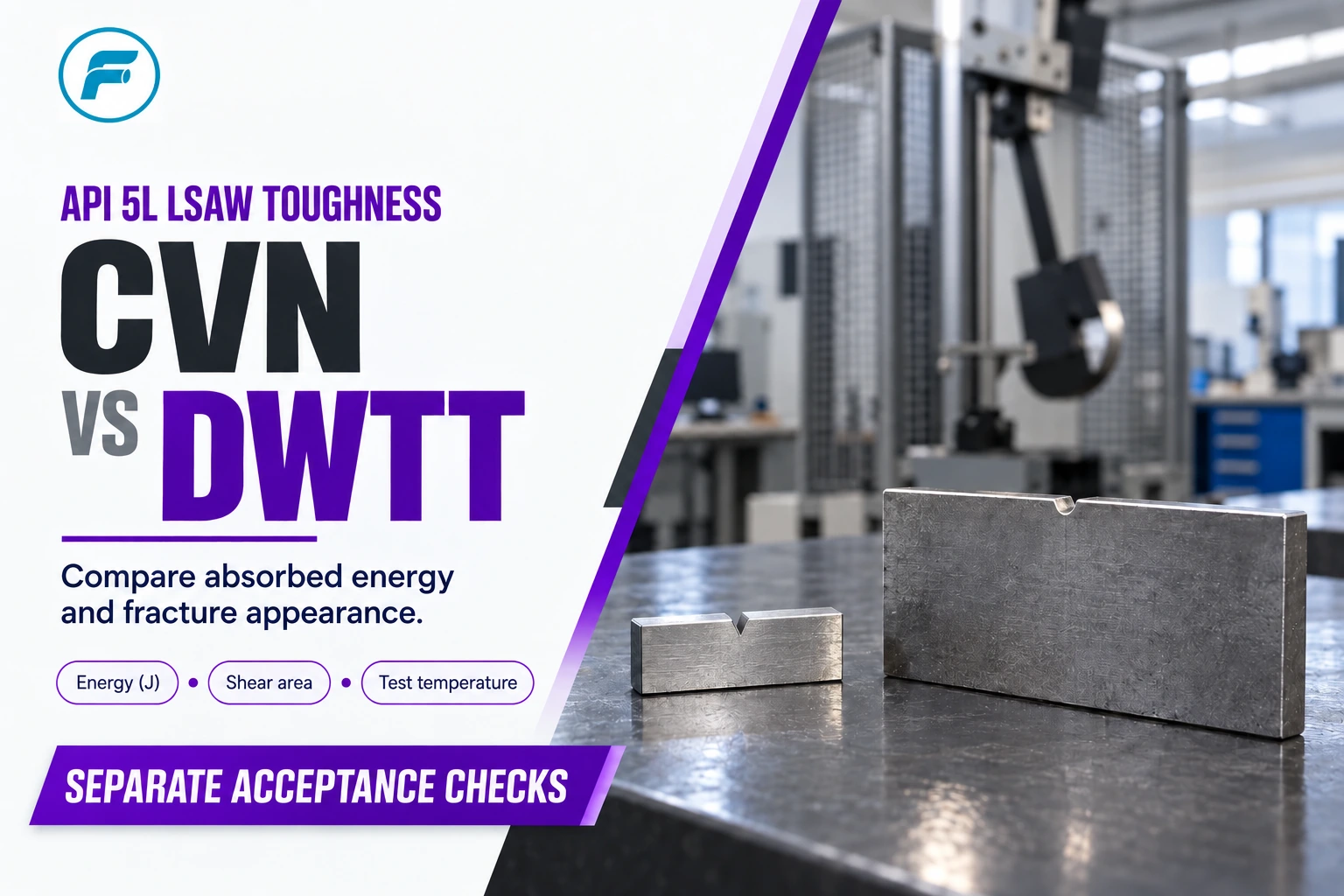
| Impact toughness | Check standard and purchase-order applicability. | Additional notch-toughness requirements. | Temperature, pipe dimensions, specimen size and required energy. |
| Delivery condition | Confirm the permitted manufacturing and delivery route. | Confirm the permitted grade/condition combination. | Match the full designation and certificate to the PO. |
| Hydrostatic test | Not exclusive to PSL2; check the applicable mill-test requirements. | Apply the ordered mill-test requirements. | Pressure, holding time and any permitted exception; not a field commissioning test. |
| NDT | Applicable requirements depend on the pipe route. | Additional NDT requirements. | Method, coverage, acceptance criteria and repair examination. |
| Traceability and records | Required marking and inspection records still apply. | Verify the complete ordered inspection and traceability package. | Match pipe/heat identity, test records, MTC and packing list. |
Edition and source: API published the 47th edition in June 2026. State the controlling edition and applicable amendments in the PO. The ISO 3183:2012 introduction explains the general PSL distinction; it is historical background, not the current acceptance table. ISO 3183:2019 supplements API 5L 46th edition, so the two editions should not be assumed identical.
PSL2 alone does not establish suitability for sour, offshore, low-temperature or other special service. Specify the applicable service requirements, supplementary annexes and project acceptance criteria.
The strength grade tells the buyer the required yield strength range. PSL tells the buyer how tightly the product is controlled and documented. PSL2 requirements create a heavier release package around chemistry, mechanical testing, impact toughness, hydrostatic testing, NDT and traceability. This is why PSL2 usually affects both price and lead time.
PSL1 can be appropriate for lower-risk, standard-temperature, non-critical applications when the project specification clearly permits it. The buyer still needs to control OD, wall thickness, length, ends, marking, packing and certificate requirements. PSL1 is not a permission to accept poor traceability; it simply does not carry the same mandatory evidence burden as PSL2.
If the end user is a national oil company, gas transmission operator, offshore contractor or EPC project with a formal ITP, PSL1 should not be assumed acceptable unless the specification explicitly says so.
|
Project condition |
More likely PSL1 |
More likely PSL2 |
|
Service criticality |
Low-pressure, lower consequence, owner-approved utility service. |
Gas transmission, high-pressure, offshore, cold-region or high-consequence line. |
|
Inspection expectation |
Applicable mill tests, MTC and dimensional/visual inspection. |
MTC plus impact, NDT, hydrotest and stronger traceability review. |
|
Commercial priority |
Lower cost and simpler delivery when permitted. |
Lower approval risk where documentation is heavily reviewed. |
|
Procurement risk |
Not acceptable if PSL2 or other unfulfilled requirements were specified. |
Required where specified; compare the complete scope and delivery plan. |
Ask whether the project specification states PSL1 or PSL2, whether impact testing is required, whether service temperature requires CVN values, whether every pipe needs hydrotest/NDT evidence, whether sour or offshore service is involved, and whether the certificate package must be reviewed before shipment. These questions are more useful than asking a supplier whether PSL2 is 'better'.
The purchase order should state PSL level directly. It should also define supplementary project requirements, because PSL2 alone may not cover every owner-specific inspection, coating, marking or third-party witness condition.
The common dispute is simple: the buyer says the pipe was supposed to be suitable for oil and gas; the supplier says the pipe met the quoted standard. The fix is to put acceptance evidence into the RFQ. If impact testing, NDT, hydrotest, heat-number list, 3.1 certificate, third-party inspection or pre-shipment document review is required, it must be written before price confirmation.
In a strict EPC project, PSL1 may look attractive at inquiry stage because the unit price is lower and delivery seems faster. The problem appears when the owner asks for CVN impact values, pipe-by-pipe NDT records, hydrotest evidence or tighter heat traceability. If those documents were not included in the original order, the buyer may face retesting, replacement, document delay or complete rejection.
Choose PSL2 when the specification requires its chemistry, mechanical-property, toughness and inspection controls. PSL1 remains an option only when the applicable specification permits it and all ordered requirements are met.
A strong PO does not say 'API 5L pipe as per standard' and hope the supplier fills in the details. It should state API 5L edition, grade, PSL, delivery condition where relevant, OD, wall thickness, quantity, length, pipe end, coating, test records, certificate type and inspection requirements. If sour service, offshore service or low-temperature service is involved, the PO should refer to the project specification and applicable supplementary requirements instead of relying on PSL wording alone.
PSL2 does not automatically solve coating damage, wrong pipe length, wrong bevel, missing third-party inspection or owner-specific sour-service requirements. It is one important control layer inside a broader project specification.
· State the applicable standard, grade, edition, size, wall thickness, quantity, length and manufacturing route.
· Define coating, pipe ends, marking, packing and shipment method before price comparison.
· Confirm MTC, heat-number traceability, NDT, hydrotest, dimensional report and coating report where applicable.
· Ask the supplier to identify any alternate offer separately from the base requirement.
· Agree document submission and third-party inspection hold points before production if the order is critical.
No. A label cannot establish compliance with requirements that were not met or documented. Any proposed requalification needs a formal review against the ordered edition, product condition and available manufacturing and test evidence.
No. State the sour-service requirements, environment and applicable project or supplementary specification separately. Check the material and required qualification evidence rather than relying on PSL2 alone.
Yes. Put owner-specific witness points, document reviews, coating checks, marking and release requirements in the RFQ and ITP. PSL2 does not automatically include every inspection service or document your project needs.
· API 5L Line Pipe Selection Guide for Oil and Gas Projects
· API 5L Grade B vs X42 vs X52: Which Line Pipe Grade Fits Your Project
· Steel Pipe Tolerance Guide: OD, WT, Ovality & Dimensional Inspection
· Steel Pipe Inspection Checklist Before Shipment
· API Specification 5L standards page
· API announcement: API Spec 5L 47th Edition
· ISO 3183 line pipe standard overview
· PHMSA pipeline safety regulations, 49 CFR Parts 190-199
Eng-Tips Pipeline Engineering Forum, used as field-question signalSelecting PSL1 or PSL2 is only the first decision. The RFQ and purchase order should also identify the exact API 5L edition required by the contract, grade and delivery condition, dimensions, design temperature, impact-test requirement, NDT scope, hydrostatic test evidence, marking, coating and document review points.
This structure prevents a PSL label from being treated as a substitute for the project specification.
| PO field | What to state | Release evidence |
| Product identity | API 5L edition, PSL, grade and delivery condition | MTC and pipe marking |
| Dimensions | OD, wall thickness, length and tolerances | Dimensional report and tally |
| Toughness | Test temperature, specimen requirement and acceptance criteria where applicable | CVN report linked to heat or lot |
| Integrity tests | NDT method, extent and hydrostatic test requirement | NDT and hydrotest records |
| Project additions | Sour service, offshore, coating, third-party witness or owner-specific clauses | Approved ITP and signed release dossier |
For PSL2, chemistry limits, manufacturing route, delivery condition, toughness and inspection requirements are more controlled, but PSL2 does not by itself approve sour service, a specific design temperature or every owner requirement. Those conditions still need explicit engineering acceptance and contractual wording.
When Forever Steel reviews an API 5L inquiry, the comparison is made against the complete acceptance package rather than the PSL label alone. Buyers can start with the API 5L seamless line pipe supply scope and send the project specification, data sheet and required document list for gap checking before quotation.
For a project specifying longitudinal submerged arc welded pipe, review our LSAW steel pipe supply scope with the same acceptance package. Include OD, wall thickness, grade, PSL, length, coating and inspection requirements so the proposed mill can check the complete combination before quotation.