+8615674993216
 sales@forever-steels.com
 English
 العربية

The wrong purchasing question is, 'Which method is better?' The useful question is, 'Which discontinuities must be controlled in this weld, and what method, coverage and acceptance criteria are required by the applicable standard and project risk?'
For HFW, LSAW, SSAW and EFW pipe, the answer can differ because the weld geometry and expected discontinuities are different.
|
Quick answer:UT and RT respond differently to planar and volumetric weld discontinuities. Method, coverage, calibration, acceptance criteria and operator qualification must match the pipe standard and failure risk. |
Public discussions rarely begin with a standard clause. They begin with a conflict that blocks a decision:
· The report says 100% UT. Does that mean the weld is free of every relevant defect?
· Why does the client still request RT when automated UT already covered the seam?
· What happens at pipe ends and repaired areas that the online system may not fully cover?
· Can an NDT report be accepted without the procedure, calibration and acceptance standard?
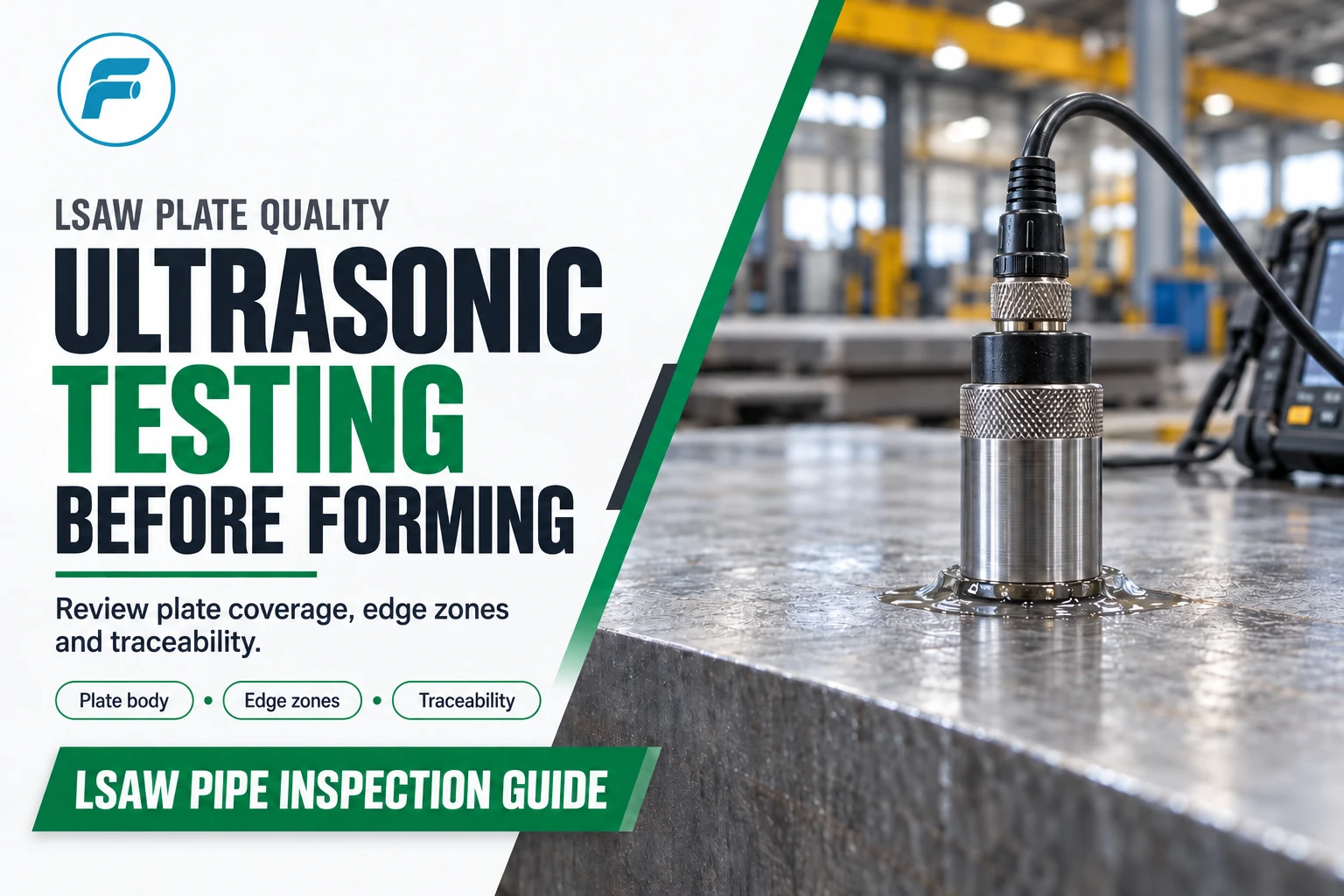
Ultrasonic testing introduces sound into the material and evaluates reflected signals. It can be highly sensitive to planar discontinuities when the beam angle intersects them effectively. Automated systems can provide continuous weld coverage at production speed.
Radiographic testing records differences in transmitted radiation through the weld. It produces an image and is generally effective for volumetric discontinuities and visible changes in weld density, although sensitivity depends on technique, thickness and defect orientation.
|
Method |
Often effective for |
Important limitation |
|
UT |
Planar discontinuities, lack of fusion, cracks and laminations when beam orientation is suitable. |
Detection and sizing depend on beam angle, calibration, surface condition and operator or system setup. |
|
RT |
Porosity, slag-type volumetric indications and weld-profile changes that create radiographic contrast. |
Tight planar defects aligned unfavorably to the beam may be difficult to reveal. |
A discontinuity is not detected merely because it exists. The inspection energy must interact with it in a detectable way. For UT, a planar reflector may produce a strong response when the sound beam meets it at a favorable angle and a weak response when orientation is unfavorable. For RT, a thin planar defect may create little density change if its orientation does not provide sufficient projected thickness.
This is why qualified procedures define probe angles, reference reflectors, scan zones, image-quality indicators and examination geometry.
HFW pipe has a narrow longitudinal bond line and process-related risks that differ from submerged-arc welds. LSAW and SSAW welds contain deposited weld metal and heat-affected zones, while EFW standards may specify different radiographic classes or heat-treatment conditions.
The inspection plan should identify the manufacturing route, weld seam, pipe ends, repairs and base-material areas requiring examination. A generic statement such as '100% NDT' is incomplete unless the method, coverage, reference standard and acceptance level are stated.
|
Pipe route |
Inspection focus |
|
HFW/ERW |
Longitudinal weld continuity, bond-line indications, heat-affected zone and pipe ends. |
|
LSAW |
Longitudinal submerged-arc weld, heat-affected zones, weld repairs and end regions. |
|
SSAW |
Helical weld, strip end welds or jointers where permitted, repairs and pipe ends. |
|
EFW |
Weld metal and heat-affected zones under the class and heat-treatment requirements of the product standard. |
Replacement is possible only when the governing product standard, project specification and approved inspection procedure allow it. Technical capability alone is not sufficient if the purchase order requires a named method.
The reviewer should compare required coverage, discontinuity types, acceptance criteria, procedure qualification, calibration records and reporting. In critical service, the methods may be complementary rather than alternatives.
A quotation that says 'UT passed' or 'RT available' does not define the inspection. Buyers should confirm whether the examination is online or offline, manual or automated, full-length or sampled, which weld zones are covered, what reference standard applies, and how indications are recorded and dispositioned.
Also confirm whether pipe-end areas excluded from an automated system receive a separate examination and whether repaired weld areas are re-examined by the required method.
|
Quotation field |
What a complete answer should identify |
|
Method |
UT, RT or another specified method. |
|
Coverage |
Full weld length, pipe ends, repairs, base metal or sampled locations. |
|
Procedure |
Applicable standard and approved procedure revision. |
|
Calibration or image quality |
Reference standard, sensitivity and verification frequency. |
|
Acceptance |
Named acceptance criteria and disposition process. |
|
Records |
Report format, traceability and availability for purchaser review. |
UT and RT are not interchangeable labels. UT can be highly effective for suitably oriented planar discontinuities and continuous automated inspection. RT provides an interpretable image and can reveal volumetric weld indications, but it also has orientation and technique limitations.
Forever Steels can coordinate the welded-pipe NDT scope, documentation and third-party inspection requirements against the applicable product standard and purchase specification.
Public NDT discussions repeatedly return to the same frustration: a report says 100 percent UT or RT, yet the reader cannot tell what was examined. One hundred percent can refer to the weld length while excluding pipe ends, repairs, base material or areas outside the automated scan zone.
A complete statement must identify the method, component and zone, coverage, procedure, calibration or image-quality control, acceptance criteria, operator qualification and the treatment of indications. Without those details, the percentage is not a usable quality claim.
An indication can be detected without being accurately sized, and a discontinuity can be characterized without determining whether it threatens service. NDT acceptance criteria are manufacturing acceptance rules, not a complete remaining-life assessment.
If an indication exceeds the product-standard limit, disposition may involve confirmation by another method, grinding, weld repair, re-examination or rejection. If the project is evaluating an in-service flaw, engineering critical assessment may be needed. The original mill NDT report cannot answer every fitness-for-service question.
Automated ultrasonic systems are valuable because they can examine the production weld continuously and consistently, but equipment geometry may create untested end zones. Product standards and procedures can require separate manual or automated examination of those ends.
Repair areas also require explicit treatment. A repaired submerged-arc weld should be re-examined with the method and acceptance criteria required by the specification. The inspection record should preserve the pipe identity, repair location and final disposition.
|
Report statement |
What should be added before it is meaningful |
|
100% UT of weld |
Scan zones, probe arrangement, calibration reflectors, end treatment and acceptance level. |
|
RT accepted |
Examined length, technique, image quality, sensitivity, interpretation and repair coverage. |
|
No relevant indications |
Procedure and criteria defining relevant and acceptable indications. |
|
Repair passed NDT |
Repair location, method, re-examination extent and traceable final report. |
|
Third-party witnessed |
The exact hold or witness point and records reviewed by the inspector. |
The expected discontinuities in HFW differ from those in submerged-arc weld metal. The NDT scope for ERW steel pipe should account for the longitudinal bond line and end zones, while LSAW and SSAW steel pipe inspection must address deposited weld metal, heat-affected zones, repairs and any permitted jointer welds.
This is why a generic requirement for 'UT and RT' can be both expensive and incomplete. The specification should connect each method to a defined zone and failure concern.
Send Forever Steels the applicable standard and edition, grade, dimensions, quantity, manufacturing method, delivery condition, testing, inspection documents, coating, pipe ends and destination. Our team can review the specification against practical production and supply routes before quotation confirmation.
Continue with these closely related Forever Steel technical resources:
• ISO 17635:2025 — General Rules for Non-Destructive Testing of Welds — International Organization for Standardization.
• ISO 17640:2018 — Ultrasonic Testing of Welded Joints — International Organization for Standardization.
• ISO 17636-1:2022 — Radiographic Testing of Welds with Film — International Organization for Standardization.
• Independent Qualification of Phased-Array Inspection of Welds — The Welding Institute (TWI) technical paper on procedure qualification and detection reliability.
• Phased-Array Ultrasonic Testing vs Radiographic Testing — Eng-Tips practitioner discussion; use for field viewpoints, not acceptance criteria.
• Can Ultrasonic Testing Replace Radiographic Testing? — Eng-Tips practitioner discussion; use for field viewpoints, not acceptance criteria.