+8615674993216
 sales@forever-steels.com

 English
 العربية


Choose heat exchanger tubes by checking four things together: the operating environment, the approved tube specification, the ordered wall basis and the tube-to-tube sheet interface. A familiar grade and an outside diameter are not enough to compare quotations. Before releasing an order, reconcile the design drawing, the supplier offer and the inspection plan against the same requirements.
This guide covers tubing for shell-and-tube exchangers and condensers. It helps buyers prepare and review a purchase specification; equipment sizing and pressure-boundary approval remain with the responsible designer. It uses the public technical sources listed at the end, and the contract edition and approved engineering documents govern each order.
Tube selection is rarely one decision. Start with the question that is still open, then work through the numbered stages that follow.
|
Your starting point |
Resolve first |
Useful output |
|
New exchanger with an approved data sheet |
Material specification, dimensions and fabrication requirements |
A purchase line tied to the approved drawing |
|
Existing exchanger with early tube failures |
Failure location, mechanism and operating history |
A documented reason to retain or change the material |
|
Replacement bundle with limited records |
Original drawing, tube count, length, tubesheet and joint details |
A verified replacement specification |
|
Two suppliers quoting the same grade |
Wall basis, tolerances, tests and document scope |
A deviation list before price comparison |
For replacement work, use the existing heat exchanger retubing specification guide to collect the equipment records. A worn sample alone cannot reliably establish the original ordered wall or material condition.
Material selection for heat exchanger tubes starts with the environments on both sides of the tube wall. Record both tube-side and shell-side fluids, normal and design temperatures, pressures, differential-pressure cases, contaminants, deposits and cleaning methods. Include shutdown and upset conditions: a material acceptable during normal circulation may face a different environment when stagnant or chemically cleaned.
For water service, record chloride content, treatment chemicals and the location of deposits rather than writing only “cooling water.” For process service, identify the actual chemical composition and concentration range. Give the materials reviewer the failure history when one exists.
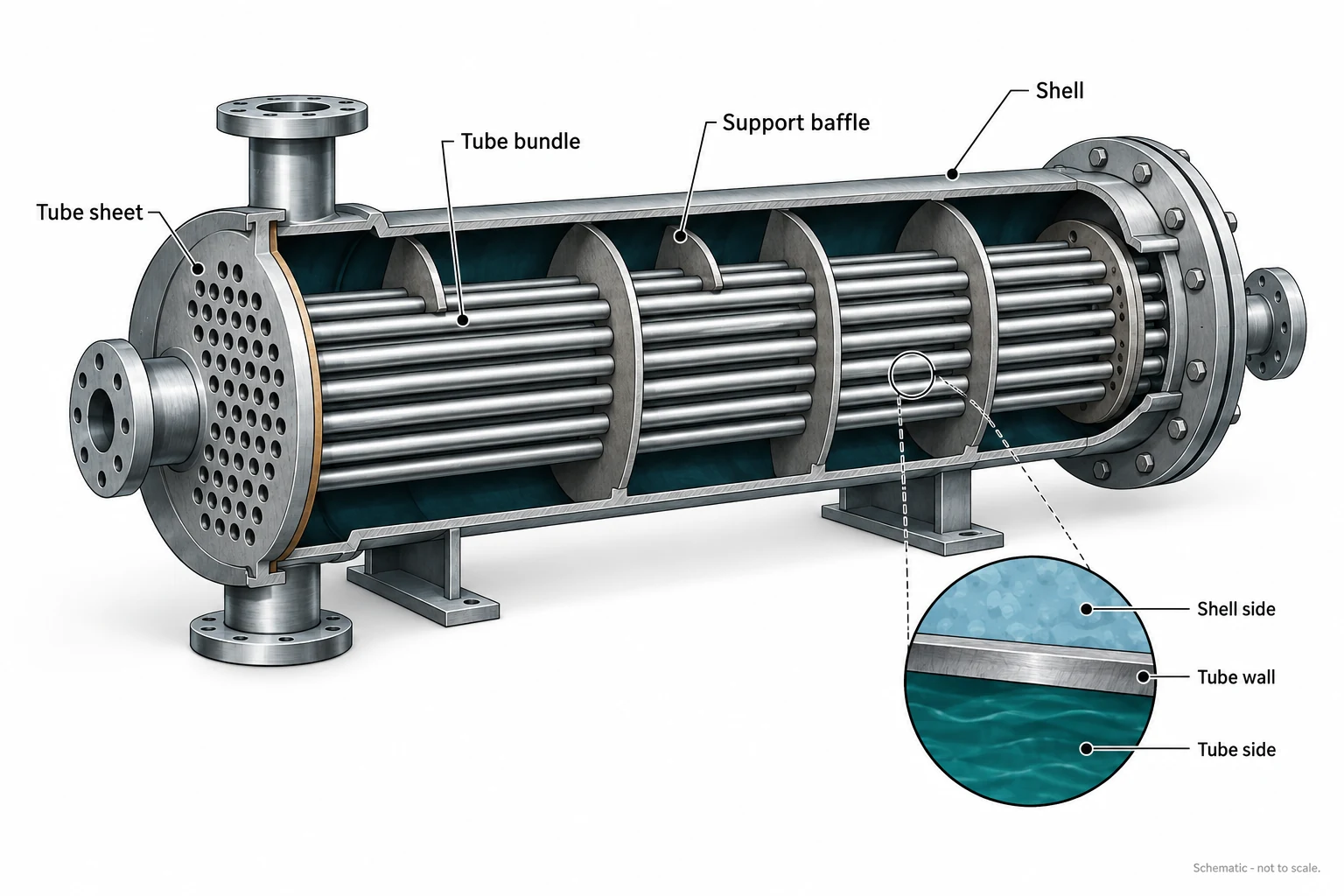
Figure 1. Shell and tube exchanger components and the tube wall separating the two fluids. Schematic, not to scale.
Alleima’s published exchanger examples show why material selection needs the specific environment: its hydrochloric-acid service discussion compares corrosion performance for defined alloys and conditions, rather than treating all stainless steels as equivalent (Alleima material selection article).
Use the following shortlist as a review sequence, not an automatic alloy selector.
|
Material family |
Reason to investigate it |
Question that can change the decision |
|
Carbon steel |
An approved economical option for a controlled duty |
Can the water chemistry, corrosion allowance and maintenance plan support the required life? |
|
Austenitic stainless steel |
A candidate where the specified corrosion and fabrication requirements support it |
What do chlorides, temperature, deposits and residual stress mean for this service? |
|
Duplex stainless steel |
A candidate for specified corrosion and strength requirements |
Are fabrication, heat treatment and temperature limitations addressed? |
|
Titanium, copper alloys or nickel alloys |
Candidates when the particular environment justifies specialist review |
Is the exact alloy compatible with both fluids, the tubesheet and the cleaning procedure? |
Do not attach one universal chloride limit or maximum operating temperature to a whole material family. For example, Alleima’s SAF 2707 HD data discusses a particular grade, test environment and tube-to-tube sheet arrangement. Those results do not approve every duplex tube for every seawater duty.
For a heat exchanger tube inquiry, identify the product standard and manufacturing route before requesting availability. A product standard defines a tube category. It does not approve the complete exchanger, establish the heat duty or make a different manufacturing route an acceptable substitution.
|
Standard |
Publicly stated product scope |
Purchase review |
|
ASTM A179/A179M |
Seamless cold-drawn low-carbon steel exchanger and condenser tubes |
Confirm the specified minimum-wall basis and ordered edition |
|
ASTM A214/A214M |
Electric-resistance-welded carbon steel exchanger and condenser tubes |
Confirm the welded route and its project acceptance |
|
ASTM A213/A213M |
Seamless ferritic and austenitic alloy-steel boiler, superheater and exchanger tubes |
State the exact grade, condition and wall basis |
|
ASTM A249/A249M |
Welded austenitic boiler, superheater, exchanger and condenser tubes |
Confirm grade, manufacturing condition and supplementary requirements |
|
ASTM A789/A789M |
Seamless and welded ferritic/austenitic stainless tubing for general service |
Confirm that the project accepts the particular duplex grade and route |
Scope references: ASTM A179, ASTM A214, ASTM A213, ASTM A249 and ASTM A789.
Read the scopes together. A179 and A214 address carbon steel tubes by manufacturing route (seamless cold-drawn and electric-resistance-welded). A213 covers seamless alloy and stainless grades, and A249 covers the welded austenitic route. A789 applies to ferritic/austenitic (duplex) stainless tubing. The choice between standards is therefore a choice of material family and manufacturing route, and neither is better in general.
Read the applicable general requirements and purchase-order options with the product standard. Do not substitute general-service pipe or tubing solely because the alloy name matches. Our A213 versus A249 comparison addresses the seamless-versus-welded decision in more detail.
For exchanger construction, state the governing equipment requirements and edition separately. TEMA’s current standards page describes its 2026 edition and updated exchanger specification sheet. A new edition on a website is a reason to check the contract, not to silently change an existing project’s requirements.
Order tube outside diameter, wall thickness, wall basis, length and tolerances explicitly. Pipe NPS and schedule are not a substitute for exchanger-tube dimensions.
BWG (Birmingham Wire Gauge) numbers are a common way to talk about exchanger tube wall. The gauge is a label for a thickness, so the order should also state the corresponding thickness and units. The nominal values below are for orientation only; the tolerance and acceptance basis come from the ordered product standard.
|
BWG |
Nominal thickness (in) |
Nominal thickness (mm) |
|
10 BWG |
0.134 |
3.40 |
|
12 BWG |
0.109 |
2.77 |
|
14 BWG |
0.083 |
2.11 |
|
16 BWG |
0.065 |
1.65 |
|
18 BWG |
0.049 |
1.24 |
|
20 BWG |
0.035 |
0.89 |
Source for gauge values:ProjectMaterials tube gauge reference.
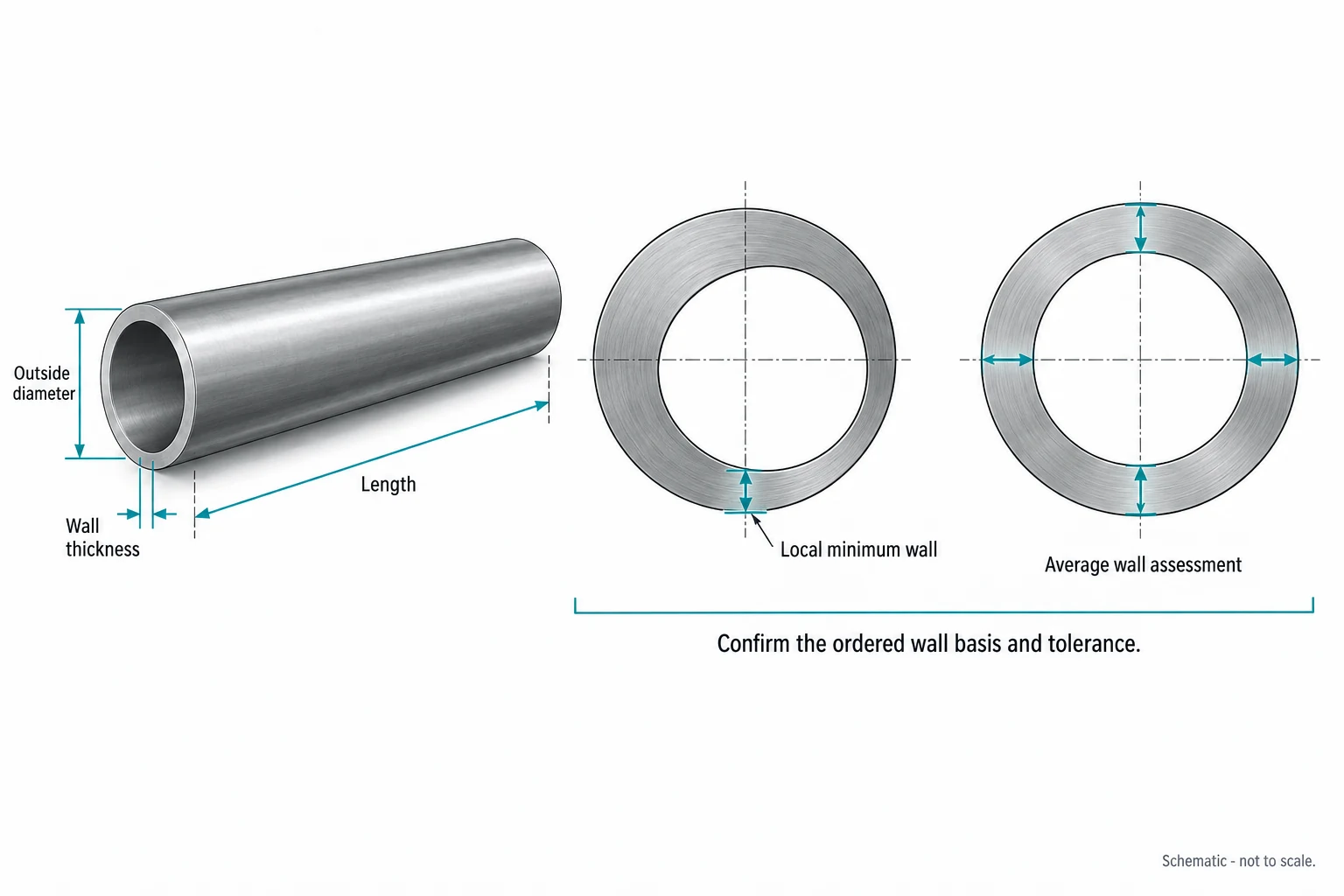
Figure 2. Tube dimensions and the distinction between local minimum wall and average wall assessment. Schematic, not to scale.
Minimum-wall ordering controls a lower wall acceptance limit under the applicable specification; average-wall ordering uses a different dimensional acceptance basis. The order must name the intended basis rather than leaving the supplier to infer it. ASTM A213/A213M allows minimum wall or, when specified in the order, average wall. ASTM A789/A789M describes average wall thickness or, if specified in the order, minimum wall thickness. The default wording therefore differs from A213; copying only the grade and thickness can leave the intended acceptance basis unclear. Confirm the actual tolerance rules for the selected product and dimensions instead of applying one percentage to all tubes.
Assume, solely for this example, that an approved requirement calls for at least 1.50 mm wall at acceptance and that a proposed average-wall offer permits a 10% negative variation. The assumed percentage is not an ASTM tolerance quoted by this article.
• An offer of 1.50 mm average wall could permit 1.50 × 0.90 = 1.35 mm.
• Under that assumed tolerance, the nominal wall would need to be at least 1.50 ÷ 0.90 = 1.667 mm to preserve a 1.50 mm lower limit.
• Selecting a suitable ordered thickness still requires confirmation of the actual standard, rounding, available size and approved drawing.
This arithmetic only compares an assumed purchase tolerance with an acceptance threshold. It is not a pressure-design calculation. It shows why two offers reading “1.50 mm tube” may be commercially incomparable.
Keep corrosion allowance and manufacturing tolerance as separate entries in the design review. A buyer cannot resolve an inadequate design wall by relabelling an average-wall order as minimum wall.
Review the tube drawing with the tubesheet and fabrication drawing before approving a substitution. Confirm straight or U-bent configuration, straight length or developed length, bend geometry, end projection, hole fit and the specified expanded, welded or combined joint.
Changes in tube outside diameter or wall alter the bore. They can affect fluid velocity, pressure drop, cleaning access and the tube-to-tubesheet procedure. A thicker tube is therefore not an automatic replacement upgrade.
For U-tubes, identify who performs bending and which dimensional checks, heat treatment and examinations are required after bending. Evidence for the original straight tube does not, by itself, demonstrate the final bent component’s condition.
The practical interface check is simple: every proposed material or geometry change needs an owner. Ask who approves corrosion compatibility, thermal performance, pressure integrity and fabrication fit. Record the approvals against a drawing revision rather than resolving them only in email descriptions.
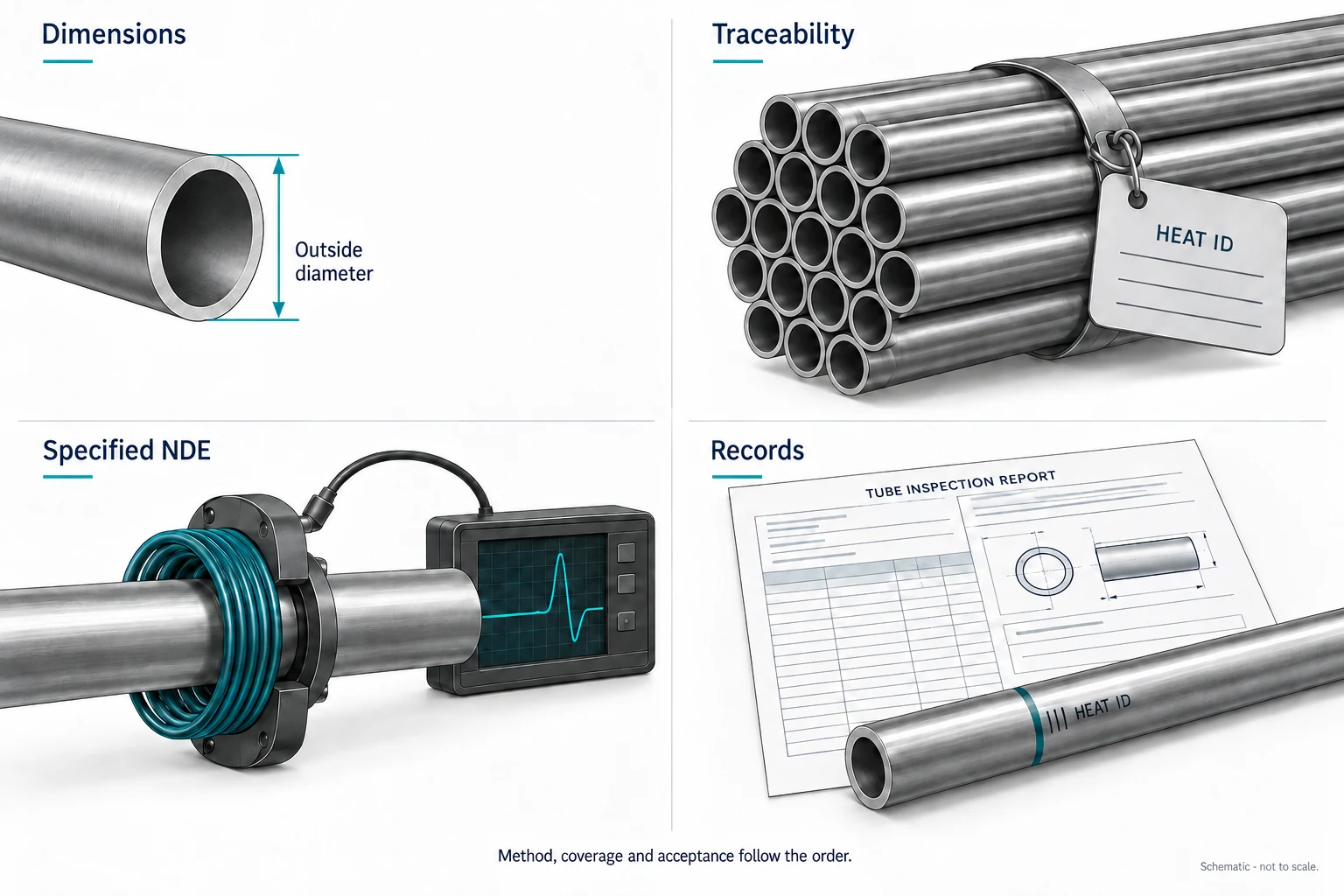
Figure 3. Dimensions, traceability, specified examination and inspection records form complementary purchase evidence. Schematic, not to scale.
Nondestructive examination (NDE) and pressure testing provide different evidence. “100% tested” does not state the method, sensitivity, coverage or acceptance criteria. Specify the examinations required by the ordered standard and project inspection plan, including any additional tests that the buyer requests.
|
Evidence |
What the purchase review should establish |
|
Material certificate |
Correct specification, grade, heat, condition and required results |
|
Dimensional report |
OD, wall basis, length, tolerances and the inspection locations or sampling basis |
|
Nondestructive examination record |
Method, coverage, calibration reference, acceptance criteria and lot or tube identity |
|
Hydrostatic test record where required |
Test conditions and traceability to the supplied tubes |
|
Final fabrication record where applicable |
U-bend or other post-processing requirements completed |
|
Packing and marking record |
Tube or bundle identity reconciled to certificates and packing list |
Do not assume eddy-current testing, ultrasonic testing and hydrostatic testing establish the same condition. The required test combination must follow the product specification and purchase order; a certificate saying “pass” should be traceable to that scope.
Price comparison becomes useful after technical differences are visible. Ask each supplier to mark every requirement as compliant, excluded or proposed for approval.
|
Offer difference |
Review action before award |
|
Average wall offered against minimum wall |
Hold until the lower acceptance limit is reconciled |
|
Welded offered against a specified seamless route |
Obtain documented technical acceptance or retain the required route |
|
Grade change offered to reduce lead time |
Obtain materials and design review before substitution |
|
Tests listed without acceptance criteria |
Obtain a revised inspection scope |
|
Straight tubes offered for a U-tube package |
Identify bending, post-bend inspection, packing and delivery responsibilities |
A usable request for quotation (RFQ) attaches the following. Require a separate deviation list; silence should not be interpreted as acceptance.
1. Equipment data sheet and tube drawing, with revision
2. Material and product specification, with editions
3. Ordered dimensions: OD, thickness with units, wall basis, tolerances and length
4. Quantity by length and, for U-tubes, bend requirements
5. Fabrication scope and tube-to-tubesheet joint details
6. Inspection plan and documentation requirements
7. Delivery basis
For a supply enquiry, send Forever Steel the approved specifications and quantity schedule. Availability, manufacturing route, inspection scope and delivery are confirmed against the inquiry.
ASTM A179 covers seamless cold-drawn low-carbon steel exchanger and condenser tubes, while ASTM A213 covers seamless ferritic and austenitic alloy-steel boiler, superheater and exchanger tubes [3][5]. The decision depends on the approved material family and route, so check the ordered grade and edition against the design specification.
The approved service, grade, manufacturing route and examination requirements determine acceptability. ASTM A213 covers seamless tubes and ASTM A249 covers welded austenitic tubes; a purchasing decision should not replace the designer’s approval with a general “seamless is better” rule.
No. Include the actual thickness, units, ordered wall basis and applicable tolerances, together with OD, length and product specification.
The one the approved design requires. Minimum-wall and average-wall ordering use different acceptance bases, and a copied grade and thickness can leave the basis unclear. Name it in the order.
Not automatically. A thicker wall changes the bore, which can affect fluid velocity, pressure drop, cleaning access and the tube-to-tubesheet procedure. Get the change approved against a drawing revision.
No. Assess the actual chemistry, temperature, deposits, cleaning and stress conditions. Retubing with a familiar grade without diagnosing the damage can repeat the original problem.
Typically a material certificate, dimensional report, nondestructive examination and hydrostatic test records where required, final fabrication records for U-tubes, and packing and marking records. The required set follows the product specification and purchase order.
Reconcile material and route, minimum acceptable wall, dimensions, final fabrication condition, tests, traceability and delivery scope. Record exclusions before treating the prices as equivalent.
Heat exchanger tube selection is complete only when service suitability, product route, accepted wall, bundle fit and inspection evidence describe the same item. Compare quotations against that approved specification and record every deviation. Changing an alloy or buying a thicker tube requires review of the consequences for corrosion, performance and fabrication.
1. ASTM A213 vs A249 for Stainless Steel Heat Exchanger Tubes
2. Heat Exchanger Retubing Specification: How to Replace Tubes Without Repeating the Original Failure
3. ASTM A192 vs A210 vs A213 Boiler Tubes: Material Selection and RFQ Requirements
Public scope pages support the standard descriptions below. They do not reproduce the complete standards or replace the edition specified by the contract. Manufacturer guidance applies within its stated material or service conditions. Sources checked 27 October 2026.
[1] Choosing the right material can advance the life of your heat exchanger
[2] SAF® 2707 HD Tube and pipe, seamless
[3] ASTM A179/A179M-24: Seamless Cold-Drawn Low-Carbon Steel Heat-Exchanger and Condenser Tubes
[4] ASTM A214/A214M-25: Electric-Resistance-Welded Carbon Steel Heat-Exchanger and Condenser Tubes
[8] The 2026 Edition introduces numerous changes to the TEMA® Standards
[9] ProjectMaterials: Tube Gauge Selection for Heat Exchangers (BWG thickness values)