+8615674993216
 sales@forever-steels.com
 English
 العربية


Low-temperature steel pipe selection is often reduced to a single statement: use ASTM A333 Grade 6. Grade 6 is indeed widely used, but the correct grade depends on the project minimum design metal temperature, required toughness, wall thickness, welding procedure, heat treatment and availability.
The operating temperature alone may not be sufficient. During depressurization, startup, shutdown or an upset condition, the pipe metal can fall below the normal fluid temperature. The design team therefore works with the minimum design metal temperature, not simply the usual operating point.
A useful grade guide must connect temperature and toughness requirements with the way the pipe will actually be manufactured, tested, welded and supplied.
|
Quick answer:ASTM A333 grade selection begins with the project minimum design metal temperature, but also depends on impact testing, heat treatment, welding, size and actual mill availability. |
Public discussions rarely begin with a standard clause. They begin with a conflict that blocks a decision:
· The process normally runs above freezing, so why is a low-temperature grade being requested?
· Can ordinary carbon steel be accepted after an extra impact test?
· Which temperature matters: ambient, operating, design or the temperature during depressurization?
· Why does a rare A333 grade create a new mill order even at a common pipe size?
The minimum design metal temperature is the lowest metal temperature considered under the applicable design conditions. It may be influenced by ambient exposure, process cooling, autorefrigeration, blowdown and pressure reduction.
The selected material must satisfy the governing design code and project impact-toughness rules at the stated condition. The ASTM product standard defines material and testing requirements, while the piping code and project specification determine where exemptions or additional tests apply.
ASTM A333 contains several grades intended for different low-temperature requirements. Exact chemistry, mechanical properties and test temperatures should be verified against the purchase-order edition.
|
Grade family |
Typical selection logic |
Supply implication |
|
Grade 6 |
Common low-temperature carbon steel choice for many industrial piping projects. |
Broadest recognition and usually the most accessible A333 grade. |
|
Grade 3 |
Nickel-bearing option used for lower-temperature requirements than common Grade 6 applications. |
More specialized mill route and usually less stock availability. |
|
Grades 7 and 9 |
Higher-strength low-temperature options for selected designs. |
Availability can be size- and mill-dependent. |
|
Grade 8 |
High-nickel grade associated with very low-temperature service. |
Specialized production, welding and procurement route. |
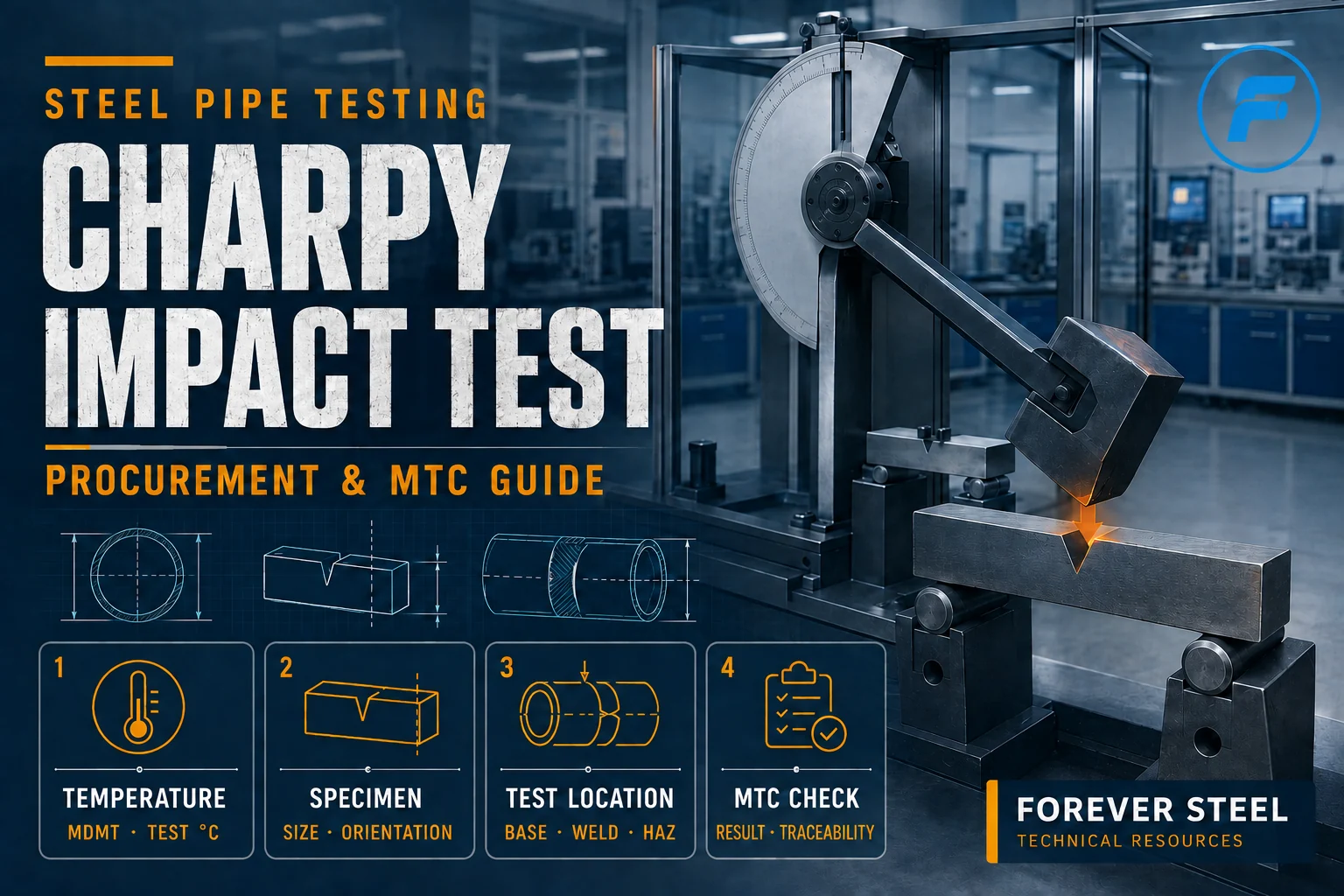
Charpy V-notch testing is not an optional marketing feature when it is required by the material grade or project. Test temperature, specimen orientation, specimen size, acceptance values and the represented lot must be clear.
A certificate showing impact values at an unrelated temperature does not automatically prove suitability for the project condition. Reduced-size specimens can also require adjusted test conditions or acceptance treatment under the applicable rules.
This question arises when A106 Grade B is available but A333 Grade 6 has a longer lead time. Additional impact testing on A106 material may provide useful toughness data, but it does not automatically convert the material into ASTM A333 Grade 6.
The standards can differ in chemistry, heat treatment, mandatory tests, marking and certification. A proposed substitution must be evaluated under the design code and approved project deviation process. Re-certifying finished stock after production may be impossible if the required heat treatment, sampling or lot controls were not maintained.
|
Question |
Required review |
|
Was the material produced to A333 requirements? |
Check original manufacturing, heat treatment and lot records. |
|
Are impact tests representative? |
Confirm sampling location, orientation, size and test temperature. |
|
Does the design code permit substitution? |
Engineering approval is required; strength alone is insufficient. |
|
Can documents be revised legitimately? |
Certification must reflect the actual manufacturing route, not a retrospective label. |
Less common grades can require a dedicated heat, special billet chemistry, controlled heat treatment or a limited group of qualified mills. Small quantities may therefore carry a long lead time even when the dimensions themselves are ordinary.
Before freezing a rare grade, the purchaser should confirm whether the requirement is driven by the actual minimum temperature, a legacy specification or an assumed equivalence. Any change must remain an engineering decision, but early availability feedback can prevent avoidable schedule risk.
ASTM A333 grade selection is a temperature-and-toughness decision supported by manufacturing and test controls. Grade 6 is common, but lower-temperature or higher-strength applications can require different grades and a more specialized supply route.
Forever Steels can review the grade, dimensions, minimum design temperature, impact requirements and inspection documents to identify an appropriate production and documentation route.
Many low-temperature material questions begin with a normal operating temperature that appears harmless. The critical condition may instead occur during startup, shutdown, depressurization, vaporization, a blocked-in condition or exposure to winter ambient temperature. Rapid pressure reduction can cool the pipe wall below the usual process temperature.
That is why material selection uses a defined minimum design metal temperature and the applicable design-code toughness rules. A product-standard test temperature is important, but it is not by itself the project’s material-selection calculation.
A recurring practical proposal is to take available A106 Grade B pipe, perform Charpy tests and treat it as A333 Grade 6. The added test may demonstrate the toughness of the sampled material at a stated condition, but A333 compliance also depends on the product standard’s chemistry, heat treatment, manufacturing controls, lot definition, sampling and certification.
The question is not whether the test result looks good. It is whether the material was produced and controlled under a route that satisfies the required specification and whether the design code accepts the proposed deviation. Testing cannot reconstruct missing traceability or an unperformed heat treatment.
Grade 6 has a broader industrial supply base than many other A333 grades. Nickel-bearing or higher-strength grades can narrow the qualified mill list and create minimum heat, billet or test-lot quantities. Common dimensions do not remove those production constraints.
For low-temperature seamless steel pipe, an early technical-commercial review should separate the temperature requirement from inherited wording in an old specification. If the rare grade is genuinely required, the schedule should reflect a dedicated production and testing route rather than a stock assumption.
|
Decision input |
Question the article should resolve |
|
Minimum design metal temperature |
What is the lowest credible pipe-metal temperature, including transient cases? |
|
Impact requirement |
At what temperature, orientation and specimen size must testing be performed? |
|
Grade availability |
Is the size available in the required grade, or does it require a new heat? |
|
Substitution proposal |
Does it preserve standard compliance, code acceptance and traceability? |
|
Welding plan |
Are filler metal, preheat and procedure qualifications suitable for the grade? |
The final supply route should distinguish common low-temperature seamless steel pipe from broader seamless steel pipes and from an alloy seamless steel pipe option required by more severe temperature or strength conditions.
Send Forever Steels the applicable standard and edition, grade, dimensions, quantity, manufacturing method, delivery condition, testing, inspection documents, coating, pipe ends and destination. Our team can review the specification against practical production and supply routes before quotation confirmation.
· Pipe Schedule Chart: Steel Pipe Dimensions and Wall Thickness