+8615674993216
 sales@forever-steels.com
 English
 العربية





A practical guide for buyers comparing Sch 40, Sch 80 and direct thickness notation
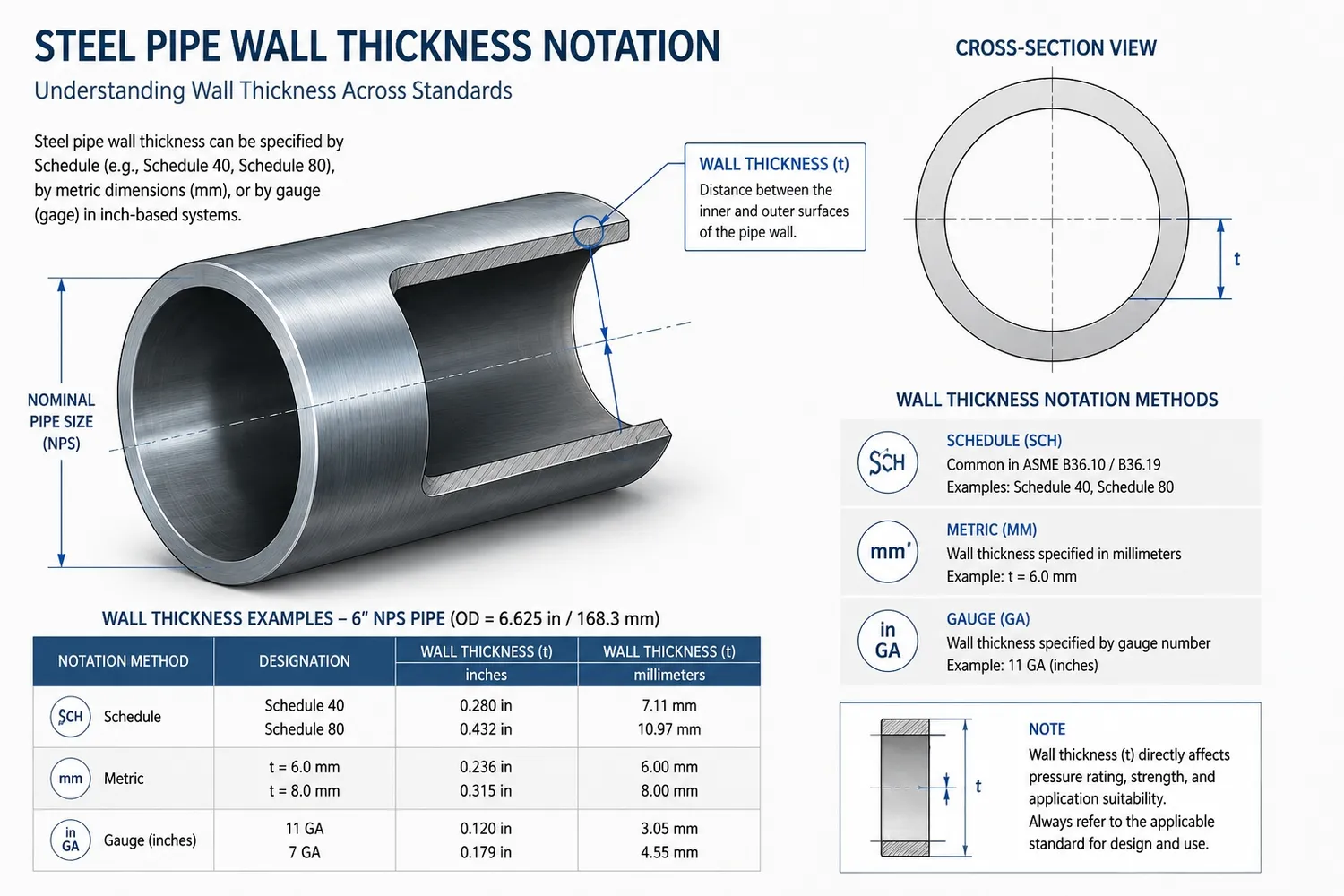
Pipe wall thickness must be specified together with nominal pipe size (NPS) or outside diameter (OD). SCH 40 and SCH 80 are wall-thickness series, not fixed millimeter values or pressure ratings. Use the tables below to compare schedule, millimeter, inch and gauge notation before preparing a pipe order.
For the same NPS, compare the specified SCH 40 or SCH 80 wall thickness, then confirm the material standard, grade and manufacturing route. Both seamless steel pipe and ERW steel pipe may be supplied in scheduled sizes, subject to the applicable standard and the confirmed OD/wall combination.
A dimension such as 114.3 x 6.02 mm states outside diameter x nominal wall thickness. For an unambiguous quotation, also specify the grade, standard, length, quantity and wall-thickness tolerance. Do not use nominal diameter as a substitute for actual outside diameter.
A thicker wall alone does not establish allowable working pressure. The design basis also depends on material, temperature, manufacturing tolerances, corrosion allowance and the governing code. For API 5L line pipe, state the grade and PSL as well as the dimensions.
Need dimensions for a specific size? Use the pipe schedule chart for size-by-size reference rows. This guide explains how to read and specify the wall thickness; gauge values must be checked against the named gauge system.
|
Method |
Full Name |
Typical Usage |
Example |
Notes |
|
Sch |
Schedule |
USA, international pressure piping |
Sch 40 |
Standardized wall series; exact thickness depends on size |
|
WT (mm) |
Wall thickness in millimeters |
Global manufacturing and export |
6.02 mm |
Direct metric thickness |
|
WT (inch) |
Wall thickness in inches |
Fabrication drawings and QC |
0.237" |
Direct imperial thickness |
|
BWG |
Birmingham Wire Gauge |
Legacy industrial usage |
10 BWG |
Must be converted into actual mm or inch thickness |
|
SWG |
Standard Wire Gauge |
Selected regional and legacy use |
12 SWG |
Should be reconfirmed against exact thickness before ordering |
|
Pipe Size |
Schedule |
Wall Thickness (inch) |
Wall Thickness (mm) |
| NPS 4 | SCH 40 | 0.237 | 6.02 |
| NPS 4 | SCH 80 | 0.337 | 8.56 |
| NPS 4 | SCH 120 | 0.438 | 11.13 |
| NPS 4 | SCH 160 | 0.531 | 13.49 |
| NPS 4 | XXS | 0.674 | 17.12 |
|
Pipe Size |
Sch 40 (inch) |
Sch 40 (mm) |
Sch 80 (inch) |
Sch 80 (mm) |
|
NPS 1 |
0.133 |
3.38 |
0.179 |
4.55 |
|
NPS 1-1/2 |
0.145 |
3.68 |
0.200 |
5.08 |
|
NPS 2 |
0.154 |
3.91 |
0.218 |
5.54 |
|
NPS 3 |
0.216 |
5.49 |
0.300 |
7.62 |
|
NPS 4 |
0.237 |
6.02 |
0.337 |
8.56 |
|
NPS 6 |
0.280 |
7.11 |
0.432 |
10.97 |
|
NPS 8 |
0.322 |
8.18 |
0.500 |
12.70 |
|
NPS 10 |
0.365 |
9.27 |
0.594 | 15.09 |
|
NPS 12 |
0.406 |
10.31 |
0.688 | 17.48 |
SCH 80 is not always the same as XS or SCH 80S. At NPS 10 and NPS 12, SCH 80 walls are 15.09 mm and 17.48 mm respectively; the 12.70 mm value belongs to XS / SCH 80S. Specify the complete designation and governing dimensional standard.
|
BWG |
Thickness (inch) |
Thickness (mm) |
Typical Use Note |
|
8 |
0.165 |
4.19 |
Heavy industrial or structural reference |
|
10 |
0.134 |
3.40 |
Common legacy steel tube reference |
|
11 |
0.120 |
3.05 |
Often close to lighter industrial pipe walls |
|
12 |
0.109 |
2.77 |
Used in selected tube and sheet-based references |
|
13 |
0.095 |
2.41 |
Lighter wall requirement |
|
14 |
0.083 |
2.11 |
Light industrial or fabrication usage |
|
16 |
0.065 |
1.65 |
Thin-wall usage |
|
18 |
0.049 |
1.24 |
Lighter tube applications |
|
20 |
0.035 |
0.89 |
Very light gauge reference |
|
Order Style |
Example |
What It Tells the Supplier |
|
NPS + Schedule |
NPS 6, Sch 40 API 5L line pipe |
Standardized pressure pipe wall series |
|
OD x WT in mm |
168.3 x 7.11 mm carbon steel pipe |
Direct production dimension in metric form |
|
OD x WT in inch |
6.625" x 0.280" seamless steel pipe |
Direct production dimension in imperial form |
|
Gauge notation |
3 in pipe, 10 BWG |
Legacy shorthand that should be verified against exact thickness |
|
Nominal description |
4 inch thick wall steel pipe |
Commercial expression that still needs exact WT confirmation |
Page scope: Use this guide to express wall thickness by Schedule, millimeter, inch or gauge and to write an unambiguous purchase description. Use the Size Chart for NPS/DN/OD conversion, the Schedule Chart for dimension rows, and the Weight guide for kg/m and lb/ft.
· Pipe Schedule Chart: Steel Pipe Dimensions and Wall Thickness
· Steel Pipe Weight: Formula, Reference Chart and Shipping Estimates
· Steel Pipe Specification Review Before Production: How We Avoid Wrong Material or Wrong Standard
1.ASME —B36.10M — Welded and Seamless Wrought Steel Pipe. Primary dimensional reference for NPS, outside diameter, wall thickness and schedule designations for wrought steel pipe.
2.ASME —Product Standardization and Specifications. Explains the role of B36 dimensional standards, including B36.10M and B36.19M, in pipe standardization.
3.NIST —Guide for the Use of the International System of Units (SI). Supports consistent conversion and presentation of millimetres, inches and other measurement units.
4.ASTM International —ASTM A106/A106M — Seamless Carbon Steel Pipe for High-Temperature Service. Shows how a material specification references pipe dimensions, permitted variations and ordering requirements rather than replacing the dimensional standard.
5.American Petroleum Institute —API Specification 5L, 47th Edition. Provides the line-pipe specification context for dimensions, tolerances, product specification levels and ordering information.
Applicability note: Schedule is a dimensional designation, not a direct pressure rating and not an interchangeable substitute for a specified wall thickness. Final selection requires the governing design code, material grade, corrosion allowance, tolerance, temperature and project specification.