+8615674993216
 sales@forever-steels.com
 English
 العربية

What is the difference between EN 10219 and EN 10210? EN 10219 covers cold-formed welded structural hollow sections; EN 10210 covers hot-finished structural hollow sections, which may be welded or seamless. The distinction is the specified manufacturing and delivery condition, not a simple higher-versus-lower strength ranking. Even when both quotations state S355 and the same nominal size, substitution requires a review of the full grade, section properties, tolerances, fabrication requirements and project approval.
For carbon steel hollow sections, compare the complete specification before comparing prices. The following table separates the product-standard differences from the checks needed for a purchase decision.
| Buyer question | EN 10219 | EN 10210 |
|---|---|---|
| Manufacturing and delivery condition | Cold-formed welded structural hollow sections | Hot-finished structural hollow sections; confirm the declared production and heat-treatment route |
| Welded or seamless? | Welded | Welded or seamless; EN 10210 does not mean seamless only |
| Does S355 make them equivalent? | No. Check the complete grade, thickness-dependent properties and design requirements | No. The same strength designation does not establish identical section behaviour |
| Which part controls dimensions? | Use the applicable EN 10219-2 tolerances, dimensions and sectional properties | Use the applicable EN 10210-2 tolerances, dimensions and sectional properties |
| What should the designer review? | Section data, member stability and connection details for the supplied cold-formed product | Section data, member stability and connection details for the supplied hot-finished product |
| Which is cheaper or faster? | Obtain a quotation for the exact size, grade, quantity and inspection scope | Obtain a quotation on the same basis; the standard alone does not determine price or lead time |
| Can one replace the other? | Only after the required technical review and approval | Only after the required technical review and approval |
EN 10219 is a series for cold-formed welded structural hollow sections. In the Part 1 scope for non-alloy and fine-grain steels, the familiar forms are circular, square and rectangular sections. Specify the applicable part and edition rather than assuming every shape or steel grade is covered by the same document. Part 1 addresses technical delivery requirements; Part 2 addresses tolerances, dimensions and sectional properties.
Cold-formed sections can be specified for frames, bracing, supports and other structural work when accepted by the design. An application label such as “building” or “piling” does not by itself establish that EN 10219 is the correct purchase standard.
EN 10210 is a series for hot-finished structural hollow sections. It includes welded and seamless products, so “EN 10210” should not be used as shorthand for “seamless.” Confirm the manufacturer’s declared delivery condition and any heat-treatment requirement in the order; products supplied under the same standard need not have identical manufacturing histories.
Select EN 10210 where the design or contract requires the relevant hot-finished product. Avoid describing it simply as a stricter version of EN 10219: the buyer must match the specified material and section to the structural design and fabrication requirements.
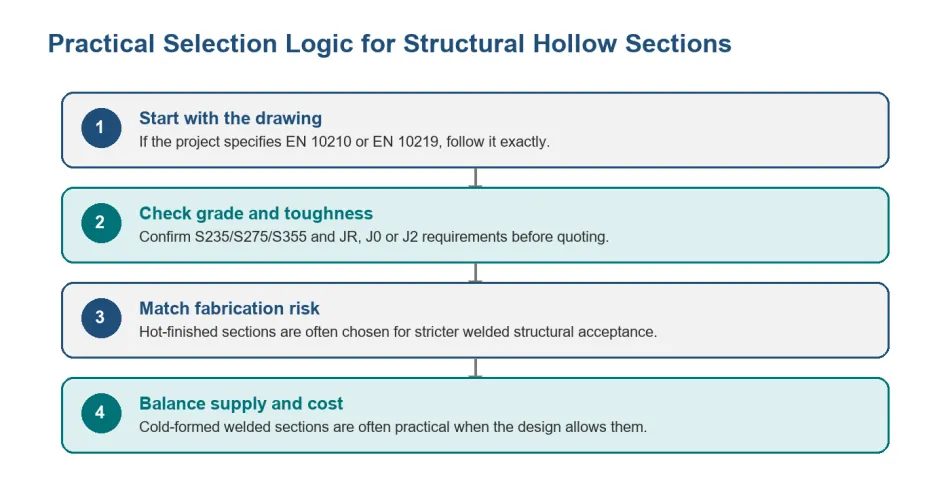
S355 identifies a strength grade, but “S355 pipe” is not a complete structural hollow-section specification. State the full grade designation, product standard, dimensions and delivery condition. The applicable strength requirements also depend on thickness, and the specified toughness requirements must match the project.
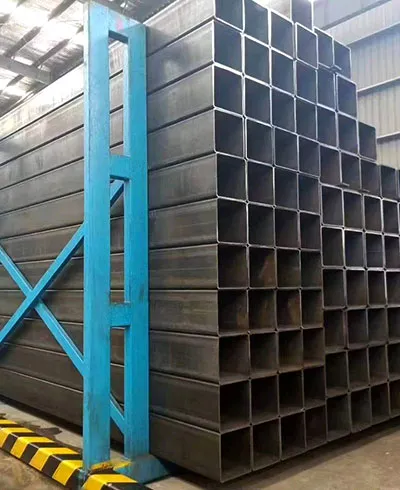
For square and rectangular hollow sections, nominal outside dimensions and wall thickness alone do not establish identical sectional properties. Corner geometry and the relevant section data matter. Compare the supplied section’s area and structural properties using the correct product data; do not transfer a design assumption from an EN 10210 section to an EN 10219 section solely because the size label matches.
Both EN 10219 and EN 10210 hollow sections can be used in welded fabrication when the material and procedure meet the design requirements. Cold-formed corner regions need particular attention when a weld is located in or near them. Have the fabricator and design authority confirm the applicable welding rules, steel grade, corner geometry and procedure for the actual connection. “Weldable steel” alone does not approve every weld location or joint detail.
EN 10219 is not an automatic substitute for EN 10210, even at the same nominal grade and size. Before accepting a change, compare the proposed product against the drawing and specification, review section properties and member stability, check connection and welding requirements, and obtain the required written approval. The same review applies to a proposed change in the opposite direction.
Example: a drawing specifies EN 10210 S355J2H RHS, but the quotation offers EN 10219 S355J2H RHS with the same outside dimensions and wall thickness. Matching S355J2H labels do not close the substitution review. Ask for the proposed product’s section data and delivery condition, then refer the change to the project design authority before ordering.
| Purchase situation | Action before placing the order |
|---|---|
| Drawing or tender names EN 10210 | Quote the specified EN 10210 product. Treat EN 10219 as a proposed deviation requiring review. |
| Drawing or tender names EN 10219 | Quote the specified EN 10219 product. Do not change the standard merely because another route is described as premium. |
| Design permits either route | Compare technically accepted offers with the same grade, dimensions, inspection, coating and delivery scope. |
| Piling or foundation enquiry | Use the project’s pile material and fabrication specification. “Piling” alone does not select EN 10219 or EN 10210. |
| Cold climate or impact-sensitive service | Confirm the complete grade, required toughness and test conditions rather than relying on S355 alone. |
Give each supplier the same order description so differences in price can be traced to the actual supply scope.
| RFQ item | State or confirm |
|---|---|
| Standard and edition | Applicable EN 10219 or EN 10210 parts and the edition required by the contract |
| Grade and delivery condition | Full designation, toughness requirements and specified manufacturing or heat-treatment condition |
| Section and dimensions | CHS, SHS or RHS; outside diameter or width × height; wall thickness; length; quantity |
| Dimensional acceptance | Applicable tolerances, corner geometry where relevant, straightness and end requirements |
| Fabrication and protection | Connection or welding requirements, cutting, coating or galvanizing requirements |
| Inspection and documents | Required inspection-document type, marking, traceability and additional project tests |
| Commercial scope | Named producing mill, availability, agreed delivery schedule and explicit deviations |
No. Compare the complete grade and thickness-dependent material properties. Member capacity also depends on geometry and the applicable design checks, so a standard number alone is not a strength comparison.
No. EN 10210 hot-finished hollow sections can be welded or seamless. If the project requires a particular manufacturing route, state it explicitly in the order.
No universal price difference applies. Size, grade, quantity, availability, testing and delivery location affect the quotation. Compare offers only after confirming that both satisfy the approved specification.
No. An inspection certificate records the supplied material and test results; it does not replace the project’s design review or approval of a change from EN 10210 to EN 10219.
1. S235 vs S275 vs S355 Steel Grades: Which Structural Pipe Grade to Choose?
2. ASTM A500 Grade B vs Grade C: Structural Tubing Guide
3. ASTM A252 Pipe Pile Selection Guide
4. Carbon Steel Pipe Standards and Grades: What to Confirm Before Asking for a Quote
5. Steel Pipe Inspection Checklist Before Shipment
Use the standard editions and design rules adopted by the project. This comparison supports specification review; the governing documents provide the detailed acceptance requirements.